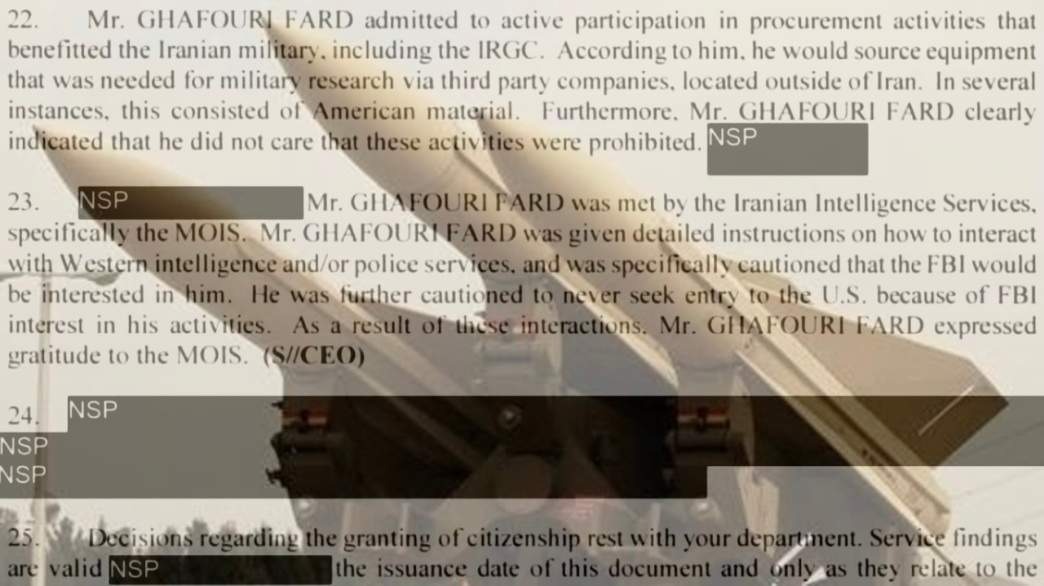
National security screening apparatuses are designed to catch foreign threats at the border, but a glaring breakdown in Canada has exposed how easily those defenses can be bypassed. Mohammad Reza Ghafouri Fard, operating under the alias Sal Ghafouri and recognized as the son of former Iranian vice president Hassan Ghafouri Fard, managed to secure more than $2 million in federal, provincial, and municipal government contracts while simultaneously being investigated by intelligence services for alleged ties to the Islamic Revolutionary Guard Corps.
This revelation has triggered intense public scrutiny and formal demands for an independent inquiry. Four major Iranian-Canadian organizations, alongside academics and former lawmakers, recently dispatched an urgent letter demanding accountability. They want to know how a man accused by the Canadian Security Intelligence Service of helping the Iranian regime develop surface-to-air missile systems and evade international sanctions managed to not only settle in Edmonton, Alberta, but also tap into public funds through corporate entities like Melanite Group Ltd. and Radian Group Ltd.
The Mechanics of an Intelligence Blind Spot
Governments pride themselves on rigorous vetting, yet inter-agency communication often resembles isolated silos rather than a unified wall. According to intelligence disclosures, Canadian authorities flagged Ghafouri as early as 2017. Despite these red flags, the Royal Canadian Mounted Police awarded his firm a contract in 2019 for specialized equipment and training. Other branches, including the Department of National Defence and Global Affairs Canada, faced direct questioning regarding trade mission invitations and procurement awards that bypassed deeper security scrutiny.
How does a foreign national linked to missile procurement slip through the bureaucratic cracks? Bureaucracy relies heavily on compartmentalized compliance checks. Standard integrity verifications look for bankruptcy filings, tax evasion, or criminal convictions within domestic jurisdictions. They do not automatically cross-reference foreign intelligence files or active national security surveillance lists unless a specific clearance level is mandated for the project. For routine supply contracts, such as purchasing inspection devices or technical accessories, extensive background checks are rarely triggered.
Ghafouri exploited this exact administrative gap. Operating through local corporate fronts, he presented himself as a skilled immigrant engineer capable of delivering technical solutions. Through a Malaysian front company, intelligence reports indicate he previously assisted the Iranian military with procurement loops. Once inside Alberta, he rebranded, adopted a shortened version of his name, and integrated smoothly into commercial ecosystems that interface directly with the state.
The Cost of Compartmentalization
The fallout from this case extends far beyond a single procurement error. It strikes at the heart of public trust in foreign interference mitigation. When taxpayer dollars fund companies linked to individuals under active investigation for aiding hostile military apparatuses, the failure is systemic.
Critics have pointed out the absurdity of a system that investigates an individual for security threats while simultaneously writing them checks for public works. Through legal representation, Ghafouri has denied these allegations, characterizing the intelligence claims as unfounded and vowing to fight them through legal channels. Yet the documentation unearthed by investigative journalists points to a deeply flawed screening workflow that allowed years of overlap between suspicion and state-sanctioned business.
Independent oversight is now the central demand from advocacy groups calling on political leadership to examine the breakdown. Without a complete structural overhaul of how intelligence agencies share threat profiles with procurement officers, foreign actors will continue to find open doors where closed gates are expected.