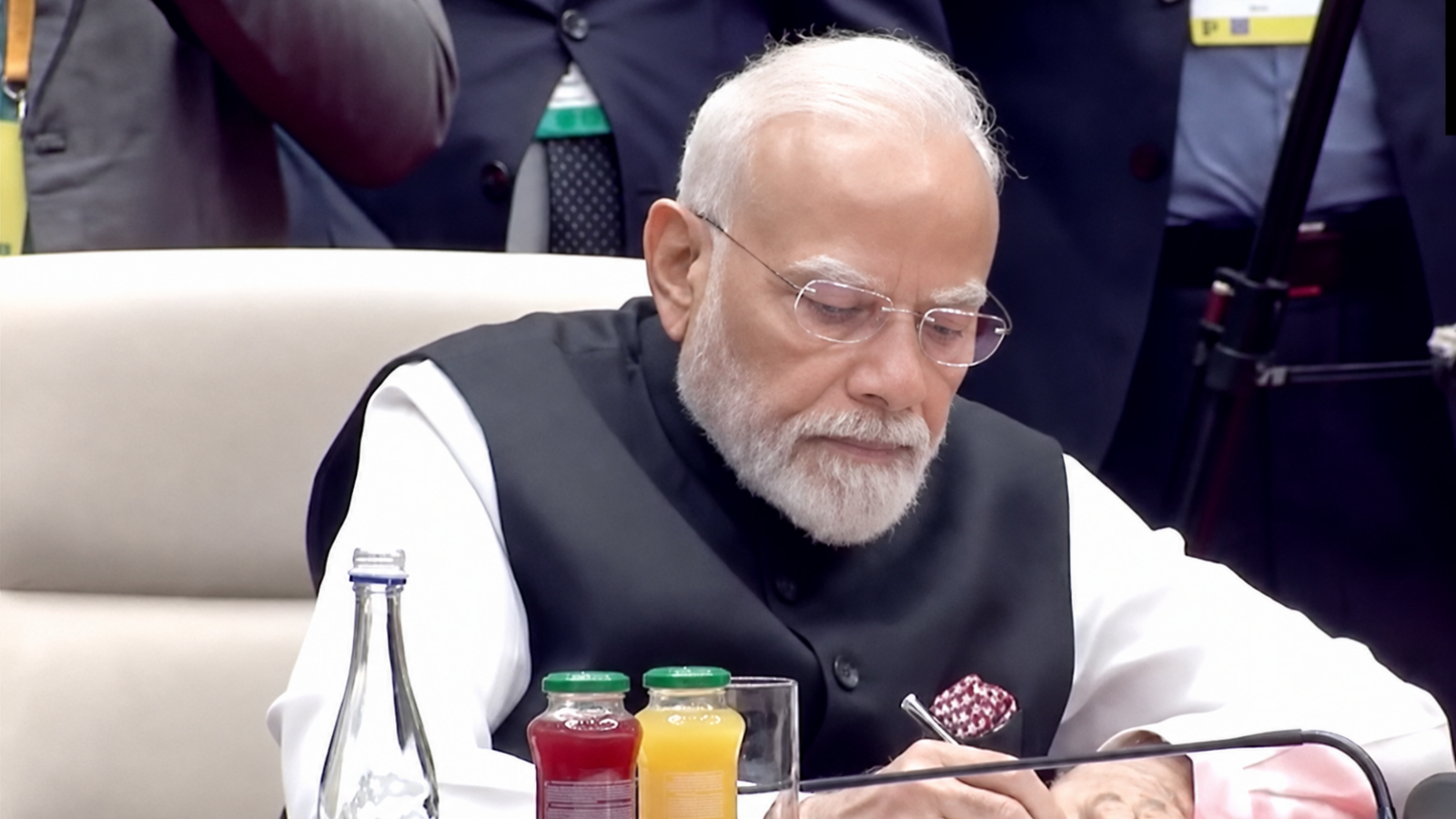
At the 26th Shanghai Cooperation Organisation Summit in Bishkek, Indian Prime Minister Narendra Modi delivered a pointed diplomatic rebuke against state-sponsored militancy, declaring directly to an assembled audience that terrorism can never function as a valid strategic asset. Standing just meters away from Pakistani Prime Minister Shehbaz Sharif, Modi demanded the complete dismantling of trans-border extremist infrastructure, targeting financial pipelines, recruitment networks, and regional safe havens.
Diplomacy rarely operates through pure candor. More often, it functions as a layered exercise in signaling, where public addresses serve as calculated pressure valves for underlying regional friction.
The Anatomy of Regional Posturing
Geopolitical forums like the Shanghai Cooperation Organisation are frequently celebrated in official communiqués as models of multilateral harmony. Beneath the polished veneer of family photos and signed declarations, however, lies an arena of competing national interests.
When New Delhi points outward toward the operational mechanics of proxy warfare, it addresses a structural vulnerability within the Eurasian security framework. For decades, certain capitals have treated non-state actors as affordable instruments of foreign policy. This calculus assumes that violence can be neatly quarantined—directed outward to achieve specific geopolitical outcomes while leaving domestic populations untouched.
Reality routinely shatters this assumption.
The financial infrastructure required to sustain cross-border insurgencies invariably bleeds into domestic criminal enterprises. Narco-trafficking syndicates, illicit arms dealers, and human smuggling rings feed directly into the logistical arteries of militant networks. Modi highlighted this exact convergence during his Bishkek address, identifying drug trafficking not merely as a localized law enforcement issue, but as an existential threat to regional youth and stability.
The Mechanics of State-Backed Proxy Failure
Treating militancy as a diplomatic tool carries a catastrophic long-term carrying cost. Historical precedent demonstrates that militant proxies eventually turn their capabilities inward against their original sponsors.
Consider a hypothetical state actor that decides to cultivate insurgent groups to pressure a neighboring rival over disputed territory. Initially, the arrangement appears cost-effective. The sponsoring state avoids conventional military expenditure while maintaining plausible deniability. Intelligence agencies manage the logistical flow of funds, safe houses, and communication channels.
Over time, independent command structures take root within these proxy groups. Ideological radicalization supersedes state oversight. The domestic civilian population of the sponsoring nation begins to absorb the blowback through localized terror attacks, institutional decay, and international financial blacklisting.
When international bodies like the Financial Action Task Force apply pressure, the economic toll multiplies exponentially. Foreign direct investment dries up. Currency reserves dwindle. The state finds itself trapped in a cycle of crisis management, forced to deploy conventional military assets against the very infrastructure it once protected.
The structural flaw in the proxy doctrine is absolute. Security cannot be outsourced to violent extremists without eventually consuming the state itself.
Shifting Perimeters in an Interconnected Era
Security calculations in Eurasia are no longer dictated exclusively by local border disputes. Modern supply chains, digital interdependencies, and energy corridors mean that regional friction instantly ripples across the globe.
The ongoing instability in West Asia serves as a masterclass in modern systemic vulnerability. A localized conflict immediately disrupts maritime trade routes, chokes energy supplies, and inflates commodity prices for nations thousands of miles away. Developing economies across the Global South absorb the brunt of these disruptions, paying an exorbitant price for conflicts they had no hand in engineering.
Modi utilized the Bishkek platform to tie regional counter-terrorism efforts directly to broader global stability. By framing state-supported militancy as an impediment to reliable connectivity and economic growth, India is attempting to shift the multilateral consensus. The argument moves away from bilateral grievances and toward collective economic self-preservation.
If major Eurasian powers continue to tolerate double standards regarding violent extremism, the entire economic architecture of the region remains vulnerable to sudden collapse.
The Limits of Multilateral Consensus
Declarations made at multilateral summits rarely translate into immediate operational shifts on the ground. The Shanghai Cooperation Organisation operates on consensus, meaning that member states with divergent security agendas can easily water down binding commitments.
When Pakistan assumes leadership roles within regional security frameworks while simultaneously facing severe domestic militant blowback from groups like the Tehreek-i-Taliban Pakistan, the structural contradictions of the organization become glaringly apparent. A forum designed to foster mutual trust struggles to enforce accountability when foundational definitions of terrorism remain politically fractured.
New Delhi understands these institutional limitations. Direct appeals issued at high-profile podiums are not designed to trigger sudden conversions among rival delegations. Instead, they establish a hard evidentiary baseline for international consumption. They record official positions, isolate bad actors, and provide diplomatic cover for future unilateral or multilateral punitive measures.
The friction exposed at Bishkek is a symptom of a broader transition. As global power disperses and regional blocs jockey for economic and logistical supremacy, the tolerance for state-sanctioned chaos is shrinking.
Borders remain porous, logistical networks remain exposed, and the financing channels driving proxy networks continue to adapt to regulatory pressure. Until the structural incentive to deploy terrorism as foreign policy is entirely eradicated, declarations of unity will remain subordinate to raw geopolitical ambition.