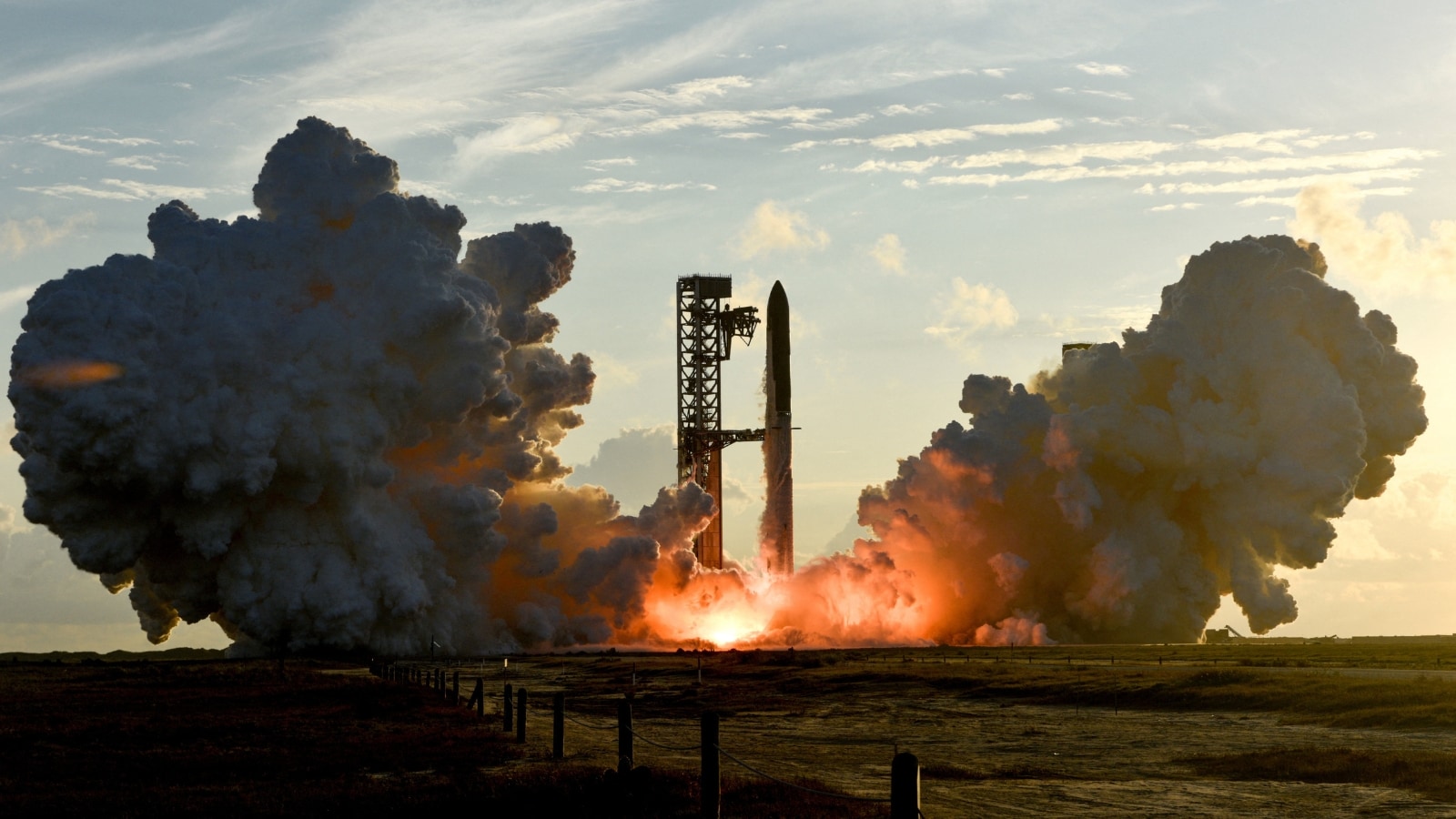
When a Raptor engine flamed out mid-flight during the latest orbital test, SpaceX engineers watched telemetry data spike in real time, knowing the entire mission hung by a thread. Starship successfully achieved orbit and deployed twenty-six Starlink satellites despite this critical engine failure, proving both the resilience of the architecture and the terrifying margins of modern heavy-lift rocketry. This wasn't a pristine textbook demonstration. It was a brutal trial by fire that exposes exactly how SpaceX handles catastrophic anomalies at high Mach numbers.
The Architecture of Fault Tolerance
Orbital insertion is an unforgiving endeavor. When a booster or upper stage loses propulsion while traveling at thousands of miles per hour, momentum alone cannot save the vehicle if guidance, navigation, and control systems fail to compensate instantly. Traditional aerospace philosophy relies on triple-modular redundancy and exhaustive pre-flight analysis to prevent anomalies before ignition. SpaceX takes a fundamentally opposite route. They build hardware to fail, observe the failure mode under actual flight conditions, and rewrite software loops on the fly.
During this flight, the anomaly occurred during the upper stage burn. Telemetry showed a pressure drop in one of the vacuum-optimized Raptor engines, followed by an immediate, automatic shutdown command executed by the onboard flight computer. In an older rocket architecture, a single engine outage on an upper stage carrying a commercial payload could trigger mission termination or an off-nominal ballistic reentry. Instead, Starship redistributed propellant flow, adjusted gimbal angles on the surviving engines, and extended the burn duration to make up for lost specific impulse.
This maneuver required splitting hairs with orbital mechanics. Every second of extended burn alters the orbital trajectory, requiring precise recalculations of the insertion vector to ensure the vehicle reached its target altitude without burning through attitude control propellant reserves. The deployment mechanism for the twenty-six Starlink satellites had to adapt to a slightly non-standard injection orbit. While ground stations back in Hawthorne held their breath, the payload bay doors opened on schedule, releasing the cluster of flat-panel satellites into the vacuum of low Earth orbit.
Anatomy of a Raptor Failure
To understand why an engine failure during an orbital test matters so much, one must look closely at the engineering constraints of full-flow staged combustion. Raptor is not a conventional rocket engine. By routing all fuel and oxidizer through separate preburners—one running fuel-rich and the other oxidizer-rich—every drop of propellant enters the main combustion chamber as a gas. This design eliminates seal failures between fluid loops and pushes chamber pressures far beyond traditional limits.
However, operating at extreme temperatures and pressures leaves zero margin for metallurgical shortcuts. The failed engine experienced an internal thermal anomaly that triggered safety sensors. SpaceX engineers have spent years refining the metallurgy of the turbine blades and combustion chamber walls, using advanced copper alloys and regenerative cooling channels to withstand the heat. When an anomaly occurs in flight, it points directly to localized thermal stress concentration or fuel mixture imbalances that computational fluid dynamics models failed to predict accurately on the ground.
Post-flight reviews at Starbase revealed that the root cause traced back to a localized fuel injector pressure oscillation. In a multi-engine cluster where six Raptors fire simultaneously in the vacuum skirt, acoustic resonance and vibration feedback loops create chaotic environments. Controlling combustion stability across a cluster of that magnitude is one of the hardest unsolved problems in propulsion engineering. The fact that the vehicle absorbed the loss and kept flying demonstrates that the vehicle's flight software possesses the dynamic rerouting capability needed for crewed missions to the Moon and Mars.
The Reality of Flight Testing Hardware
Public perception of spaceflight remains heavily influenced by decades of NASA programs where every component underwent years of qualification testing before ever leaving a static test stand. SpaceX operates on an iterative philosophy where flight data is the ultimate currency. Every anomaly is treated as a paid-for data point rather than an unmitigated disaster.
Critics often point out that blowing up rockets or losing engines during flight tests is wasteful. Yet static test stands can never replicate the vibrational harmonics, acoustic coupling, and thermal gradients experienced during actual atmospheric ascent and orbital insertion. A test stand holds the vehicle stationary, shielding it from dynamic pressure and aerodynamic shear forces. When Starship punches through max Q, the structural loads on the engine mounts and propellant plumbing reach levels that can only be measured by putting metal in the sky.
When the engine shut down on this mission, the telemetry gathered from that single failure event provided engineers with more actionable diagnostic data than months of ground simulations. The sensors captured micro-vibrations and temperature spikes millisecond by millisecond. This empirical dataset allows the propulsion team to modify injector geometries and update thermal protection coatings faster than any traditional paper-bound design review cycle could achieve.
Manufacturing and Scalability Bottlenecks
Behind the software triumphs and propulsion wizardry lies a sprawling industrial machine at Starbase in Boca Chica, Texas. Building vehicles of this scale out of stainless steel requires an entirely different supply chain and fabrication ethos than traditional aerospace carbon composites. Giant ring sections are rolled, welded, and stacked in high bays under the open Texas sun.
The pressure to scale production clashes directly with the necessity for metallurgical perfection. When you are building dozens of Starship iterations a year, quality control across welding seams, heat shields, and avionics harnesses becomes a massive operational hurdle. An engine anomaly is rarely an isolated incident; it often traces back to minute variations in manufacturing tolerances or assembly procedures.
Inspecting thousands of delicate turbine components and fluid lines without introducing human error is a constant battle for the manufacturing floor. As the cadence of test flights increases, the factory must match the pace of the launch pad. If an engine fails due to a micro-defect in a fuel line weld, the entire production line must pause to trace the batch number, inspect sister components, and update quality assurance protocols. This tight feedback loop between the factory floor and the launch pad is the true engine driving the program forward.
The Regulatory and Environmental Crucible
While engineers debug combustion instabilities in Texas, external pressures are mounting. Launching vehicles of this unprecedented scale from populated coastal regions brings intense regulatory scrutiny. Every test flight requires navigating complex environmental impact assessments, Federal Aviation Administration license modifications, and airspace closures that impact commercial aviation corridors.
Marine life protection, noise mitigation, and debris dispersion zones dictate the cadence of flight windows. When a flight experiences an anomaly—even one that successfully reaches orbit and deploys its payload—regulatory bodies demand exhaustive incident reports and corrective action plans before granting authorization for the next launch. This bureaucratic friction tests the financial endurance of the program just as much as the engineering challenges test the hardware.
SpaceX has invested heavily in acoustic suppression systems and deluge water pads at the launch site to protect ground infrastructure, but public tolerance for anomalies is shrinking as Starship transitions from experimental hops to regular orbital operations. Every debris recovery operation in the Gulf of Mexico or the Straits of Florida serves as a reminder that heavy-lift rocketry carries inherent terrestrial risks. Navigating these regulatory waters requires diplomatic finesse alongside raw engineering brilliance.
The Road Ahead for Heavy-Lift Architecture
Achieving orbit with a disabled engine is a milestone, but it is merely a stepping stone toward the ultimate design requirements. Future mission profiles demand full and rapid reusability. Both the Super Heavy booster and the Starship upper stage must return to the launch site, catch on the mechanical arms of the launch tower, and prepare for turnaround within hours.
An upper stage that requires an engine shutdown and emergency trajectory compensation to survive its ascent is not yet ready for rapid turnaround. Reusability demands that engines operate within comfortable thermal and structural margins, with zero component degradation that requires manual intervention or refurbishment. The telemetry from this mission will dictate the design changes for the next generation of Raptor engines, pushing engineers to enhance cooling efficiency and chamber durability even further.
Furthermore, deploying twenty-six Starlink satellites is a modest payload fraction compared to the full design capacity of the vehicle. As SpaceX looks toward deploying next-generation satellite constellations and eventually heavy cargo payloads for lunar missions, the reliability of the entire propulsion cluster must approach statistical perfection. A single engine out on a crewed mission to Mars is survivable, but repeated anomalies will undermine confidence long before the first human steps onto the regolith.
The roar of the engines over the Gulf of Mexico marks a turning point in aerospace history. By pushing hardware to the absolute edge of failure and trusting software to catch the falling pieces, SpaceX is redefining how heavy-lift systems evolve. The twenty-six satellites currently circling the planet in a slightly irregular orbit stand as tangible proof that resilience built into code and steel can snatch operational success from the jaws of mechanical failure. The question is no longer whether Starship can reach orbit, but whether the engineering pipeline can eliminate the margin of error before the stakes get even higher.