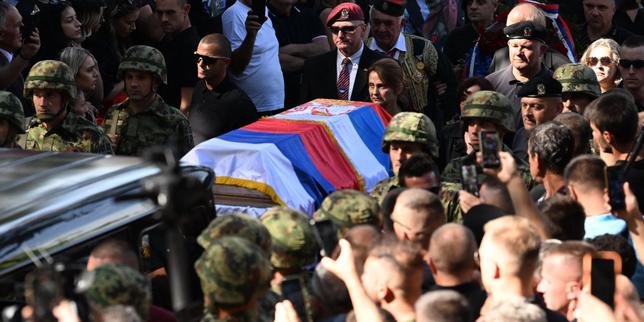
Thousands of mourners flooded the streets of Belgrade to lay Ratko Mladic to rest, transforming the funeral of a convicted war criminal into a mass nationalist spectacle. The state-backed military honors, complete with an army brass band and active-duty soldiers carrying a flag-draped coffin, exposed a chilling reality. Serbia has not distanced itself from the architects of the 1990s Balkan atrocities. It has institutionalized their rehabilitation.
Mladic died at eighty-four in a United Nations detention unit in The Hague, serving a life sentence for genocide, crimes against humanity, and the orchestration of the Srebrenica massacre. Yet the official machinery in Belgrade treated his repatriation not as the return of a condemned mass killer, but as the homecoming of a fallen hero. This public veneration is not a spontaneous outburst of grief from rogue extremists. It is the predictable harvest of decades of historical revisionism cultivated by the political elite.
The Mechanics of State Denial
To understand how a man responsible for the worst massacre on European soil since the Second World War receives a state-orchestrated military send-off, one must examine the utility of manufactured grievance. Serbian President Aleksandar Vucic has spent years walking a diplomatic tightrope. He postures as a pragmatist eager for European Union integration while simultaneously stoking the nationalist embers that keep his base loyal.
When the Serbian government dispatched a state plane to fetch Mladic’s remains from the Netherlands, it sent an unmistakable message. Official complicity was masked behind bureaucratic technicalities, with leaders claiming the arrangements were strictly a family matter. This plausible deniability is a core pillar of modern Balkan realpolitik. State-controlled media broadcast the funeral live, transforming a grim historical reckoning into a patriotic masterclass.
The strategy relies on a simple inversion of reality. The perpetrators of ethnic cleansing are reframed as defenders of the nation, while international courts that delivered justice are dismissed as anti-Serbian tribunals. By sanitizing Mladic, the current political establishment shields its own ideological origins. Many of today's power-brokers were active participants or enthusiastic cheerleaders in the expansionist projects of the Milosevic era. Admitting that Mladic was a genocidal criminal requires admitting that the entire project was built on criminal foundations.
Reaching the Post-War Generation
The most dangerous aspect of the Belgrade spectacle was the demographic makeup of the crowds. Young men born long after the signing of the Dayton Accords marched behind banners bearing Mladic's likeness. These youths have been raised in an informational ecosystem where textbooks gloss over war crimes and independent journalism is systematically undermined.
Consider a hypothetical example to illustrate this mechanics. Imagine a teenager growing up in a provincial Serbian town, fed a daily diet of tabloid headlines claiming the nation is perpetually under siege by hostile foreign powers. When state institutions honor a man like Mladic with military pageantry, that teenager learns that brutality in defense of the ethnic collective is not a crime, but a supreme virtue.
This revisionism finds fertile ground across borders. Milorad Dodik, the separatist leader of Bosnia's autonomous Serb entity, flew to Belgrade to pay his respects. The alignment between Belgrade and Banja Luka ensures that the ideology of Greater Serbia remains alive, albeit operating through political obstruction and cultural separatism rather than active artillery sieges.
The Cost of European Cowardice
The European Union responded with predictable dismay. Enlargement commissioner Marta Kos canceled a scheduled diplomatic visit to Belgrade in protest, condemning the glorification of a war criminal as fundamentally incompatible with European values. Yet sternly worded rebukes from Brussels carry little weight when unaccompanied by concrete consequences.
For years, Western capitals prioritized regional stability over transitional justice, treating strongman leaders as reliable partners as long as they kept the lid on simmering ethnic tensions. This transactional diplomacy allowed figures like Vucic to play a double game. They pocket EU financial assistance while domestic media outlets spew vitriol and celebrate convicted war criminals.
When international actors prioritize short-term geopolitical management over moral clarity, they create an environment where historical truth is negotiable. The EU's toothless response to the rehabilitation of Mladic signals to aspiring authoritarians everywhere that accountability has an expiration date.
The coffin has been lowered into the earth at Topcider Cemetery, placed quietly beside the grave of his daughter. But the ideology that armed his battalions and justified the slaughter of eight thousand Muslim men and boys in a few blood-soaked days remains untouched, venerated, and woven directly into the fabric of the state.