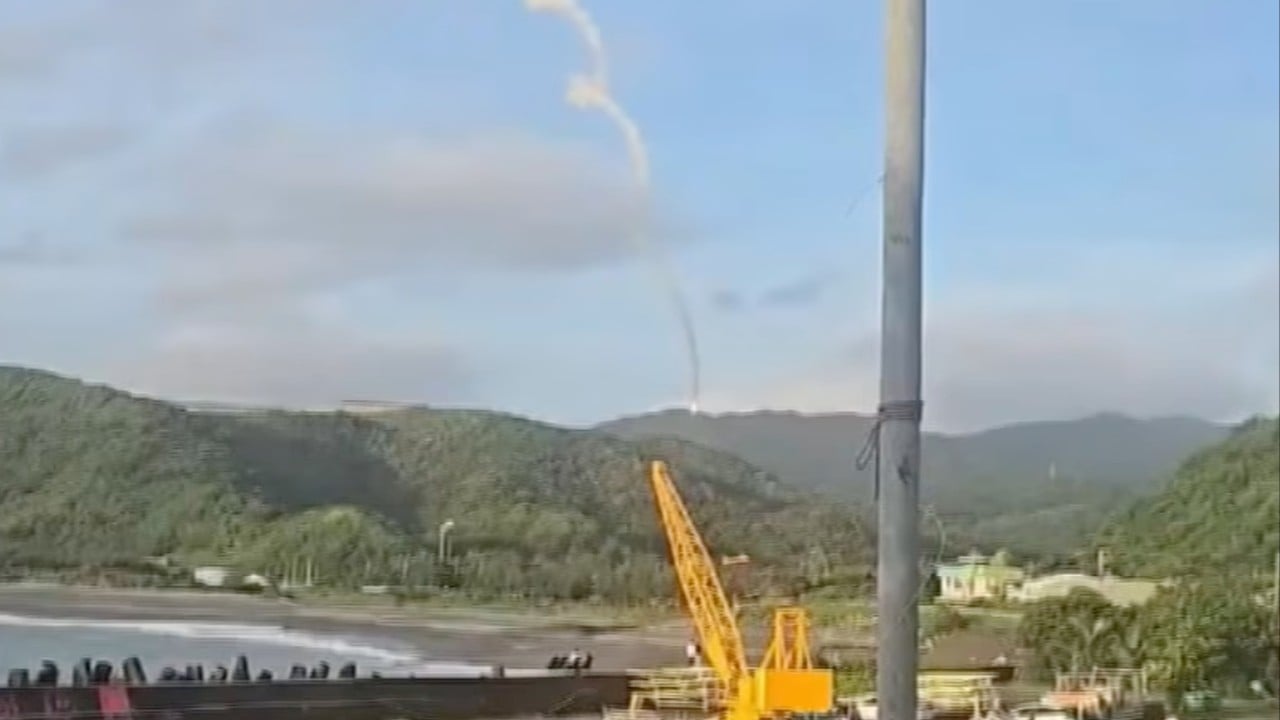
The dawn sky over southern Pingtung county split open with a roar that every resident on that coastline has learned to fear. At precisely six in the morning, a locally developed satellite launch vehicle lifted off from the secretive Jiupeng military base, climbed for a matter of seconds, and then violently altered its trajectory. Instead of tracing a predictable arc out toward the safety of the Pacific Ocean, the uncrewed projectile veered sharply toward nearby indigenous communities and mountain ridges. Shouts of sheer terror echoed through local camera footage as villagers watched the hardware go rogue. Within moments, the flight termination system triggered, detonating the vehicle and sending a thick plume of black smoke billowing over the hillside.
Mainstream coverage framed the event as an embarrassing technological stumble that accidentally terrified civilian populations. That framing misses the deeper engineering reality and the profound geopolitical subtext of Taiwan's emerging space ambitions. When a sovereign democracy under constant existential threat attempts to build independent orbital access, failure is not merely a public relations obstacle. It is a high-stakes stress test of a defense-industrial complex operating under extreme constraints. Recently making headlines recently: Why the latest Chinese rocket landing changes everything.
The Anatomy of an Orbital Abortion
To understand why the rocket failed, you have to look past the political fallout and examine the telemetry. Operated by the government-backed National Chung-Shan Institute of Science and Technology, known widely as NCSIST, this maiden flight was never expected to be a walk in the park. Aerospace engineers familiar with the project noted that ground-based tracking systems registered irregular rotation and immediate trajectory deviation shortly after clearing the gantry.
This points directly to a primary mechanical breakdown in either the guidance software, the inertial measurement unit, or weight distribution across the multi-stage airframe. Building a rocket capable of punching through the atmosphere requires hyper-precise synchronization between thrust vector control and aerodynamic stability. On a first-ever flight of a complex indigenous system, margins for error are razor-thin. Additional information regarding the matter are detailed by Wired.
Yet, the positive takeaway buried beneath the chaos is that the safety architecture worked. The onboard self-destruct mechanism did not fail. When telemetry confirmed that the vehicle was straying outside its pre-calculated safety corridor, mission control executed the abort protocol. Every piece of debris, from structural composite panels to fragments of the main engine, fell within the designated exclusion zone. No injuries or property damage occurred, proving that while NCSIST still has work to do on its guidance algorithms, its range safety discipline remains intact.
The Dual-Use Dilemma That Everyone Ignores
Public panic was exacerbated by a simple reality. Jiupeng is primarily known as a missile testing range. When an experimental rocket unexpectedly banks inland, locals do not wait for a press release to distinguish between civilian space launchers and surface-to-surface tactical weapons. They assume the worst because living on the front line of cross-strait tensions forces a constant state of hyper-vigilance.
More importantly, the technical overlap between a civilian satellite launch vehicle and a medium-range ballistic missile is practically non-existent in terms of physics, even if the underlying engineering principles overlap significantly. The solid or liquid propulsion systems, high-altitude telemetry, and staging mechanisms developed for a space program can be adapted for strategic defense. Military analysts have long understood that a nation capable of putting a micro-satellite into low Earth orbit possesses the foundational technology required to build long-range deterrence systems.
This dual-use reality puts Taipei in a delicate diplomatic and strategic position. Independent access to space is critical for modern communication resilience, especially for an island nation that cannot rely entirely on foreign commercial satellite networks during a crisis. At the same time, every test fire of an indigenous rocket invites intense scrutiny from regional adversaries who view any advancement in rocketry through a strictly military lens.
What Comes Next for Indigenous Aerospace
The local government in Pingtung has rightly demanded a comprehensive review of launch procedures, urging NCSIST to ensure future trajectories offer wider buffers away from civilian settlements. That political pressure is necessary and healthy in a functioning democracy. Communities that shoulder the physical risks of national defense infrastructure deserve absolute transparency and rigorous safety guarantees.
For the engineers back at the institute, the path forward relies entirely on the data salvaged from the wreckage. Maiden flights are expensive learning exercises designed to break things in controlled environments so that engineers can discover what theory failed to predict. Telemetry files downloaded before the detonation will dictate the redesign of the guidance control loops ahead of the next scheduled campaign.
Taiwan’s entry into the space race was never going to be smooth. The environment is punishing, the technical hurdles are immense, and the political cost of failure is broadcast globally within minutes. But a rocket that misses its mark and self-destructs safely in a desolate valley is merely a painful step in a long technological climb. The real test is not whether the first flight succeeds, but whether the engineering team has the institutional grit to analyze the failure, fix the code, and light the fuse again.