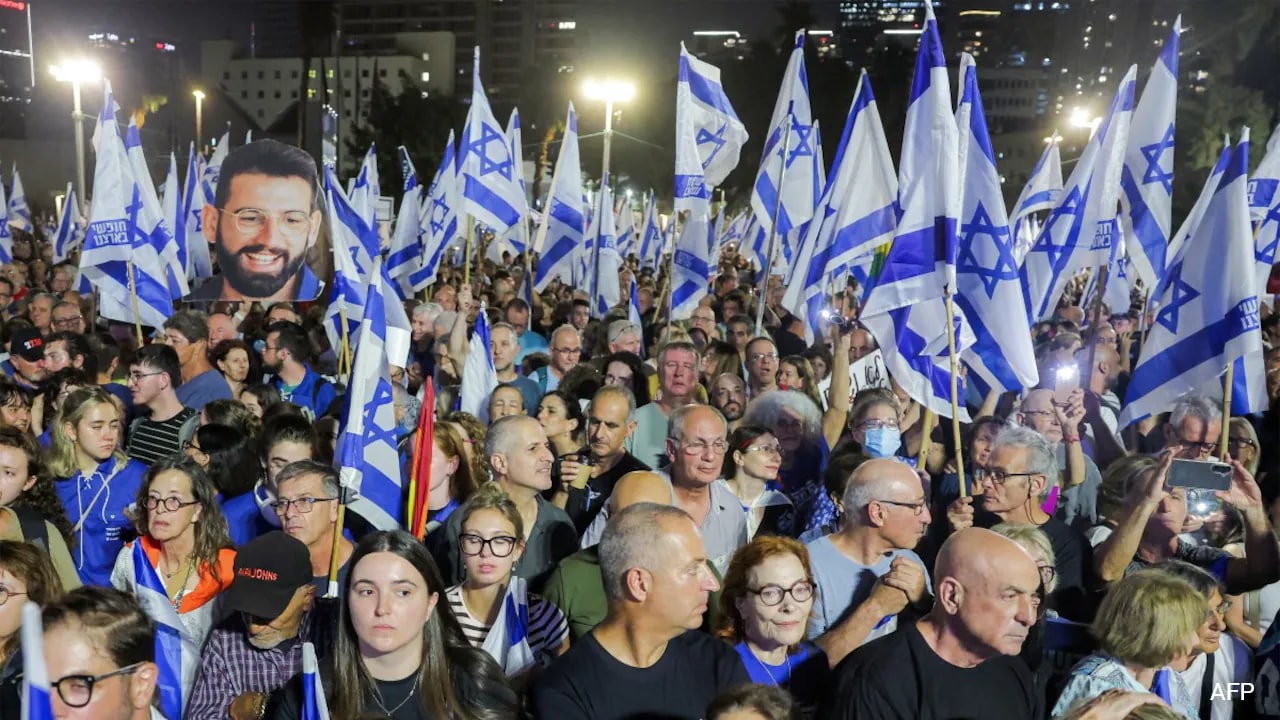
Three days before Israel’s October 27, 2026 general election, thousands of demonstrators packed Hostages Square in Tel Aviv to demand Prime Minister Benjamin Netanyahu’s removal and force a state commission of inquiry into the October 7, 2023 security failures. While wire reports framed the rally as a routine pre-election gathering, the protest exposed a deeper institutional standoff over who controls the official historical record of Israel’s worst military failure, how grief has been converted into electoral leverage, and why street mobilization alone faces structural limits inside the 120-seat Knesset.
Wire coverage of the Saturday night demonstration focused on crowd size, Pinocchio masks mocking Netanyahu, and brief quotes from opposition leaders. That surface reporting misses the actual mechanics driving the confrontation. The October 24 rally was organized by the October Council, a coalition of bereaved families and former hostages who recognized that an election victory by Netanyahu’s governing bloc would effectively bury any independent investigation into the 2023 intelligence and military collapse.
The Battle Over the October 7 Inquiry
At the center of the Tel Aviv protest was a fierce legal and political dispute over the State Commission of Inquiry. Under Israel’s Commissions of Inquiry Law of 1968, a state commission is the highest investigative body in the country. Crucially, its members are appointed by the President of the Supreme Court, granting it subpoena power, judicial independence, and the authority to recommend personal sanctions against sitting officials—including the prime minister.
Netanyahu’s coalition spent years blocking that mechanism. In its place, the government proposed a "political" commission whose members would be split evenly between appointees from the ruling coalition and the opposition.
Opposition leaders, including former military chief Gadi Eisenkot and former prime minister Naftali Bennett, announced they would boycott any politically appointed panel. To the protesters in Tel Aviv, a bipartisan political panel is designed to produce gridlock rather than accountability. If half the investigators answer to the officials under scrutiny, the panel cannot issue unified findings on chain-of-command failures, intelligence warnings, or cabinet decision-making prior to October 7.
Why Hostages Square Became the Campaign’s Center of Gravity
The physical location of the protest carried deliberate weight. For over two years following the 2023 attacks, Hostages Square served as the nerve center for weekly vigils demanding the return of captives from Gaza. By October 2026, all living hostages and the remains of those killed in captivity had been returned, yet the public anger had not dissipated.
Families and demonstrators accused Netanyahu of prolonging the conflict and delaying earlier ceasefire-hostage frameworks to preserve his right-wing coalition. For those in the square, the transition from hostage advocacy to electoral mobilization was direct. Protest organizers argued that without removing the political leadership that presided over the crisis, no structural reform of Israel’s security doctrine could take place.
The rally also highlighted the economic and diplomatic anxieties hanging over the October 27 ballot. Speakers and opposition figures warned voters that another term for the current coalition risked international isolation, trade sanctions, and severe friction with Washington over long-term security agreements. Britain and several other governments had already imposed sanctions on goods from Israeli West Bank settlements following surges in settler violence and state-approved construction.
The Electoral Math Behind the Street Anger
Large crowds in Tel Aviv are a familiar sight in Israeli politics, and veteran observers know that coastal turnout does not automatically translate into parliamentary majorities. Tel Aviv represents the secular, liberal, and centrist core of the Israeli electorate—a demographic that was already voting against Netanyahu.
To unseat a prime minister in Israel’s proportional representation system, an opposition bloc must secure at least 61 seats in the 120-member Knesset. While Eisenkot attended the rally to signal solidarity with the October Council, both he and Bennett scheduled separate, targeted voter meetings in Tel Aviv the following evening. Their split appearances underscored the core vulnerability of the anti-Netanyahu camp: ideological fragmentation.
A realistic assessment of the protest movement requires acknowledging its blind spots:
- Demographic limits: Street demonstrations in Tel Aviv rarely sway traditional Likud voters in peripheral towns or ultra-Orthodox communities whose electoral behavior is anchored in identity, religious autonomy, and welfare allocations rather than judicial norms.
- Coalition contradictions: Even when opposition parties and Arab factions combine to pass the 61-seat threshold, turning that mathematical majority into a functioning government requires bridging deep ideological divides over security policy and the role of Arab parties in coalition governance.
- The incumbency shield: While standing trial on domestic corruption charges and facing an International Criminal Court arrest warrant issued in 2024 over the Gaza war, Netanyahu retained a disciplined media apparatus and a loyal parliamentary base capable of framing the protests as an elite effort to overturn the will of right-wing voters.
What the Demonstration Actually Accomplished
If the Tel Aviv protest did not convert committed right-wing voters, it served a different, decisive function in the final 72 hours before polls opened. It locked the opposition parties into an explicit public commitment.
By standing on the stage at Hostages Square alongside the October Council, opposition contenders boxed themselves into a non-negotiable platform plank. Any post-election coalition formed by Netanyahu’s rivals would face immediate street backlash if it attempted to compromise on the establishment of a Supreme Court-appointed State Commission of Inquiry or struck side deals with coalition holdouts to water down the mandate.
At the same time, the rally demonstrated that civic infrastructure built during wartime does not simply demobilize when a ceasefire takes hold or hostages come home. The organizational networks, logistics, and public pressure campaigns forged over three years of crisis had evolved into a permanent accountability bloc.
For the demonstrators who filled Tel Aviv ahead of the vote, the election was never merely a contest between rival politicians. It was a fight over whether a sitting government can survive a historic national catastrophe without ever submitting to an independent subpoena.
Netanyahu Faces Mass Protests Ahead of Israel Election
This video captures the scale of the Tel Aviv demonstrations and examines whether mass street mobilization can translate into decisive parliamentary votes.