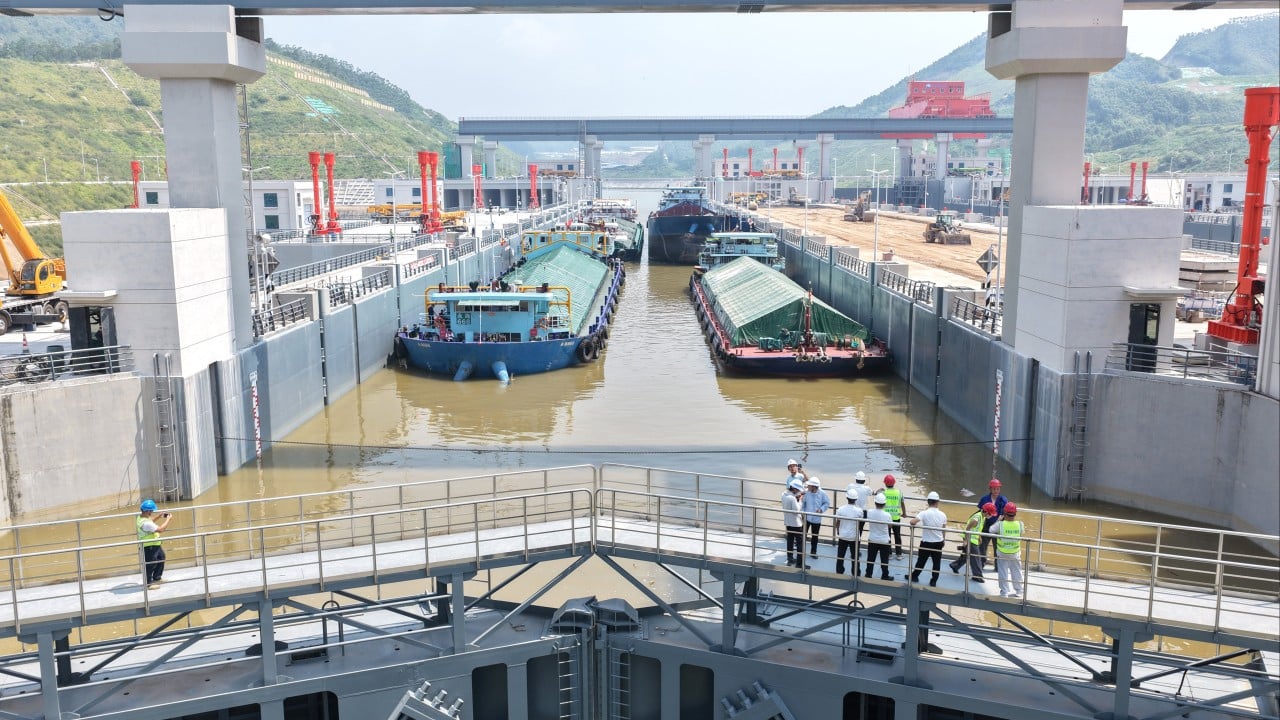
For decades, the geography of southern China imposed a quiet tax on commerce. Factories sitting deep within the interior provinces watched their cargo crawl down winding, congested riverways or face expensive overland truck transits just to reach the sea. That bottleneck is snapping. Engineers have carved an artificial maritime highway directly through the terrain of Guangxi, connecting inland waterways straight to the Beibu Gulf.
Known as the Pinglu Canal, this 10.8 billion dollar engineering undertaking is entering its operational trial phase. It shrinks transit distances to Southeast Asian markets by hundreds of kilometers. The official narrative focuses on triumph, speed, and efficiency. Yet the physical reality of moving millions of tons of containerized freight through an artificial channel reveals a more complex wager. This infrastructure gamble attempts to rewrite supply chain economics across the Association of Southeast Asian Nations bloc, bypassing old administrative friction points and establishing a direct maritime pipeline from the Chinese heartland to the Gulf of Tonkin.
The Anatomy of an Artificial Shortcut
Water does not naturally flow where commerce demands it. To solve this, planners designed an 84-mile aquatic corridor linking the Xijin Reservoir area directly to the sea. The scale defies casual observation. Millions of cubic meters of earth were moved, concrete lock systems were anchored into the subtropical bedrock, and specialized command vessels are now testing the depth tolerances.
The corridor accommodates 5,000-ton ships. That specification matters. Previously, goods moving from inland factories toward Vietnam and the wider maritime south had to navigate the lower reaches of the Xijiang River system, which bottlenecked at shallower points and forced cargo transfers onto smaller barges. Now, a single vessel loaded in the interior can maintain its draft all the way to saltwater ports.
The economic arithmetic driving this project relies on a stark reduction in mileage. Traditional transit routes out of southwestern hubs historically depended on navigating toward Guangzhou and the Pearl River Delta, forcing a lengthy detour eastward before turning south. The canal cuts straight down through Guangxi's southern belly, shaving roughly 350 miles off the journey to the sea. Transit times that once hovered around a week or longer under congested conditions are dropping sharply, slashing millions in annual operational expenses for regional manufacturers.
Reshaping the Regional Board
Trade routes are inherently political. For years, provincial planners in Guangxi watched enviously as neighboring Guangdong absorbed the lion's share of export revenue generated by the Greater Bay Area initiative. Guangxi functioned largely as an interior transit corridor rather than a primary maritime beneficiary.
This canal alters that internal balance. By funneling international shipping directly through Beibu Gulf ports such as Qinzhou, Be海, and Fangchenggang, Beijing is manufacturing a new southern economic anchor. This structural shift pulls the center of gravity away from the crowded delta hubs of the east and injects maritime capability straight into China's southwestern frontier.
The regional implications for Southeast Asia are immediate. Vietnam, Thailand, and Malaysia maintain heavy trade integration with the Chinese manufacturing apparatus. A direct water outlet into the Gulf of Tonkin creates a frictionless artery for raw materials, intermediate electronics, and agricultural products moving in both directions. Consider a hypothetical shipment of mechanical components originating in an inland industrial park: instead of enduring congested highway transit or circuitous river transshipments, the cargo loads once, drops south via the new locks, and clears customs directly at a deep-water seaport ready for regional distribution.
The Hidden Pressures of Megaprojects
Megaprojects of this magnitude carry steep environmental and financial overheads. Carving a massive shipping channel through subtropical terrain disrupts local hydrology, agricultural irrigation networks, and regional ecosystems. Maintaining water levels during seasonal dry spells requires complex reservoir management, raising questions about long-term ecological sustainability.
Financial auditing also reveals stark realities. While proponents emphasize long-term logistics savings, the initial capital expenditure of nearly eleven billion dollars requires sustained, high-volume throughput to justify the balance sheet. If global manufacturing demand dips or regional supply chains fragment under geopolitical pressure, the projected annual capacity of nearly 90 million tons must still be met to recover the investment.
Critics point out that infrastructure alone cannot manufacture organic market demand. If cross-border trade friction or regulatory barriers between nations tighten, even the most direct canal cannot force goods to move. The physical capability exists, but the economic velocity depends entirely on external geopolitical stability.
The Broader Global Context
This waterway does not exist in a vacuum. Major economies are increasingly obsessed with supply chain resilience and redundancy. While Western capitals focus on friend-shoring and decoupling, industrial planners inside Asia continue to double down on physical connectivity.
By shortening the path to ASEAN markets, the canal signals a deliberate pivot toward deepening southern trade integration regardless of external headwinds. It positions the Middle Kingdom to anchor regional commerce more tightly to its domestic manufacturing base.
The concrete locks are sealed, the test vessels have completed their initial runs, and the regional trade map has been physically altered. Whether this artificial shortcut becomes the engine of a southern economic renaissance or an expensive monument to overcapacity depends on the relentless flow of cargo through the locks.


