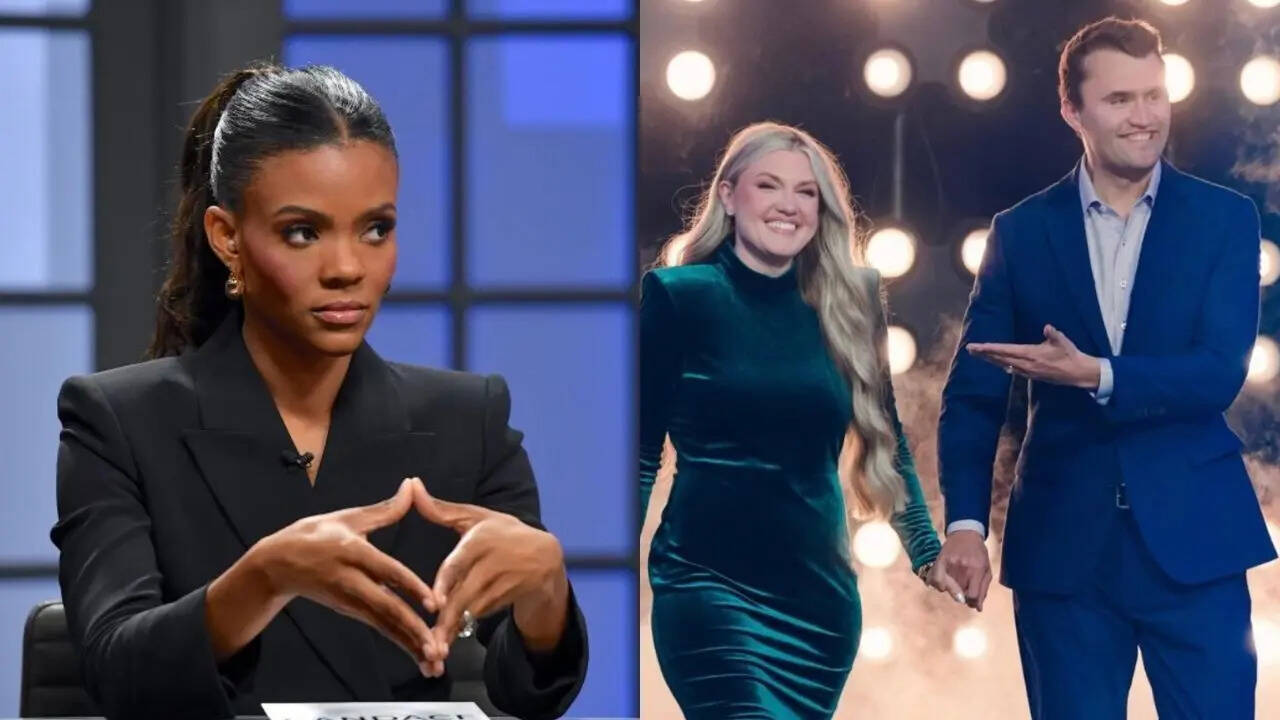
Social media doesn't just watch videos anymore. It dissects every pixel, every blink, and every micro-expression. The latest clip to go viral features Erika Kirk and a reaction so bizarre it's got people questioning what actually happens behind the scenes of high-profile political podcasts. People aren't just talking about the words spoken. They're obsessed with the face Kirk made when Candace Owens was mentioned.
If you've spent any time on TikTok or X lately, you've seen the loop. It’s Erika Kirk, wife of Turning Point USA founder Charlie Kirk, appearing to glitch or recoil during a podcast appearance. The clip originated from an episode where the conversation turned toward the high-profile and often controversial media personality Candace Owens. What followed wasn't a standard "we agree to disagree" nod. It was a physical manifestation of discomfort that has birthed a thousand theories.
Why Erika Kirk’s Expression Struck a Nerve
The internet loves a "mask slip" moment. We live in an age of highly curated public personas, especially within the political influencer sphere. When Erika Kirk’s face contorted into what many described as an eerie or "creeped out" look, it broke the fourth wall of political unity. It suggested a level of internal friction that the public rarely gets to see in such a raw, unfiltered way.
Most viewers are looking for authenticity. They want to know if the people they follow actually like each other when the cameras stop rolling. This specific reaction suggested that the relationship between the Kirks and Owens might be far more strained than the official PR narratives suggest. It’s the kind of non-verbal cue that speaks louder than a ten-page press release.
Humans are hardwired to detect social disharmony. When you see someone’s facial muscles twitch in a way that contradicts their social setting, your brain flags it as "uncanny." That's exactly what happened here. The reaction looked visceral. It looked involuntary. That’s why it’s sticking in people's minds.
The Candace Owens Factor and the Conservative Rift
You can't talk about this reaction without looking at the context of Candace Owens' current standing in the conservative media world. Owens has recently navigated a very public and very messy exit from The Daily Wire. Her rhetoric has shifted, her alliances have changed, and she’s become a polarizing figure even among those who used to be her closest allies.
Charlie Kirk and Candace Owens have been the twin pillars of young conservative activism for years. They shared stages. They shared audiences. But as the political landscape shifts, those old alliances are fraying. Erika’s reaction isn't happening in a vacuum. It’s happening against a backdrop of ideological divorce.
When Owens is mentioned now, she isn't just another pundit. She represents a specific brand of controversy that some in the movement are clearly trying to distance themselves from. Erika Kirk’s face didn't just look "creeped out." It looked like someone seeing a ghost of a partnership that has gone south.
Decoding the Body Language
Body language experts often point to "micro-expressions" as the most honest form of communication. These are the split-second movements that happen before the conscious brain can tell the face to "look professional."
In the viral clip, Kirk’s eyes seem to widen while her mouth tightens—a classic sign of "fear-disgust" overlap. It’s the face you make when you smell something bad but have to stay in the room. Online commentators have used words like "terrified" or "disturbed" to describe it. While we can't know her internal thoughts, the physical response was undeniable. It wasn't a smile. It wasn't a neutral mask. It was a recoil.
The Viral Lifecycle of a Podcast Clip
This is how modern media works. A two-hour podcast gets recorded. 99% of it is standard talking points. But five seconds of a weird facial expression gets ripped, posted to X, and suddenly it has four million views. The algorithm prioritizes conflict and strangeness.
The "internet frenzy" mentioned in headlines isn't just about the politics. It’s about the meme-ability of the moment. We’ve seen this before with other public figures—think of the "Ben Affleck looking tired" memes or the various "Real Housewives" reaction shots. The difference here is the heavy political baggage attached to the participants.
People are using this clip to validate their own theories. If you dislike Owens, you see Kirk's face as proof that Owens is "toxic." If you dislike the Kirks, you see it as proof of their "fakeness." The clip becomes a Rorschach test for the viewer's own political biases.
What This Says About Political Influencers in 2026
We're reaching a point of influencer burnout. The audience is getting smarter at spotting when things are performative. When a genuine, weird, or "creepy" moment like Erika Kirk’s reaction happens, it cuts through the noise because it feels like the only real thing that happened in the entire broadcast.
Authenticity is the most valuable currency right now. But the irony is that "real" moments are often the ones that make people look the worst—or at least the most awkward. The Kirks have built an empire on being composed, prepared, and on-message. A single "eerie" reaction threatens that polish because it reminds everyone that these are just people with personal grudges and messy professional lives.
Comparing the Reaction to Past Media Moments
Think back to the most famous "awkward" political moments in recent history. There was the Howard Dean scream. There was the Rick Perry "oops" moment. Those were verbal gaffes. We’re now in the era of the visual gaffe. In a silent-on-default scroll culture, what you look like matters more than what you say.
Erika Kirk’s reaction is the visual equivalent of a hot mic moment. It’s the "mic" that never turns off—her own face.
Moving Beyond the Hype
It's easy to get lost in the "creepy" labels and the TikTok edits. But the real story is the fragmentation of conservative media. The "frenzy" is just a symptom of a larger shift where the big names are no longer playing nice.
If you're following this story, don't just watch the 5-second loop. Look at the timing of the podcast. Look at the specific question that prompted the reaction. Usually, these "glitches" happen when a guest or host brings up a topic that is strictly off-limits or "too close to home" for the person on camera.
Pay attention to the follow-up. Notice if there’s an effort to "over-correct" in the next few weeks. Usually, when a clip like this goes viral, you’ll see the subjects try to post a "happy" or "unified" photo to bury the lead. Watch the social media feeds of both the Kirks and Owens. If a sudden "reunion" or supportive post appears, you'll know that the "creepy" face hit a little too close to the truth.
Stop looking for the polished answer and start watching the edges of the frame. That's where the real story usually lives. Keep your eyes on the upcoming podcast guest lists. If Owens doesn't appear on a Turning Point platform for the rest of the year, that "eerie" face told you everything you needed to know back in May.