The beep of a neonatal monitor is a rhythmic promise. In a standard hospital, it is the background hum of safety, a steady pulse that says, "I am here, and I am breathing." But in the neonatal intensive care units of Gaza, that beep has become a countdown. It is a fragile tether to life that requires three things the world outside takes for granted: oxygen, warmth, and electricity. When any of those three flickers, the promise breaks.
Souleiman was born into this countdown. He did not arrive in a quiet room with soft lighting and a waiting bassinet. He arrived in a blur of sirens and the smell of cordite. He weighed less than a bag of flour. His skin was translucent, a map of veins that pulsed with a desperate, instinctual will to survive. For a premature baby, the world is supposed to be an extension of the womb—a humidified, temperature-controlled sanctuary. Instead, Souleiman’s first home was a plastic box in a ward where the windows had been blown out by the concussive force of nearby strikes. Discover more on a connected issue: this related article.
The Physics of Survival
A premature infant is an unfinished masterpiece. Their lungs are like wet tissue paper, lacking the surfactant necessary to keep the air sacs open. Their brains are prone to hemorrhaging because the blood vessels are as delicate as spider silk. Most critically, they cannot regulate their own body temperature. Without an incubator, they radiate heat until their organs begin to shut down.
Consider the mechanics of a single breath in this environment. To keep a baby like Souleiman alive, a ventilator must push air into his lungs at a precise pressure. If the pressure is too low, he suffocates. If it is too high, his lungs pop. This precision requires a constant, unwavering stream of power. When the fuel runs out for the hospital generators, the ventilators stop. The monitors go dark. The rhythmic promise is replaced by a terrifying, hollow silence. More reporting by Al Jazeera delves into similar views on this issue.
Doctors in these wards have had to learn a specialized, grim kind of math. They calculate how many liters of oxygen are left in a tank versus the number of infants needing respiratory support. They decide which babies are strong enough to be moved two to a crib to share body heat, and which are so fragile that even a slight drop in temperature will be fatal. This isn't medicine anymore. It is a desperate triage of the soul.
The Weight of a Name
Souleiman’s mother, Shaima, spent the first weeks of his life navigating a landscape of rubble just to reach the hospital gates. In Gaza, the act of naming a child has shifted. It is no longer just a rite of passage; it is an act of defiance. By naming him Souleiman—a name of prophets and kings—she was claiming a future for him that the present reality seemed determined to erase.
She would sit by the incubator, her hands pressed against the plastic. She couldn't hold him. To lift him out would be to expose him to the cold, dusty air of a ward that was losing its battle with sterility. Instead, she whispered to him. She told him about the olive trees that used to stand near their home. She told him about the taste of sea salt on the breeze. She spoke to him as if he were already a man, a survivor, rather than a two-pound ghost fighting for his next inhalation.
The staff around her moved like shadows. Nurses who had lost their own homes, and sometimes their own children, continued to adjust IV drips by the light of their mobile phones. They used manual resuscitation bags—small rubber pumps—to breathe for the babies when the power failed. They did this for hours, their own muscles cramping, their eyes stinging with exhaustion. One squeeze. Two squeeze. Three. A human heartbeat translated into a manual rhythm.
The Invisible Stakes
We often talk about the casualties of conflict in terms of direct hits. We count the craters and the statistics of the fallen. But the true cost is often found in the quiet failures of infrastructure. It is found in the "excess mortality" of those who never saw a battlefield. When a neonatal ward loses power, the tragedy isn't always explosive. Sometimes, it is just a slow cooling. A baby grows lethargic. Their heart rate slows. They simply drift away because the world failed to keep them warm.
This is the invisible front line. It is a battle fought with solar panels that are covered in grey soot and oxygen canisters that are smuggled through corridors of ruin. The doctors describe the sound of the ward changing when the drones are overhead. The vibration of the engines rattles the incubators, a mechanical predator circling a glass nursery.
The logistical nightmare is staggering. To keep an ICU running, you need a sterilized environment. But how do you scrub floors when there is no clean water? How do you prevent sepsis when the antibiotics ran out three weeks ago? The medical staff began using vinegar to clean surfaces. They used salt water to flush wounds. They became alchemists of necessity, trying to turn scraps of supplies into life-saving interventions.
The Birthday That Almost Wasn't
There is a moment in the life of every "preemie" parent that feels like a miracle: the first time the baby breathes without the machine. For Souleiman, that day came during a week of intense bombardment. The generator had sputtered and died three times in twenty-four hours. Each time, a nurse had jumped to his side to pump air into his lungs by hand.
On the fourth day, as the sun began to bleed across the horizon, the doctor noticed something. Souleiman wasn't fighting the tube anymore. He was breathing around it. His chest, tiny as a bird’s, was rising and falling on its own.
It was the day they decided to celebrate his "birth." Not the day he was pulled from the womb in terror, but the day he claimed his own air. There was no cake. There were no balloons. There was only a small piece of bread shared among the nurses and a mother who finally got to touch her son’s skin without a layer of plastic between them.
He was still tiny. He was still at risk. A simple infection could still take him. But for that hour, the war felt distant. The beep of the monitor—now powered by a flickering, jury-rigged solar battery—resumed its rhythmic promise.
The Fragility of the Future
The story of Gaza’s infants is not a story of politics. It is a story of biological limits. We are creatures that require specific conditions to exist, and those conditions are being systematically dismantled. When we look at a baby in an incubator, we are looking at the ultimate vulnerability. We are looking at a being that cannot run, cannot hide, and cannot ask for help.
The survival of Souleiman is a testament to human endurance, but it is also a searing indictment of a world that allows the most basic requirements of life to become luxuries. A child should not have to be a hero just to survive their first month of life. A mother should not have to count the seconds between generator hums to know if her son will live through the night.
As Souleiman grows, he will carry the marks of his beginning. Many premature babies in these conditions suffer from long-term developmental delays, vision problems, or chronic respiratory issues. The environment of stress and deprivation leaves a chemical signature in the body—a "toxic stress" that alters the way the brain develops. He will be a child of the ruins, shaped by the very air he fought so hard to breathe.
The monitors eventually stop beeping for everyone. But for the babies in Gaza, the silence comes far too soon, and for reasons that have nothing to do with medicine and everything to do with the choices of the world outside the ward.
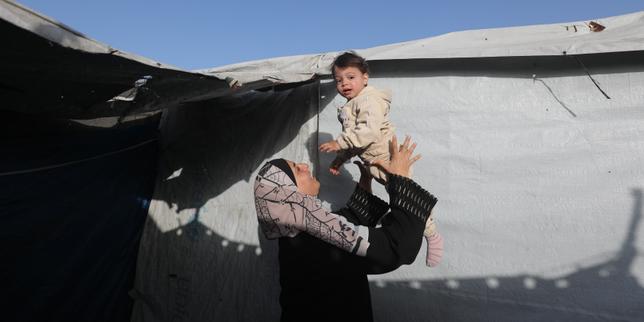
Souleiman is home now. Home is a tent. Home is a crowded room with plastic sheets for walls. But he is breathing. Every inhalation is a small, quiet victory against the dark. Every exhalation is a reminder that even in the center of a storm, life tries to find a way to anchor itself to the earth. He is no longer a bag of flour or a map of veins. He is a boy with a name, and for today, that is enough.
The plastic box is empty now, waiting for the next tiny occupant to begin the same harrowing journey, hoping the light stays on long enough for them to find their own rhythm.