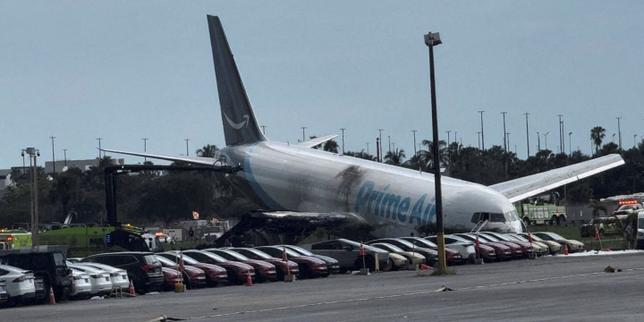
An Amazon cargo jet shooting off a runway and plowing into a public road is the kind of aviation nightmare people assume only happens in movies. Prime Air Flight 7598 changed that reality when a Boeing 767-300 operated by 21 Air overran Miami International Airport's pavement, striking vehicles and bursting into flames. Five people lost their lives, and several others sustained critical injuries in a disaster that has instantly spotlighted the complex realities of modern air cargo operations.
When you track the details coming out of federal briefings, the central question isn't just what happened on that runway—it's why standard safety margins failed. Let's break down what actually went wrong during those crucial final seconds in South Florida.
The Landing That Lost Too Much Real Estate
Flight 7598 arrived from San Juan, Puerto Rico, touching down on a Sunday afternoon under volatile weather conditions. Heavy storm clouds hung over Miami, and gusting winds whipped across the tarmac. Flight-tracking data indicates the aircraft was still traveling at roughly 129 miles per hour when it ran off the usable end of the pavement.
Aviation experts reviewing initial footage point to a glaring issue with the landing profile. The aircraft appeared to float down the runway for an extended period without dropping its nose to force the main gear down. Planes need stable ground contact to deploy spoilers and reverse thrust effectively. When a pilot floats past the standard touchdown zone—typically the first 3,000 feet of a runway—valuable stopping distance evaporates.
If a plane isn't down and decelerating within that window, standard procedure demands a go-around. Continuing the landing under those conditions turns a minor approach anomaly into a runway excursion. Investigators from the National Transportation Safety Board and the Federal Aviation Administration are parsing the cockpit voice recorders and flight data to determine why a wave-off wasn't initiated.
Age, Maintenance, and the Air Cargo Grind
The aircraft involved carries its own history into the investigation. Built as a passenger jet back in 1994, the Boeing 767 had spent over three decades in service before its conversion into a freighter. While older airframes fly safely every day under rigorous maintenance schedules, the intense rotation cycles of modern e-commerce logistics put heavy wear on cargo fleets.
Carriers like 21 Air manage high-frequency routes for major logistics giants, keeping older planes working around the clock. Investigators are reviewing the maintenance logs to check whether previous international owners or structural aging played any role in how the aircraft responded during braking. Mechanical anomalies combined with a high-speed touchdown create a dangerously narrow margin for error.
Infrastructure Gaps on the Tarmac
Runway safety areas are designed to catch mistakes, but they aren't foolproof everywhere. Miami International Airport lacks engineered material arresting systems—those beds of crushable concrete blocks built at the end of runways to decelerate runaway aircraft. Federal safety data shows those systems have saved nearly 500 lives across more than 120 US airports. Without them at the end of the Miami runway, the heavy freighter rolled straight through the perimeter security and onto a busy surrounding roadway, colliding directly with traffic.
The disaster has triggered immediate ground stops, widespread flight cancellations, and severe delays across the region. As federal investigators comb through the wreckage, the findings will likely force a hard look at how cargo carriers balance tight delivery schedules against safe pilot decision-making when an approach goes sideways.