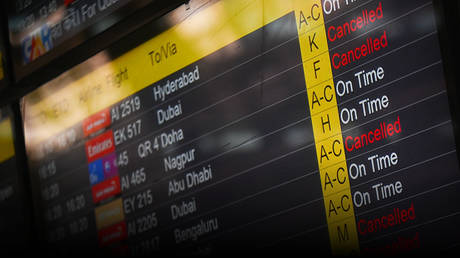
If you thought the days of sleeping on airport floors and staring at "Cancelled" screens were over, the last 48 hours have been a rude awakening. We're currently seeing the most violent shake-up to global aviation since the pandemic grounded the world. This isn't just about a few delayed flights in the Middle East. It’s a systemic collapse of the "super-highway" that connects Europe, Asia, and Africa.
On February 28, 2024, the military landscape shifted overnight after US and Israeli strikes targeted Iran. The subsequent retaliatory strikes didn't just hit military targets; they've effectively shuttered the world’s most critical transit hubs. If you're holding a ticket with a layover in Dubai, Doha, or Abu Dhabi, your travel plans aren't just at risk—they're likely already in the trash.
The Hub Model is Breaking in Real Time
For years, the global travel industry has relied on the "mega-hub" strategy. Airlines like Emirates and Qatar Airways turned Dubai (DXB) and Doha (DOH) into the world’s waiting rooms. It’s a brilliant business model until the sky literally closes.
As of March 1, 2026, Dubai International—the busiest international airport on the planet—has sustained damage during retaliatory attacks and has halted operations. Qatar Airways has suspended all flights from Doha. Imagine the scale of that for a second. We're talking about a 41% cancellation rate for Qatar Airways and nearly 40% for Emirates in a single day.
This isn't a localized issue. When you take out the "middle" of the Middle East, the ripple effect hits Bali, London, and New York. Aviation analytics from Cirium show that over 22% of all scheduled flights to the Middle East were wiped out in the first 24 hours. By Sunday, FlightAware reported over 19,000 delays globally. This is what happens when you try to funnel the world through a needle's eye and the needle breaks.
Why Your Flight Time Just Jumped by Three Hours
Even if your flight isn't cancelled, it’s going to be longer and more expensive. Airlines are now forced to skirt around the closed airspaces of Iran, Iraq, Israel, Jordan, and the UAE.
- The Northern Detour: Carriers like Lufthansa and British Airways are rerouting over Turkey and the Caucasus.
- The Southern Push: Other flights are being shoved into narrow corridors over Saudi Arabia and the Red Sea.
Rerouting a wide-body jet like a Boeing 777 or an Airbus A380 isn't cheap. These detours add 2 to 3 hours per leg. In terms of cold, hard cash, that's an extra $6,000 to $10,000 in fuel and crew costs per hour. You don't need a degree in economics to know who’s going to pay for that eventually. Jet fuel prices have already spiked as crude oil jumped $5 to $7 a barrel on the news.
The Airspace Squeeze is Getting Dangerous
It’s not just the Middle East that's the problem. The Russia-Ukraine war already closed off a massive chunk of the northern sky. Now, with the Middle East "super-highway" dark, planes are being forced into increasingly crowded, narrow strips of sky.
Safety regulators like EASA have issued high-risk advisories. They’re basically telling airlines to stay out of the region at all altitudes. The risk isn't just a stray missile; it's the total loss of air traffic control coordination across a region that manages thousands of flights a day. If Pakistan and Afghanistan see further escalation, the remaining corridors between Europe and Asia could vanish entirely.
What to Do If You're Stranded
I've seen people waiting in lines that snake through the entire terminal in Bali and Dhaka. It’s miserable. If you’re caught in this, stop waiting in the physical line. Get on the app. Use the airline’s chat function.
Most airlines are triggering "force majeure" clauses, but that doesn't mean they don't owe you a refund or a rebooking.
- Check your travel insurance immediately. Most standard policies cover "scheduled airline failure" or "denied boarding," but war-risk exclusions are common. You need to know exactly what your fine print says before you spend $2,000 on a last-minute replacement ticket.
- Don't cancel your own flight. If you cancel before the airline does, you might lose your right to a refund. Wait for them to make the move.
- Look for "Relief Valve" hubs. Cairo, Riyadh, and Larnaca are currently operating as "overflow" points. If you can get a flight into one of these, you might have a better chance of catching a connection than sitting in a shuttered Dubai terminal.
The Cargo Crisis No One is Talking About
While passengers are sleeping on suitcases, the global supply chain is taking a massive hit. Dubai and Doha aren't just for people; they handle millions of tons of cargo. Electronics, pharmaceuticals, and "just-in-time" parts for manufacturing are now sitting in grounded freighters.
Experts are predicting an "economic earthquake" in the shipping sector. We're looking at potential 40% spikes in sea freight rates if the Strait of Hormuz becomes as restricted as the skies above it. This conflict is moving beyond travel—it’s hitting the cost of everything you buy.
Next Steps for Travelers
Check your flight status every two hours via a tracking site like Flightradar24, not just the airline's website, which can lag. If your flight is within the next 48 hours and transits through the Gulf, call your carrier now. If your travel is more than a week away, hold tight but have a Plan B. The aviation industry is currently in a state of "continuous volatility," and the map of the sky is being redrawn every hour.