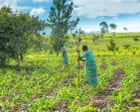
African food security is hanging by a thread and that thread runs straight through the Strait of Hormuz. When the world’s largest fertilizer company, Yara International, sounds the alarm about a potential war involving Iran, it isn't just corporate posturing. It's a math problem with lethal consequences. If the Middle East explodes, the cost of growing a single ear of corn in Kenya or Nigeria will skyrocket beyond what local farmers can afford.
The logic is simple but brutal. Modern farming relies on nitrogen. Nitrogen fertilizer is made using natural gas. Iran and its neighbors sit on the world's most critical gas reserves and shipping lanes. You don't need a degree in economics to see the trap. If gas prices spike or supply chains snap because of a regional war, fertilizer production stalls. For Africa, a continent that already pays a premium for imported nutrients, this is a direct hit to the gut. Learn more on a connected subject: this related article.
We’ve seen this movie before. When Russia invaded Ukraine, the global fertilizer market lost its mind. Prices tripled in some regions. Farmers in sub-Saharan Africa simply stopped buying it. They planted without it, and their yields crashed. Now, imagine that same scenario but with the added chaos of a closed Strait of Hormuz.
The Nitrogen Trap and Why Gas Matters
Most people think of fertilizer as "dirt food," but it’s actually "buried energy." To make ammonia—the base of nitrogen fertilizer—factories use the Haber-Bosch process. This requires immense amounts of natural gas. Iran isn't just a regional power; it's a gas titan. More importantly, it borders the world's most sensitive maritime chokepoint. Additional analysis by TIME delves into comparable views on the subject.
If a conflict shuts down the Strait, roughly 20% of the world's liquefied natural gas (LNG) stops moving. When gas supply drops, prices for everyone—from a factory in Norway to a plant in Qatar—go up. Yara International’s CEO, Svein Tore Holsether, has been blunt about this. He knows that his plants, and those of his competitors, can't operate cheaply if energy costs are volatile.
Africa is uniquely vulnerable because its soil is naturally nutrient-poor. In the West, we have decades of residual fertilizer in our ground. African farmers often work with "tired" soil that needs an annual hit of nitrogen just to produce a baseline crop. If that nitrogen costs $1,000 a ton instead of $400, the farmer goes bankrupt, or the city dwellers go hungry. Usually both.
Why Africa Takes the Hit First
Global supply chains are basically a giant game of musical chairs. When supply tightens, the guy with the most cash gets the seat. Europe and North America have the subsidies and the capital to absorb price hikes. Africa doesn't.
During the 2022 price surge, we saw a "silent famine" of inputs. International agencies like the World Food Programme had to divert funds just to keep up with rising costs, meaning they could buy less food with the same amount of donor money. An Iran-led conflict would be even worse because it targets the very region—the Middle East—that has become Africa’s primary alternative to Russian supply.
Nigeria, for instance, has tried to boost its own production with the massive Dangote fertilizer plant. But even domestic plants aren't immune. Global prices dictate local prices. If a Nigerian producer can sell their urea for a massive profit in Brazil because of a global shortage, local farmers will still face high prices or empty shelves.
The Myth of Self Sufficiency
Governments love to talk about food sovereignty. It's a great campaign slogan. In reality, Africa imports nearly 80% of its fertilizer. The "Green Revolution" that transformed Asia hasn't fully taken root here, partly because the infrastructure is so fragile.
A war in the Middle East would disrupt the shipping routes in the Red Sea. We're already seeing Houthi rebels attacking cargo ships. This forces vessels to go around the Cape of Good Hope, adding weeks to travel time and thousands of dollars in fuel costs. For a bulky, low-margin product like fertilizer, those shipping costs are a dealbreaker.
I’ve talked to farmers in the Rift Valley who say they're one bad season away from selling their livestock just to buy seeds. When you add a 50% jump in fertilizer costs because of a drone strike 3,000 miles away, you're not just talking about "market fluctuations." You're talking about a humanitarian catastrophe that no amount of late-stage aid can fix.
Energy Security is Food Security
We need to stop looking at "energy" and "food" as separate buckets. They're the same bucket. The global food system is essentially a system for turning fossil fuels into calories.
If Iran is drawn into a full-scale war, the volatility won't just stay in the Persian Gulf. It will manifest as a bread riot in Cairo or a maize shortage in Lusaka. The interconnectedness of our world means that an "over there" problem becomes an "at home" crisis in days.
The world's largest fertilizer firms aren't warning us because they're worried about their profit margins—well, they are, but that's not the whole story. They're warning us because they see the physical impossibility of feeding 8 billion people without stable energy. Africa, with the fastest-growing population on earth, is the canary in the coal mine.
How to Prepare for the Shifting Market
If you're involved in the agricultural supply chain or an investor in emerging markets, you can't wait for the first missile to fly. The risk is already priced into the uncertainty of the market.
First, diversify your sources immediately. Relying on a single geographical region for inputs is a recipe for disaster. Look toward North American or North African producers who are less dependent on the Strait of Hormuz.
Second, push for "precision agriculture" at the smallholder level. We waste a staggering amount of fertilizer through inefficient application. Using less, but using it better, is the only way to buffer against price shocks.
Third, monitor the "gas-to-urea" spread. This is the primary indicator of where food prices are headed. If gas prices in Europe or the Middle East climb, food prices in Africa will follow with a three-to-six-month lag.
Stop thinking of the Middle East as a geopolitical theater and start seeing it as the engine room of the global kitchen. If that engine catches fire, everyone stays hungry. The time to build a more resilient, localized nutrient cycle in Africa isn't after the war starts. It's right now. Don't get caught staring at an empty plate when the shipping lanes close. Get your supply contracts locked in and look for organic alternatives that don't depend on a volatile gas tap half a world away.