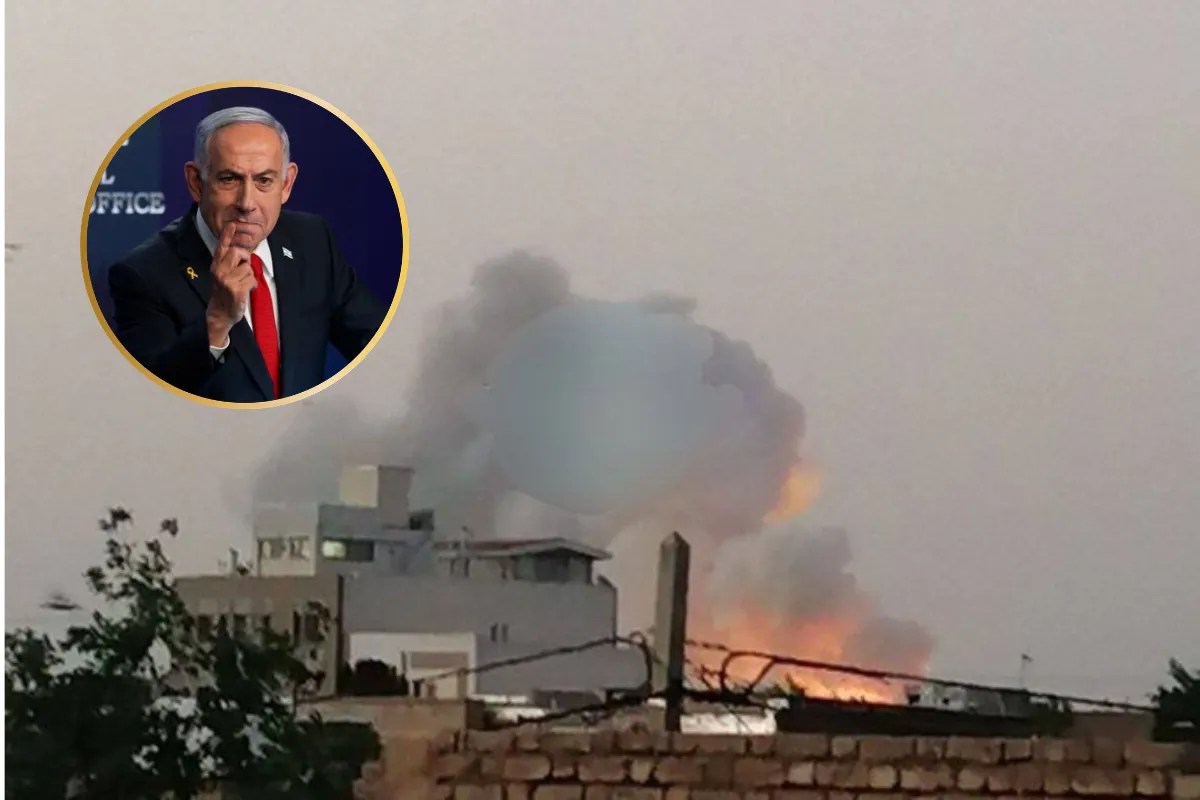
The Middle East just shifted again. Israel launched a direct missile strike against Iran, completely ignoring public and private warnings from US President Donald Trump. West Asia is now teetering on the edge of a full-scale region-wide war that Washington desperately tried to prevent.
Everyone wants to know why Benjamin Netanyahu chose this exact moment to defy the White House. Building on this theme, you can find more in: Why Visuals of the Philippines Earthquake Show We Are Asking the Wrong Questions About Safety.
The answer isn't simple. It lies in a volatile mix of survival, military strategy, and a fundamental disagreement over how to handle Tehran. Trump wanted restraint to avoid global economic chaos. Israel saw an existential threat that required immediate retaliation. By sending multiple missiles deep into Iranian territory, Israel made its position clear. It won't let Washington dictate its core security decisions.
The Night The Missiles Flew
Air defense systems activated across several Iranian provinces after explosions echoed near major military installations. This wasn't a minor drone skirmish. It was a coordinated strike utilizing high-precision ballistic missiles aimed directly at neutralizing specific strategic assets. Observers at Associated Press have shared their thoughts on this matter.
Initial reports from regional intelligence sources indicate the targets included air defense radars and military bases associated with Iran’s Islamic Revolutionary Guard Corps (IRGC). Israel used complex flight paths to bypass early warning networks. It worked. The strike proved that despite Iran's massive missile arsenal, its internal airspace remains highly vulnerable to penetration.
The timing tells the real story. Netanyahu ordered the attack just days after Trump explicitly warned both nations to de-escalate. Trump used his trademark mix of social media posts and direct diplomatic channels to signal that a wider war would hurt global energy markets and disrupt American foreign policy goals. Israel listened, then pulled the trigger anyway.
Why Trump Warnings Failed To Stop Netanyahu
American presidents usually carry immense leverage over Tel Aviv. The US provides billions in military aid, advanced weaponry, and vital diplomatic cover at the United Nations. Yet, Netanyahu chose to ignore Donald Trump warnings and attacked Iran anyway because the strategic calculus in Tel Aviv has fundamentally changed.
Israel views Iran’s nuclear ambitions and its regional proxies as threats that cannot be managed through diplomacy alone. For years, the Israeli security establishment watched Iran build a "ring of fire" around its borders via Hezbollah in Lebanon, the Houthis in Yemen, and various militias in Syria and Iraq.
Tel Aviv saw the recent escalation as a rare historical window to strike the head of the snake directly. They felt that waiting or showing restraint would only invite a more devastating future attack.
Internal politics also played a massive role. Netanyahu leads a fragile right-wing coalition. His political survival depends on projecting absolute strength. Accepting a US veto on a matter of national defense would have shattered his standing at home. He wagered that while Trump might be furious privately, the US would never actually abandon Israel if a major war broke out. It is a high-stakes gamble.
The Severe Failure Of Global Deterrence
This strike exposes a harsh reality about international politics today. Deterrence is broken. When the most powerful leader in the world publicly demands that an ally stand down, and that ally proceeds to launch a major missile offensive anyway, global power dynamics have shifted.
Washington's traditional leverage is losing its potency. The US is stretched thin by competing global priorities, from checking Chinese naval expansion in the Pacific to managing European security. Regional powers know this. They realize American attention is divided, making them far more willing to take unilateral actions that risk dragging the US into conflicts it wants to avoid.
The Nuclear Facilities Factor
Speculation immediately centered on Iran's nuclear infrastructure near Isfahan and Natanz. While initial assessments suggest these heavily fortified underground sites were not the primary targets of this specific wave, their proximity to the blast zones sent an unmistakable message.
Israel demonstrated it can reach these locations whenever it chooses. Netanyahu has long maintained that a nuclear-armed Iran is a line Israel will never allow Tehran to cross. By striking deep within Iran, Tel Aviv proved its operational capacity to execute the complex, long-range missions required to hit those highly protected facilities if the order is given.
How Tehran Might Respond Now
Iran faces a brutal dilemma. If they launch another massive retaliatory strike against Israeli cities, they risk triggering a total war that could destroy their economic infrastructure and involve the US military directly. If they do nothing, they look weak to their regional proxies and their own domestic population.
The Iranian leadership will likely rely on asymmetric warfare in the short term. Expect increased activity from proxy networks throughout the region, cyber attacks targeting critical infrastructure, and harassment of commercial shipping lanes in the Strait of Hormuz. This approach allows Tehran to project power and inflict economic costs without immediately triggering a devastating conventional war on its own soil.
What This Means For Global Energy Security
The immediate fallout extends far beyond the borders of the Middle East. The global economy is highly sensitive to instability in this region, particularly regarding oil production and transit routes.
The Strait of Hormuz remains the ultimate geopolitical choke point. Roughly a fifth of the world's total oil consumption passes through this narrow waterway daily. Any prolonged conflict that threatens shipping traffic will cause immediate spikes in global crude prices. This reality explains why the White House fought so hard behind the scenes to prevent this strike from happening. Higher energy costs feed inflation, disrupt supply chains, and create political headaches for leaders worldwide.
Tracking The Next Flashpoints
Watch the diplomatic maneuvers in Washington over the coming days. The Trump administration must balance its public anger over being ignored with its long-standing commitment to Israeli security. Look for quiet discussions regarding future weapons shipments and intelligence sharing as the US attempts to regain some measure of control over Israel's next moves.
Pay close attention to international shipping advisories in the Persian Gulf and Red Sea. Insurance rates for commercial vessels in these waters will likely skyrocket, serving as a reliable real-time indicator of how dangerous the maritime environment is becoming. Finally, monitor official statements coming out of Tehran for clues on whether they intend to absorb this blow or escalate further. The situation is incredibly fluid, and the room for miscalculation is dangerously small.