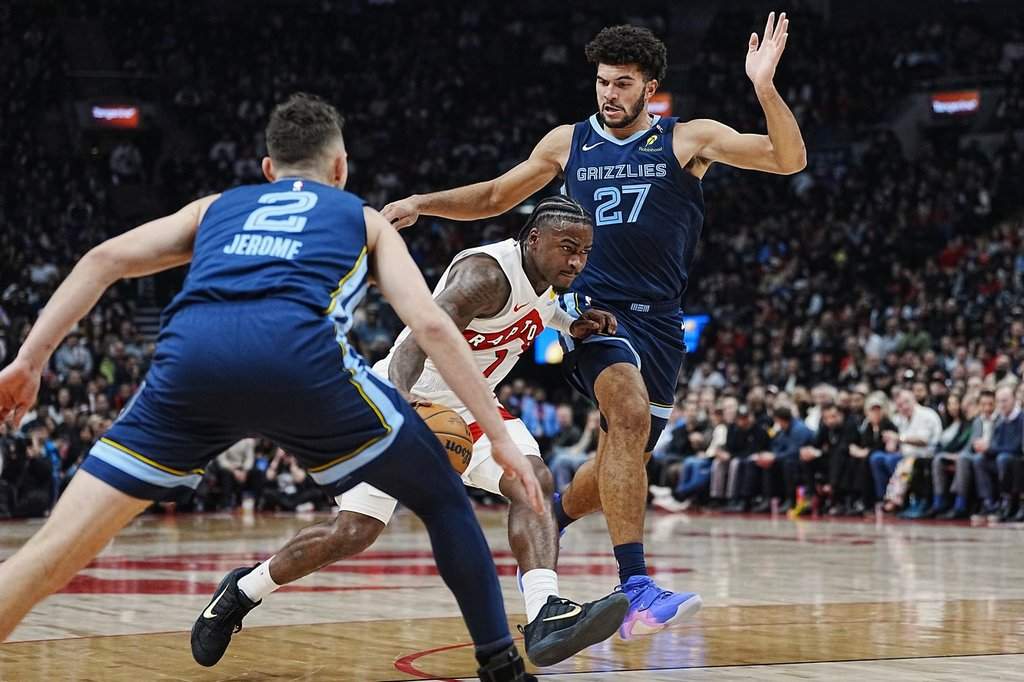
Walk into Scotiabank Arena right now and you won't recognize half the guys wearing Toronto jerseys. Ten games into the 2026-27 NBA season, the Raptors had already burned through six different starting lineups. Fast forward to late November, and Toronto sits at an ugly 6-11, having dropped seven of its last eight games, including a brutal 116-111 home loss to a Milwaukee Bucks squad that snapped a 13-game losing streak.
When a roster gets shredded this early, most fans panic about lottery odds or trade rumors. They miss the guy quietly keeping the offense from imploding every night. Jamal Shead isn't a flashy lottery pick, and he doesn't drop 30-point triple-doubles on national television. Yet with Scottie Barnes, Immanuel Quickley, Kawhi Leonard, and RJ Barrett all missing chunks of the opening month, the third-year point guard out of Houston has become the exact lifeline Toronto can't afford to lose. Also making headlines recently: Kawhi Leonard Sitting Out Another Week Is Actually the Smartest Play in Basketball.
The Injury Crisis That Forced Jamal Shead Into the Fire
Nobody draws up an offseason blueprint where your backup point guard carries primary playmaking duties before Thanksgiving. Toronto entered the 2026-27 campaign with real expectations after acquiring seven-time All-Star Kawhi Leonard, pairing him alongside Barnes, Quickley, and Barrett. That dream lasted two games before Leonard went down with an injury that sidelined him for weeks.
Then the dominoes fell fast. Quickley battled a hamstring issue, Barnes dealt with adductor and groin trouble, rookie Collin Murray-Boyles missed time, and Barrett pulled up with a hamstring strain. Suddenly, head coach Darko Rajakovic was duct-taping rotations together with rookies like Alijah Martin and Jamison Battle alongside second-year wing Ja'Kobe Walter. Additional details into this topic are detailed by FOX Sports.
Most second-round picks freeze when handed the keys to a broken offense. Shead did the opposite. After a sluggish first few outings where he struggled to find his shooting rhythm, the 6-foot-1 guard grabbed the responsibility with both hands.
Look at his numbers across the first 17 games of the 2026-27 season. Shead is averaging career highs across the board—7.9 points, 6.3 assists, 1.9 rebounds, and 1.0 steal in 23.4 minutes per night. More importantly, when Rajakovic has pushed his minutes past the 30-minute mark during the worst stretches of the injury crisis, Shead's floor general instincts have popped off the screen. Against Milwaukee in the NBA Cup earlier this month, he dished out 16 assists with just one turnover in a massive win. Days later, thrust into the starting lineup against Memphis, he poured in 20 points and 11 assists in 36 minutes.
"A lot of guys wait for those opportunities and are just ready to play," Shead said following that Memphis game. "Obviously, those are really important pieces for us and really important guys to our team. But when they're out, it's just next man up. It's a lot of opportunity, and we get excited for it."
That isn't empty locker-room talk. You can see the urgency in how he attacks every possession.
Why His Two-Man Game With Jakob Poeltl Actually Works
If you want to understand why Toronto's half-court offense hasn't completely flatlined without Quickley and Barnes, watch Shead and Jakob Poeltl operate in the pick-and-roll.
Toronto struggled badly with half-court and fourth-quarter execution last season, and those bad habits haven't magically vanished. Without elite isolation scorers on the floor, the Raptors have to manufacture clean looks through screening angles, timing, and trust. Shead and Poeltl have turned their two-man actions into Toronto's most reliable safety valve, largely because they obsess over the details away from the arena.
"We watch film," Shead explained when asked about their growing chemistry. "If he sees anything and he's watching film, brings it to me on the plane, hotel, whatever. I do the same to him. We've had a lot of great conversation during the game, just about where he's going to be, especially when I take off."
That off-court homework solves a massive problem for an undersized guard. At 6-foot-1 and 200 pounds, Shead can't simply shoot over seven-foot rim protectors in the paint. He relies on pace changes, low-center-of-gravity dribble penetration, and knowing the exact split second Poeltl is slipping a screen or sealing a defender. Shead specifically pointed to Poeltl's mobility, ball-handling, and basketball IQ as the reason those reads click so quickly.
When defenders blitz Shead to get the ball out of his hands, Poeltl catches in the short roll and punishes four-on-three mismatches. When bigs drop back into the paint, Shead snakes around the screen and hits cutters or kicks out to shooters like Ja'Kobe Walter. It's basic basketball executed at a high speed, and honestly, it's the only thing keeping Toronto competitive during stretches when their bench units face opposing starters.
What Critics Get Wrong About Jamal Shead's Offensive Ceiling
Spend five minutes on NBA social media or scan basic box scores, and you'll hear the same lazy take about Jamal Shead: he's a gritty defensive specialist who can't shoot well enough to run a real NBA offense.
Let's be fair about the flaws first. Shead's shooting efficiency isn't pretty right now. He's hitting 38.0% from the field and 30.5% from three-point range on 3.5 attempts per game this season, numbers that mirror his career marks of 38.5% overall and 32.0% from deep across 174 NBA appearances. Nobody is confusing him with Stephen Curry, and defenses will continue daring him to launch pull-up threes until he punishes them consistently.
Writing him off as a pure defense-first backup misses the bigger picture, though. Evaluating a pass-first point guard solely by his three-point percentage is like judging a catch-and-shoot wing by his post moves. Shead's value comes from tempo control and decision-making under pressure.
Consider his assist-to-turnover ratio. Averaging 6.3 assists against just 1.8 turnovers per game while playing alongside makeshift lineups—guys who barely practiced together before tip-off—is remarkable. Against the Bucks on November 23, Shead posted 11 points, six assists, and zero turnovers in 26 minutes. Two weeks earlier, he logged 34 minutes in Milwaukee with 16 dimes and a single cough-up.
Rajakovic sees that growth firsthand, even after Shead's bumpy opening week. "Like anybody else on our team, he's finding the rhythm, finding the role, finding the edge, how he can help the team," Rajakovic said. "I think the last couple of games, when he had a little bit more extended minutes and a bigger role on the team, he's really shining in those moments. He embraces the moment. He embraces the challenge that's ahead of him, and he's doing a great job."
There's also a sneaky scoring wrinkle developing inside the arc. Shead is converting 45.2% of his two-point attempts this season, using his sturdy frame to absorb contact and finish around bigger defenders. In a recent stretch against New York and Washington, he put up 19 points on 7-of-12 shooting in an overtime battle with the Knicks, followed days later by 15 points on another 7-of-12 night against the Wizards. When he gets downhill with purpose instead of settling for contested jumpers, defenders bounce off him.
Leadership Without the Superstar Ego
You don't usually hear a 24-year-old third-year guard call out his locker room after a tough November loss. Most young players stick to safe clichés, praise the effort, and duck into the training room.
Shead isn't built like that. After Toronto blew a winnable game against the struggling Bucks at Scotiabank Arena—a loss that dropped them to 10th in the Eastern Conference—Shead didn't sugarcoat the team's mental lapses.
"I think we have to grow up," Shead told reporters postgame. "Just being prepared and being ready to approach every game differently and not feed off of what we've been doing, whether it's a high or low."
That quote tells you everything about why Toronto's coaching staff trusts him in crunch time. Coming out of Kelvin Sampson's notoriously demanding system at the University of Houston, Shead arrived in the NBA already wired for accountability. He finished 12th in Sixth Man of the Year voting during the 2025-26 season because he brought relentless ball pressure and vocal leadership every single night, regardless of whether the Raptors were up 20 or down 20.
Right now, Toronto's biggest enemy isn't talent—it's emotional whiplash. When they beat a strong defensive squad like Detroit 105-102 on the road, they feel invincible. Three nights later, they come out flat in the third quarter against a 1-16 Bucks team and give away a game they desperately needed. Shead recognizes that a depleted roster has zero margin for coasting.
How to Watch Shead's Impact When Toronto Gets Healthy
Eventually, the Raptors' injury report will clear up. Barrett's hamstring will heal, Barnes and Quickley will reclaim their heavy usage rates, and Leonard will return to anchor the perimeter. When that happens, Shead's minutes will naturally dip back toward the 18-to-22-minute range off the bench.
Don't mistake a smaller box score for a smaller role. Every single rep Shead is logging right now against opposing starters is paying compound interest for April and May.
If you're tracking the Raptors over the next few weeks, pay attention to three specific things whenever Shead checks into the game:
- Second-unit pace: Watch how quickly Shead pushes the ball off defensive rebounds. Toronto's half-court offense still bogs down too often, so Shead's ability to generate early-clock layups and corner threes before defenses set their shell is pure gold.
- Lineup versatility alongside Quickley: When Quickley returns, Rajakovic has plenty of room to play both guards together. Quickley thrives as an off-ball movement shooter, while Shead can hound the opposing team's best perimeter scorer and initiate sets without draining Quickley's legs.
- Catch-and-shoot volume: Shead doesn't need to become a high-volume pull-up shooter, but if he can push his corner and above-the-break catch-and-shoot three-point percentage closer to 35%, defenses won't be able to ignore him when Barnes or Leonard draws a double team.
Toronto's 6-11 start hurts, and no role player can single-handedly replace four injured starters. Yet if the Raptors manage to claw their way out of this early Eastern Conference hole, look back at November—when Jamal Shead refused to let a battered roster fold.