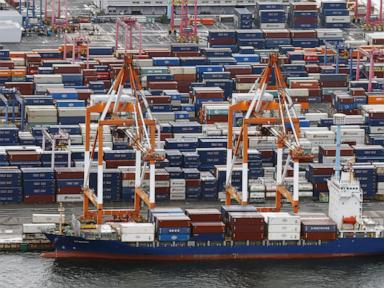
Japan just closed its fifth consecutive fiscal year in the red, a staggering run of trade deficits that signals the definitive collapse of the country’s post-war economic engine. While the immediate headlines point toward aggressive American tariffs and a cooling demand for internal combustion vehicles, the rot goes deeper than a single political cycle or a shift in automotive trends. Japan is trapped in a structural pincer movement. On one side, the nation faces soaring costs for imported energy and food; on the other, its crown jewel industries are losing their technological edge to faster, leaner competitors in China and the West. This isn't a temporary dip. It is a fundamental shift in how the world's fourth-largest economy functions.
The Myth of the Automotive Shield
For decades, the automotive sector acted as Japan’s primary defense against economic instability. When domestic consumption faltered, Toyota, Honda, and Nissan provided the surplus needed to keep the books balanced. That shield has shattered. The return of heavy-handed protectionism in the United States, specifically targeted at the heart of Japanese manufacturing, has turned a reliable revenue stream into a liability.
The strategy was simple for fifty years. Build high-quality cars at home, ship them to Los Angeles and New York, and collect the profit. But the latest rounds of tariffs have exposed a massive flaw in this logic. Japan stayed committed to hybrids and traditional engines while the rest of the world pivoted. By the time Japanese boardrooms realized that the shift toward electric vehicles was a permanent transformation of the global market rather than a passing fad, the door had already begun to close. Now, they are paying the price for that hesitation.
Japanese automakers are forced to choose between absorbing the cost of these new tariffs or raising prices in a market where they are already losing ground to domestic American players and aggressive Chinese exports. It is a no-win scenario. If they raise prices, they lose market share. If they absorb the cost, their margins vanish, leaving no capital for the massive research and development required to catch up in the software-driven vehicle race.
Energy Dependence and the Currency Trap
While cars are the visible problem, the invisible weight dragging Japan under is the energy bill. Japan imports nearly all its fuel. When the yen is weak—as it has been for a prolonged, painful stretch—the cost of keeping the lights on in Tokyo and the factories running in Nagoya skyrockets.
The traditional economic theory suggests a weak currency should be a boon for exporters. A cheaper yen makes Japanese goods more affordable overseas. In a healthy economy, this should trigger a surge in sales that offsets the higher cost of imports. That isn't happening.
The reason is the "hollowing out" of Japanese industry. To avoid previous trade tensions and lower labor costs, Japanese companies moved their production offshore years ago. When a Toyota is built in Kentucky or a Sony sensor is manufactured in Taiwan, the weak yen doesn't help the Japanese trade balance. The profits stay abroad or are eaten up by local costs, while the mother country continues to pay premium prices for imported liquefied natural gas and coal. The math no longer works. Japan has the disadvantages of a weak currency without the historical export benefits that used to make it tolerable.
The China Factor and the High Tech Retreat
We cannot discuss Japan’s trade failure without looking at the massive shadow cast by Beijing. For a long time, Japan viewed China as a giant assembly line—a place to outsource low-end manufacturing while keeping the high-value engineering in Osaka and Tokyo. That dynamic has flipped.
China is now out-competing Japan in the very categories Japan used to own. Consider the semiconductor industry or consumer electronics. Japan’s share of global high-tech exports has been in a slow-motion freefall for twenty years. Where Japan once defined the "state of the art," it now often finds itself as a secondary supplier of specialized components rather than the creator of the final, high-margin product.
This retreat from the top of the value chain means that even when global demand is high, Japan doesn't capture the lion's share of the wealth. It is fighting for the scraps of the supply chain. When you combine this loss of technological dominance with a shrinking, aging workforce that drives up domestic costs, you get a fiscal year that ends in a deficit. And then another. And then three more.
Structural Inertia and the Corporate Culture Problem
Inside the glass towers of Marunouchi, there is a palpable sense of denial. The leadership at many of Japan’s largest conglomerates remains dominated by a generation that remembers the 1980s as the natural order of things. They are waiting for a return to "normalcy" that isn't coming.
The "why" behind the trade deficit is as much about culture as it is about tariffs. The Japanese corporate structure prizes stability and incremental improvement over radical pivots. This served them well during the era of mechanical refinement. It is a disaster in the era of digital disruption. While American and Chinese firms iterate at a breakneck pace, Japanese firms are often stuck in endless cycles of consensus-building.
By the time a Japanese firm is ready to export a new solution, the market has often moved on. This delay is expensive. It shows up in the trade data as lost opportunities and diminished volumes. The tariffs are a convenient scapegoat for politicians, but the reality is that Japan is failing to produce products that the world is willing to pay a premium for regardless of the tax at the border.
The Hidden Cost of Food Security
Trade isn't just about microchips and sedans. It’s about survival. Japan’s food self-sufficiency rate is among the lowest in the developed world. As global supply chains become more volatile due to geopolitical tension and climate shifts, the cost of feeding the Japanese population has become a significant drain on the national treasury.
Every time there is a disruption in global grain markets or a spike in shipping costs, Japan’s trade deficit widens. The country is effectively exporting its wealth to buy the basic necessities of life. This is a precarious position for any nation, let alone one that is simultaneously losing its ability to generate massive export surpluses. The agricultural sector in Japan is protected and subsidized, but it is also aging and inefficient. It cannot fill the gap.
The Breakdown of the Export-Led Growth Model
For seventy years, the global community accepted a specific version of Japan: the tireless exporter. The world provided the raw materials, and Japan provided the finished, perfected goods. That era is over. The five-year streak of deficits isn't a fluke; it's a diagnostic report on a dying model.
The reliance on the US market has become a double-edged sword. As Washington moves toward a more isolationist, "America First" posture, Japan finds itself without a backup plan. The European market is heavily regulated and increasingly focused on its own green transitions, and the Southeast Asian markets, while growing, are becoming battlegrounds where Japan must fight increasingly sophisticated local and Chinese competitors.
A Nation at a Crossroads
There is no easy fix for a 5th straight year of trade deficits. Raising interest rates to strengthen the yen would crush the debt-laden domestic economy. Keeping rates low continues to devalue the currency and inflate the cost of imports. It is a classic liquidity trap, compounded by a trade environment that has turned hostile.
The path forward requires more than just negotiating better trade deals or waiting for the next US election. It requires a total reimagining of what Japan exports. The country can no longer rely on heavy industry and automotive dominance. It must find a way to monetize its intellectual property, its specialized high-end materials, and its unique cultural capital in a way that doesn't depend on shipping millions of tons of steel across the Pacific.
The current trajectory is unsustainable. A nation that cannot pay its way in the world eventually sees its standard of living erode. We are already seeing the cracks—rising prices in Japanese supermarkets, stagnant wages, and a declining influence on the global stage. The trade deficit is the fever; the underlying illness is a failure to adapt to a world that no longer values the 20th-century Japanese playbook.
Japan must stop looking at the trade deficit as a temporary hurdle to be cleared and start seeing it as a permanent boundary. The "export miracle" is dead. What comes next will determine if Japan remains a first-tier economic power or becomes a cautionary tale of how quickly a giant can fall when it refuses to change with the times. The automotive sector, once the pride of the nation, is now a symbol of this struggle. Every car that sits on a pier, priced out of the market by tariffs or outmoded by technology, is a reminder that the old ways are gone.
Action must be taken now to diversify the economy and reduce the crushing reliance on imported energy. If Japan does not pivot its industrial base toward the sectors of the future—biotech, advanced robotics, and carbon-neutral energy systems—the sixth and seventh years of trade deficits are already a mathematical certainty. The time for polite boardroom discussions and incremental shifts has passed. The numbers don't lie, and they are shouting that the current system is broken.