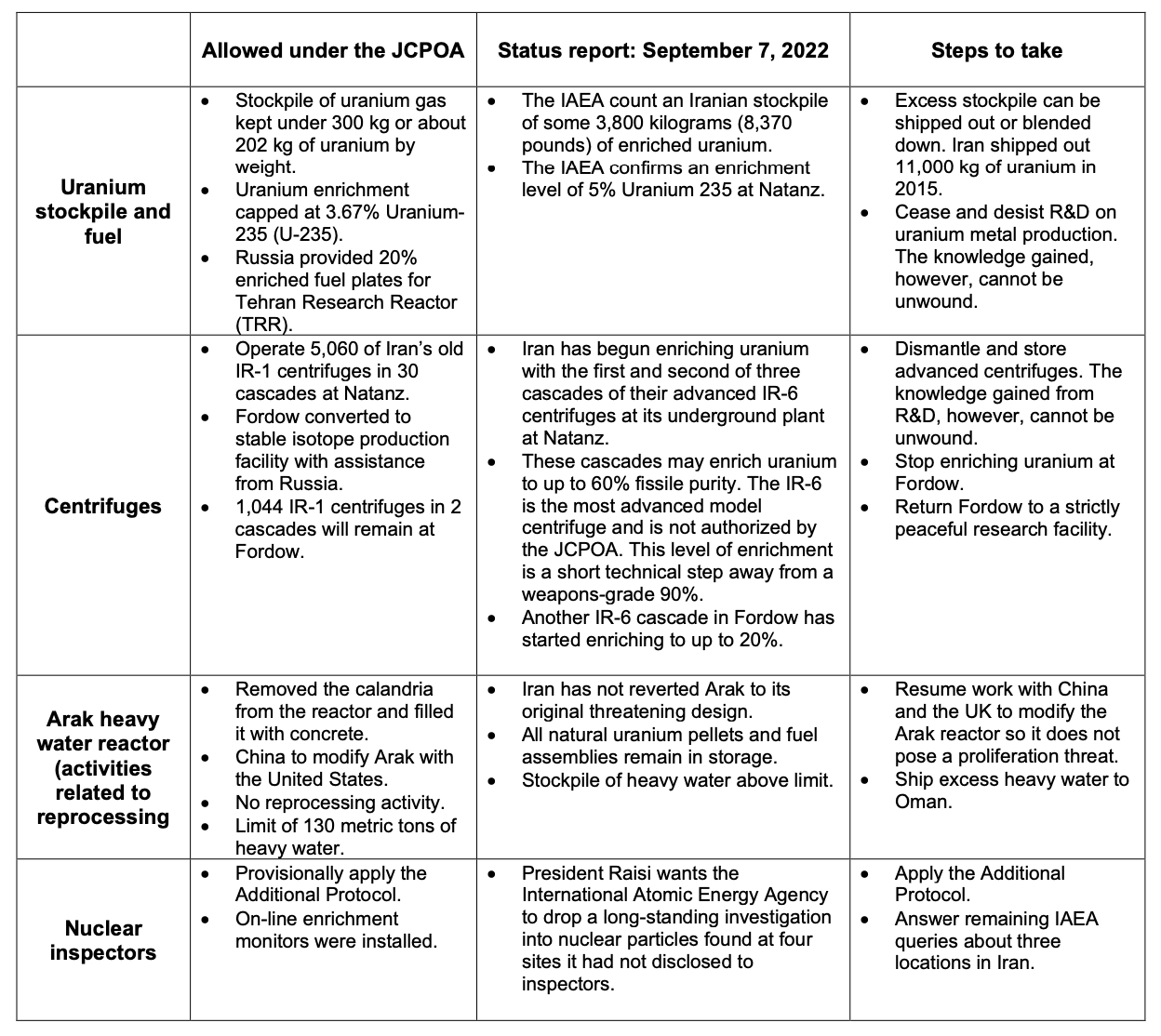
The media loves a binary. To the mainstream press, the Joint Comprehensive Plan of Action (JCPOA) was either a "historic diplomatic feat" or a "disastrous betrayal." Both narratives are lazy. Both ignore the cold, hard mechanics of nuclear proliferation and the brutal reality of geopolitical leverage.
Most analysts focus on the "breakout time"—the theoretical window Iran would need to produce enough weapons-grade uranium for a single bomb. They treat it like a stopwatch in a track meet. But if you have spent any time analyzing high-stakes procurement or dual-use technology transfers, you know the stopwatch is a distraction.
The JCPOA wasn't designed to stop Iran from getting a nuke. It was designed to manage the speed of their inevitable arrival at the threshold while preserving a global financial system that was starting to crack under the weight of unilateral sanctions.
The Enrichment Lie
The most common misconception is that the deal "blocked" the path to a bomb by limiting centrifuge counts and stockpiles.
Let’s look at the math. Under the JCPOA, Iran was limited to 5,060 older IR-1 centrifuges. That sounds like a big reduction from their previous 19,000. But the IR-1 is essentially a 1970s-era relic based on a stolen Dutch design. By forcing Iran to decommission these vibrating, inefficient machines, the deal inadvertently cleared the way for their R&D departments to focus on the IR-6 and IR-8 models.
These advanced machines are $10$ to $20$ times more efficient. In the world of industrial scaling, you don't care about the total number of machines; you care about the Separative Work Units (SWU).
$$SWU = V(N_p) \cdot P + V(N_t) \cdot T - V(N_f) \cdot F$$
By the time the "sunset clauses" kicked in, Iran would have possessed a lean, hyper-efficient enrichment infrastructure that could be housed in much smaller, harder-to-detect facilities. The deal didn't dismantle the program; it modernized it on the West's dime.
The Sanctions Paradox
Common wisdom says the "Maximum Pressure" campaign that followed the U.S. withdrawal was the only way to get a "better deal." This is a fundamental misunderstanding of how rogue economies function.
I have watched how black markets adapt. Sanctions are a tax, not a wall. When you push a nation like Iran out of the SWIFT banking system, you don't kill their trade; you force them to build a "shadow banking" architecture.
During the JCPOA years, Iran’s economy began to reintegrate. When the U.S. pulled the rug out, it didn't just hurt Tehran—it signaled to every mid-tier power on earth that the U.S. dollar is a political weapon with a hair-trigger.
If you want to know why the "BRICS+" movement is gaining steam today, look at the 2018 withdrawal. We didn't just lose eyes on the ground at the Natanz enrichment site; we lost the long-term structural dominance of the dollar as the only game in town. We traded a decade of nuclear monitoring for a permanent hole in the effectiveness of American financial statecraft.
Inspections Are Not Absolute
The "Anytime, Anywhere" inspection mantra was always a myth sold to the public to make the deal palatable.
Under the JCPOA, the International Atomic Energy Agency (IAEA) had to request access to undeclared sites. Iran then had 14 days to respond, followed by a potential 10-day deliberation period. That is 24 days.
If you are trying to hide a massive enrichment hall, 24 days is nothing. But if you are conducting "cold" experiments—modeling detonation sequences, testing explosive lenses, or machining small components—you can scrub a room and paint the walls in 48 hours.
The IAEA is composed of world-class scientists, but they are not intelligence officers. They verify what you show them. The deal's fatal flaw wasn't the presence of inspectors; it was the assumption that the "Possible Military Dimensions" (PMD) of Iran's past work could be neatly closed like a court case. History doesn't work that way. Knowledge cannot be un-learned.
The Better Deal That Wasn't
The Trump administration's "12 demands" were not a negotiation strategy; they were a demand for total capitulation. In the history of modern diplomacy, no regime has ever negotiated its own suicide while it still had cards to play.
The "better deal" proponents argued that by squeezing the oil exports to zero, the regime would collapse or crawl back to the table. They missed the nuance of Iranian internal politics. Pressure doesn't empower the moderates who want to trade with the West; it empowers the hardliners who say, "See? We told you the Americans can't be trusted."
The reality is that we are now in a "breakout time" measured in days, not months. The "Maximum Pressure" campaign accelerated the very outcome it was supposed to prevent because it removed the only thing Iran actually valued: their seat at the table of legitimate oil exporters.
The Pivot to Reality
Stop asking if the deal was "good" or "bad." That’s a child's question. Ask what the alternative looks like.
If you want zero enrichment in Iran, you have to go to war. There is no combination of sanctions or "strongly worded" resolutions that will make a sovereign nation delete thirty years of indigenous scientific progress.
The JCPOA was a cynical, transactional trade: We gave them back their own money in exchange for them slowing down their inevitable progress. It was a purchase of time.
The mistake wasn't the deal itself. The mistake was believing it was a solution. It was a tourniquet. And the problem with ripping off a tourniquet because you don't like the way it looks is that the patient tends to bleed out faster.
If you are waiting for a deal that ends Iran's nuclear ambitions forever, you are waiting for a fantasy. In the real world, we manage risks; we don't eliminate them. We are now living in the aftermath of a failed experiment in "perfection," and the result is a Middle East that is more volatile, less transparent, and closer to a nuclear arms race than it has been in forty years.
Stop looking for a better deal. Start looking for a way to survive the one we broke.


