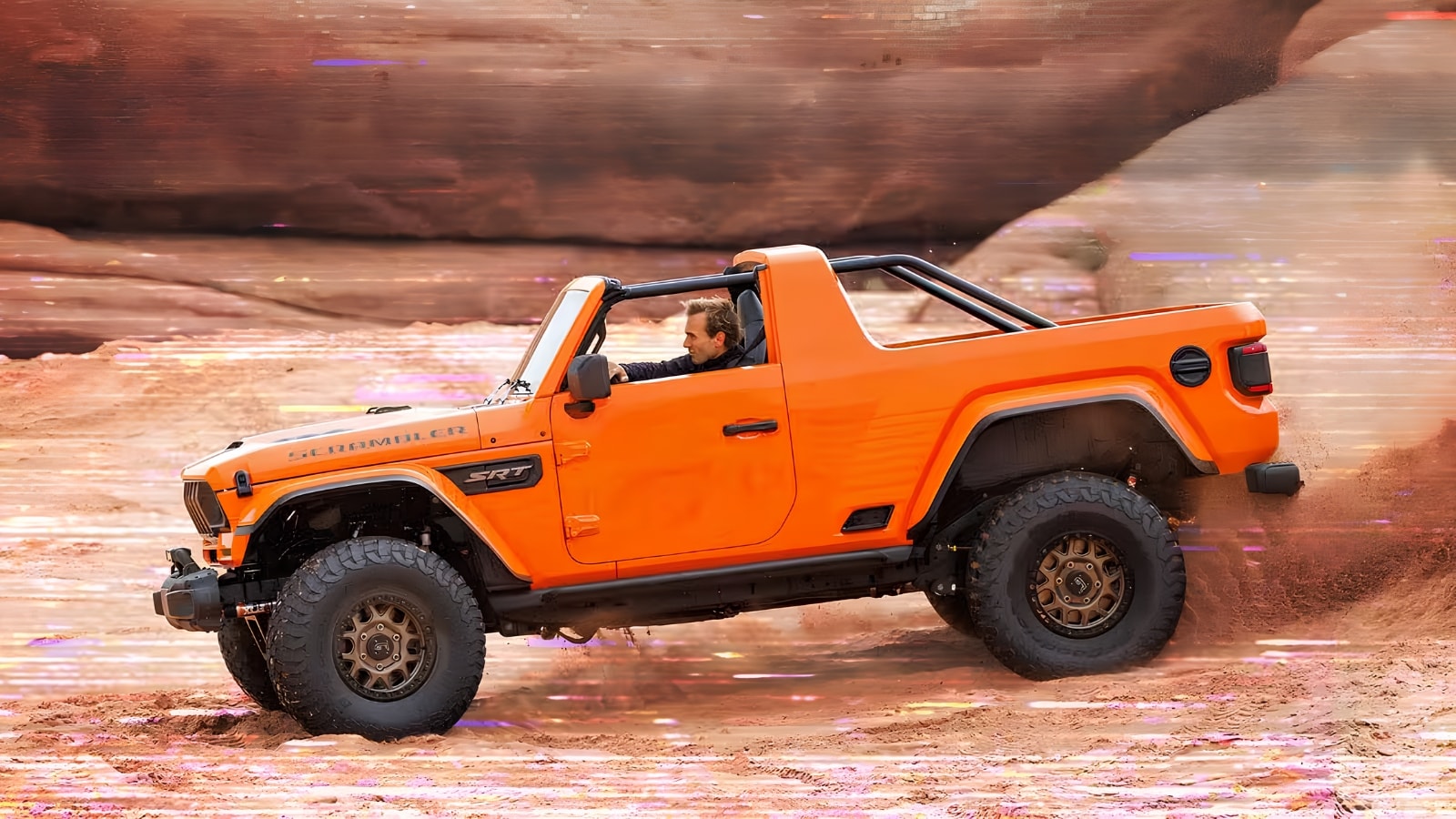
Jeep unveiled the Wrangler Scrambler SRT concept as a high-output, two-door off-road pickup equipped with a stubby cargo bed, SRT performance hardware, and rotating rear seats designed to face backward or pivot for open-air utility. On the surface, it looks like another nostalgic Easter Jeep Safari showpiece meant to generate social media buzz and remind enthusiasts of the 1981 CJ-8 Scrambler. Look closer at the engineering, packaging, and market pressures squeezing Stellantis, and a very different picture emerges. This concept is a calculated test balloon for high-margin niche customization, an answer to Gladiator cannibalization, and a clever workaround for modern safety regulations that usually kill playful seating layouts.
The Real Problem Jeep Is Trying to Solve
Automakers do not spend hundreds of thousands of dollars fabricating bespoke body tubs, custom driveline mounts, and articulated seat tracks just for nostalgia. Every concept vehicle rolled out by Jeep’s design and engineering teams serves as a live focus group. Right now, Jeep faces a very specific structural problem in its truck and SUV lineup.
The Jeep Gladiator solved the decades-long demand for a modern Wrangler pickup, yet its long wheelbase and four-door cab created compromises. On tight technical trails, the Gladiator’s departure angle and breakover geometry force drivers to drag the rear bumper and belly pan over obstacles that a two-door Wrangler clears effortlessly. At the same time, buyers who want V8 power and extreme trail agility have gravitated toward the Wrangler Rubicon 392, leaving a glaring gap for a short-wheelbase, high-horsepower utility rig.
Enter the Wrangler Scrambler SRT concept. By grafting a compact pickup bed onto a two-door-style proportions package and dropping SRT performance hardware under the hood, Jeep is testing whether buyers will pay six-figure-adjacent money for a boutique trail truck that prioritizes fun over commercial towing numbers.
Why the SRT Badge Matters Here
Slapping an SRT badge onto a Wrangler frame is never just about bragging rights. In Stellantis terminology, SRT signals upgraded cooling architectures, reinforced axles, revised suspension geometry, and braking systems capable of handling massive rotational mass.
When you pair a heavy-hitting V8 powertrain with large off-road tires and a short wheelbase, vehicle dynamics get tricky fast. Squat under hard acceleration increases dramatically, and nose-dive under braking can unsettle the rear end on loose gravel. Developing an SRT-tuned Wrangler pickup forces chassis engineers to validate spring rates, shock valving, and frame stiffness for a weight distribution that differs wildly from both the standard Wrangler and the stretched Gladiator. Even if this exact trim never reaches dealership showrooms, the suspension and cooling data collected from the build feeds directly into future high-output specialty models.
How Those Turning Rear Seats Actually Work
The headline-grabbing feature of the Wrangler Scrambler SRT concept is the rotating rear seating arrangement. Most press blurbs treat it like a party trick for tailgating. In reality, packaging swiveling seats inside a narrow body-on-frame off-roader is an engineering headache.
Standard Wrangler rear seats bolt directly into fixed floor pan reinforcements to meet strict Federal Motor Vehicle Safety Standards for crash loads and seatbelt anchorage. Once you introduce a swivel mechanism, the entire load path changes. The seat base must house a heavy-duty locking turntable capable of withstanding massive G-forces during a frontal or rear impact without shearing off its tracks.
The Seatbelt and Airbag Catch
Here is the part most automotive coverage glosses over. You cannot legally drive down a public highway in the United States with passengers seated sideways or backward unless the restraint system is explicitly certified for those orientations.
In a conventional forward-facing seat, the B-pillar or C-pillar anchors the upper shoulder belt. When a seat turns toward the open sides or faces the rear cargo bed, fixed pillar belts become useless. To make turning seats viable even in a concept—and potentially in a low-volume production variant—engineers have to integrate the entire three-point seatbelt assembly directly into the seat frame itself. That means reinforcing the backrest structure so it doesn't fold like a lawn chair under deceleration, adding substantial weight and cost per seat.
For stationary use at a campsite, trailhead, or beach, the payoff is obvious. Owners can pivot the seats outward to take off muddy boots or rotate them toward the pickup bed to create an open-air lounge without hauling folding camp chairs. Whether federal regulators and corporate liability lawyers would ever sign off on that mechanism for mass production remains the biggest hurdle standing between the concept floor and a window sticker.
The Ghost of the 1981 CJ-8 Scrambler
To understand why Jeep keeps returning to the Scrambler nameplate, you have to look at how the original truck succeeded—and why it died. Introduced in 1981, the CJ-8 Scrambler took the standard CJ-7 and stretched the wheelbase by 10 inches to 103.4 inches, creating a small steel pickup bed behind a removable half-cab hardtop.
It was light, simple, and endlessly adaptable. Ranchers, surfers, and off-roaders loved it, and President Ronald Reagan famously used one at his California ranch. Yet Jeep sold fewer than 28,000 units over its five-year run before replacing the CJ line with the YJ Wrangler in 1986. Why? Because mid-1980s buyers wanted compact trucks that could haul full sheets of plywood and carry four adults comfortably—tasks better suited to the Jeep Comanche or competing Japanese pickups.
Modern buyers treat off-roaders completely differently. Nobody buys a two-door Wrangler or a specialty SRT concept to haul drywall from a lumberyard. Today’s Wrangler buyer treats the vehicle as a recreational lifestyle platform and a canvas for factory-backed accessories. A short bed isn't a flaw when your cargo is a pair of mountain bikes, a hard-sided cooler, recovery gear, and a rooftop tent rack.
What the Gladiator Couldn't Do
When Jeep launched the JT Gladiator, product planners made a deliberate bet on utility. They gave it a five-foot steel bed, class-leading midsize towing ratings, and full four-door passenger room. That formula attracted thousands of buyers who needed one vehicle to pull a boat on Saturday and handle the school run on Monday.
That versatility came at a steep physical cost. The Gladiator rides on a 137.3-inch wheelbase—nearly 19 inches longer than a four-door Wrangler Unlimited and over 40 inches longer than a two-door Wrangler. On tight forest trails in Moab or the Rubicon Trail, that extra length turns sharp switchbacks into three-point turns and exposes the rear overhang to rock strikes.
The Wrangler Scrambler SRT concept flips the Gladiator’s priority list upside down. By keeping the overall footprint closer to a standard Wrangler and sacrificing cab length for a compact cargo box, Jeep recovers the nimble breakover and departure angles that hardcore trail drivers refuse to give up. It proves that there is still an appetite for a pure-play trail pickup that doesn't try to moonlight as a commercial workhorse.
The Economics of Factory Customization
Stellantis has spent the last several years perfecting a high-margin playbook: build a core off-road platform, then layer on limited-run, high-dollar specialty editions and factory-engineered Mopar parts. Every time Jeep rolls out a concept like the Wrangler Scrambler SRT, the Jeep Performance Parts (JPP) division watches public reaction like a hawk.
Consider how past concepts have quietly transitioned into catalog hardware:
- Half-doors and tube doors shown on Moab concepts regularly become factory order-code options within two model years.
- Beadlock-capable wheels, steel stubby bumpers, and high-clearance fender flares debut on show trucks before landing in dealer parts departments.
- Lift kits calibrated for specific engine weights get validated on one-off builds long before buyers see them in a brochure.
Even if Jeep never builds a single turnkey Scrambler SRT on the Toledo assembly line, pieces of this concept are almost certainly destined for the JPP catalog. A bed-rack modular system, heavy-duty SRT cooling upgrades, or specialized cargo tie-down rails cost far less to certify as aftermarket accessories than an entire vehicle platform.
The Hard Truths About Production Reality
Enthusiasts inevitably demand that Jeep "build it exactly like this" every time a wild concept hits the web. Veterans of the auto industry know better. Between a hand-built show vehicle and a federally certified production model lies a gauntlet of regulatory and financial reality checks.
First, there is the emissions and fuel economy math. High-displacement V8 engines face tightening corporate average fuel economy standards and state-level emissions mandates. While Jeep has found ways to keep V8 models alive in limited, high-priced allocations, expanding V8 availability to another low-volume body style requires clear profit margins to offset regulatory compliance costs.
Second, crash testing a unique body tub is brutally expensive. Unlike a simple trim package that shares its stamped steel floor pan and rear quarter panels with hundreds of thousands of standard Wranglers, a two-door pickup bed requires distinct rear body stampings, unique fuel tank routing, and separate rear-impact crash validation. Amortizing millions of dollars in stamping dies across a niche run of 3,000 or 5,000 trucks would push the retail price well past what most casual buyers are willing to pay.
Third, rollover protection complicates open-air rear seating. Every modern Wrangler relies on a hydroformed steel sport bar cage to protect occupants during a rollover. In a standard four-door Wrangler, rear passengers sit well forward of the rear axle, tucked beneath the main overhead crossbars. Placing turning rear seats closer to the rear edge of the cab forces engineers to extend structural cage protection backward without ruining the open pickup aesthetic that makes the Scrambler look right in the first place.
What Competitors Are Watching
Jeep does not operate in a vacuum. Ford’s Bronco lineup—especially the Bronco Raptor and two-door heritage trims—has forced Jeep to defend turf it owned unchallenged for decades. Meanwhile, Toyota’s latest Tacoma TRD Pro and Trailhunter trims have captured buyers looking for factory-built overland pickups with integrated bed accessories and specialized suspension tuning.
By showcasing the Wrangler Scrambler SRT concept, Jeep reminds both rivals and loyalists of a structural advantage nobody else in the industry can easily copy. Neither the Ford Bronco nor the Toyota Tacoma can shed its doors, fold down its windshield, and transform its cabin into an open-air trail lounge while keeping solid front and rear axles underneath.
When Jeep combines removable body panels with a compact pickup bed and SRT firepower, it stakes out territory where no unibody crossover or independent-front-suspension pickup can follow. That visual reminder alone is worth the cost of building the concept, even before a single part goes on sale.
How to Read Jeep's Next Move
Watch the details, not the press release hype. If you want to know whether elements of the Wrangler Scrambler SRT concept are heading toward real production, pay close attention to three telltale signs over the next twelve months.
Look at the seat track hardware. If the swiveling mechanism uses overly complex, custom-machined billet aluminum latches with no visible interlock sensors, it is pure show-car theater. If you spot stamped steel brackets, standardized wiring harnesses for occupancy sensors, and integrated seatbelt towers, engineers have already done preliminary feasibility work for production compliance.
Check the bed construction. Show trucks often use hand-laid fiberglass or carbon-fiber bed panels because stamping steel dies for one vehicle makes zero financial sense. However, if the bed floor shares stamped rib patterns with the existing Gladiator bed and bolts cleanly onto standard Wrangler frame mounts, Jeep has already figured out how to build it cheaply using existing tooling.
Finally, track the Mopar and Jeep Performance Parts trademark filings. Whenever a concept feature—like a modular bed divider, an SRT-spec cold-air intake, or a half-cab soft top—is slated for retail release, new part numbers and accessory names quietly appear in dealer ordering systems months before any official announcement. Until those part numbers surface, treat the Wrangler Scrambler SRT concept for what it truly is: a rolling engineering laboratory disguised as a throwback toy, built to test just how far Jeep can push the boundaries of open-air performance before the rulebook says stop.