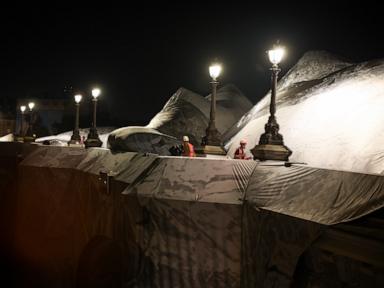
Parisian commutes just hit a massive, prehistoric wall. This week, drivers and walkers looking across the Seine noticed something bizarre happening to the Pont Neuf. The city’s oldest bridge, a 17th-century stone icon that survived revolutions and empires, started disappearing beneath a massive, jagged ridge of gray rock.
It looks like a prehistoric cliff side is erupting straight out of the river bed. Honestly, it’s wild to look at.
This isn't a freak geological event. It’s La Caverne du Pont Neuf, a massive new temporary public art installation by the famous French street artist JR. Overnight, his crew inflated a giant artificial cave directly over the bridge arches. They turned a heavily trafficked thoroughfare into a 120-meter-long, 18-meter-tall illusion that breaks the skyline.
Most news outlets are just calling this a big balloon trick. They focus on the crazy size. But they miss why this actually matters for the city, the engineering secrets keeping it upright, and the deep, slightly uncomfortable message JR is trying to force down our throats.
The Insane Engineering Behind the Fabric Cliff
Let’s talk about how you build a six-story mountain on top of a 400-year-old stone bridge without crushing it. You don't use real stone. You use air.
The structure weighs roughly five tons, which is incredibly light for its size. It covers 2,400 square meters of floor space. The whole thing relies on 80 technical fabric arches holding 20,000 cubic meters of pressurized air. It doesn't dig into the historic stone masonry at all.
I know what you're thinking. What happens if a storm hits or someone cuts the power?
JR’s team actually spent weeks inside an airplane hangar at Orly airport simulating power failures. They needed to see how the fabric collapses. If the blowers fail, the structure deflates like a slowly exhaled breath. It sinks gently instead of crashing down.
The exterior skin is textured canvas meant to look identical to the ancient limestone quarries that supplied the original building blocks for Paris. It took 25 artisans in a tiny village in Brittany weeks to hand-stitch those panels together.
Moving Past Christos Golden Ghost
This isn't the first time the Pont Neuf has been swallowed by art. Back in 1985, the legendary artist duo Christo and Jeanne-Claude wrapped the entire bridge in shimmering woven polyamide fabric. That project became legendary.
JR isn't hiding from that legacy. The entrance to his cave actually sits right by the newly named Place du Pont-Neuf-Christo-et-Jeanne-Claude. He openly admits that following in their footsteps is intimidating.
But JR is doing something completely different here. Christo wrapped the bridge to highlight its architectural shape. JR is burying it to create an environment.
Instead of walking over the Seine, you walk through a dark, winding tunnel. There is zero daylight inside. You literally lose track of time. Then, you pop out into the bright Parisian sun on the other side. JR calls it moving from darkness into lucidity.
The Real Message is a Trap for Your Smartphone
JR didn't design this massive cave just for pretty Instagram photos. It’s actually a direct trap for the people taking them.
The installation is an explicit nod to Plato’s Allegory of the Cave. You know the story. Prisoners are chained inside a cave, watching shadows on the wall, thinking those shadows are reality.
JR thinks we are doing the exact same thing today.
"What are our caves today? Our phones," JR recently pointed out. We sit there staring at social media algorithms, thinking that curated feed is the real world.
By forcing you into a pitch-black tunnel where your phone gets no service, he’s forcing you to disconnect. He wants you to stop rushing, stop scrolling, and actually look at the physical world.
To make the environment feel even weirder, the interior features a low, rumbling audio track created by Thomas Bangalter, the co-founder of Daft Punk. It’s a deep, mineral hum that vibrates through your chest as you walk.
If you want to lean into the tech side, Snap Inc. helped develop an optional augmented reality experience. You can view the cave through Snap’s AR glasses to see digital layers of history peeled back. But honestly, the raw, low-tech darkness of the tunnel is the real draw here.
How to Experience the Cave Without the Crowds
The bridge is completely closed to cars and bikes right now. From June 6 to June 28, 2026, it opens to the public for free, 24 hours a day, seven days a week. Pedestrians can only walk through in one direction. You enter from the left bank at Place du Pont-Neuf and exit on the right bank near La Samaritaine.
If you hate massive crowds, don't show up at noon on a weekend. Go at 3:00 AM on a Tuesday. The hum of Bangalter's soundtrack echoing over an empty Seine is going to feel incredible.
For the best views from the outside, skip the immediate riverbank right next to the structure. Walk over to the Pont des Arts instead. It gives you the perfect side-profile angle to see the fake mountain breaking the flat Paris landscape. You can also catch great angles from the upper quays near the famous bouquinistes bookstores, or from the water on a river shuttle.
Once June 28 hits, the blowers turn off. The technical fabric gets packed up to be recycled or reused for future projects. The cave will vanish. The old stone bridge will reappear exactly as it has for four centuries, completely unscarred.
Make sure you catch it before it disappears. Head down to the left bank entrance, leave your phone in your pocket, and walk through the dark.
French artist JR transforms Paris bridge into massive cave This short news feature offers an early look at the initial design models and construction setup showing how JR planned to take over the historic bridge.