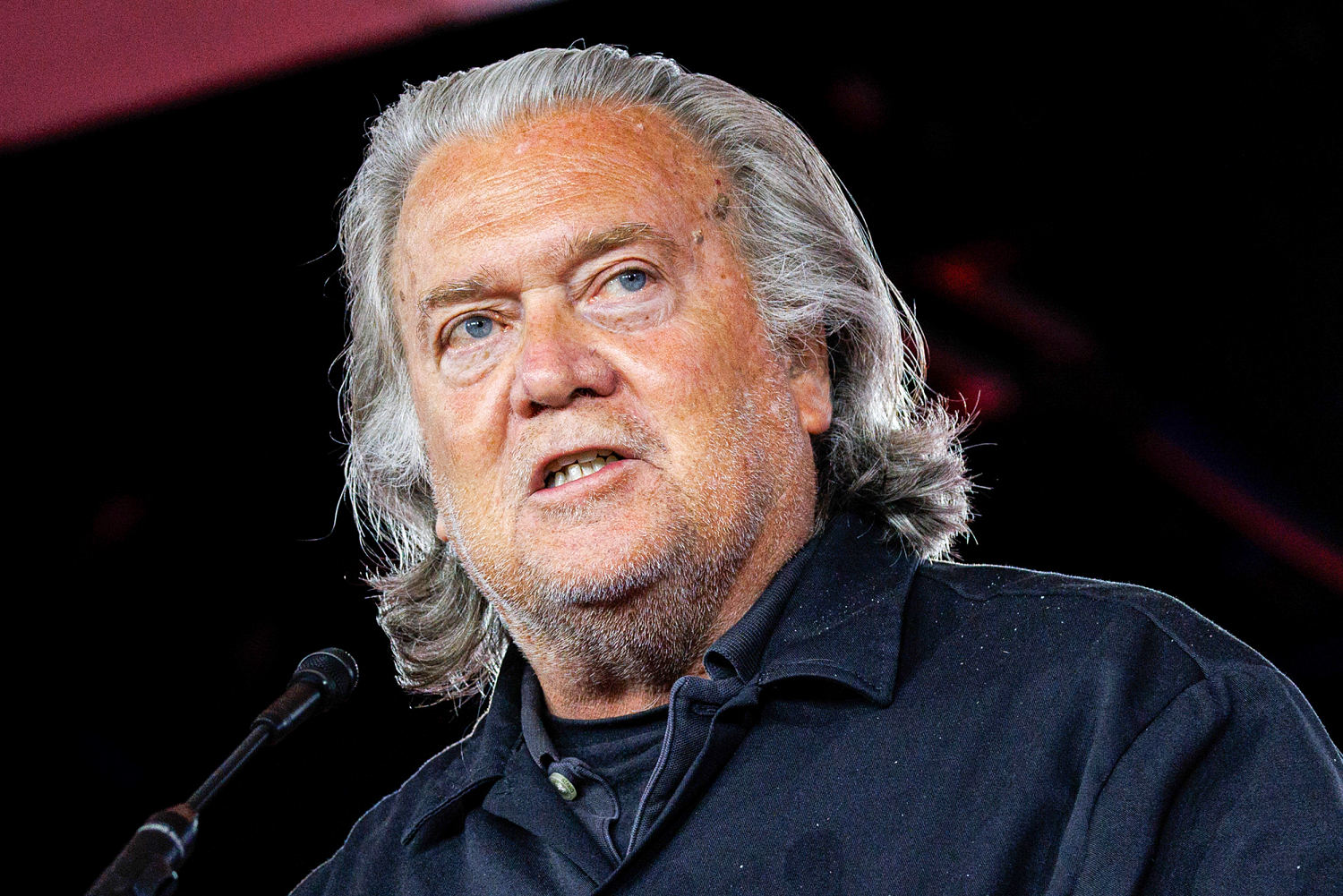
The U.S. Department of Justice has formally moved to vacate the contempt of Congress conviction against former White House strategist Steve Bannon, a sweeping reversal that effectively dismantles one of the highest-profile criminal prosecutions tied to the House investigation into the January 6 Capitol attack. By filing a motion to dismiss the underlying indictment and abandon its defense of the guilty verdict, federal prosecutors are signaling a complete institutional retreat from enforcing legislative subpoenas issued by the now-dissolved House Select Committee. The move wipes away Bannon's criminal record in the case, nullifies the legal precedent established during his trial, and leaves congressional oversight power hanging in legal limbo.
For veteran court watchers in Washington, this filing is not merely an administrative cleanup. It is a seismic shift in how the executive branch views its obligation to defend the legislative branch's investigative authority. Bannon had already served his four-month prison sentence at FCI Danbury in Connecticut in 2024 after exhausting his initial appeals, meaning this legal maneuver is entirely about erasing the stain of the felony-adjacent misdemeanor conviction and rewriting the constitutional boundaries of executive privilege.
The Anatomy of a Reversal
To understand the weight of the Justice Department's motion, you have to look at the mechanics of federal appellate practice. Usually, once the government secures a conviction at trial—and successfully defends that conviction before a three-judge panel of the D.C. Circuit Court of Appeals—it fights tooth and nail to preserve the win. Institutional momentum at Main Justice is notoriously difficult to reverse. Career prosecutors spend years building these records specifically to prevent future administrations from easily undoing them.
Yet here we are. By filing a motion to dismiss under Rule 48(a) of the Federal Rules of Criminal Procedure, the Department of Justice is asking the courts to act as though the prosecution never happened. Under Rule 48(a), the government may, with leave of court, dismiss an indictment, information, or complaint. When a defendant has already been convicted and sentenced, invoking this rule requires unwinding the entire judicial process—vacating the jury's verdict, setting aside the sentence, and expunging the legal rationale that sustained the case through multiple levels of judicial review.
The paper trail behind Bannon's defiance dates back to September 2021. The House Select Committee to Investigate the January 6th Attack on the United States Capitol issued a subpoena demanding Bannon produce documents and sit for a deposition regarding his communications with former President Donald Trump in the days leading up to the riot. Bannon refused. He claimed that Trump had invoked executive privilege, shielding him from testifying.
The legal problem for Bannon at the time was twofold. First, Bannon was a private citizen in late 2020 and early 2021, having been fired from the White House more than three years earlier in August 2017. Second, the sitting president, Joe Biden, had explicitly declined to assert executive privilege over the testimony and records sought by the committee. Under existing precedent, a former president's assertion of privilege carries vastly diminished weight when the incumbent president determines that disclosure serves the national interest.
How the Original Prosecution Built Its Case
When the House voted to hold Bannon in contempt in October 2021, the referral landed on the desk of then-Attorney General Merrick Garland. For months, critics accused Garland of dragging his feet. Eventually, a federal grand jury indicted Bannon on two counts of contempt of Congress under 2 U.S.C. § 192—one count for refusing to appear for a deposition, and a second count for refusing to produce documents.
The trial itself, presided over by U.S. District Judge Carl Nichols in July 2022, was a masterclass in narrow statutory interpretation. Judge Nichols relied on a 1961 D.C. Circuit precedent known as Licavoli v. United States. Under Licavoli, the word "willfully" in the contempt statute does not require proof that the defendant knew they were breaking the law or acted with evil intent. It simply requires proof that the refusal to comply with a congressional subpoena was deliberate and intentional, rather than the result of accident or mistake.
That ruling gutted Bannon’s primary defense. His legal team, led by David Schoen and Evan Corcoran, wanted to argue that Bannon relied in good faith on the advice of his lawyers, who told him that executive privilege barred him from cooperating until Trump and the committee resolved their dispute. Because of Licavoli, Judge Nichols barred Bannon from presenting an advice-of-counsel defense to the jury. Without that defense, the trial lasted less than a week, and the jury deliberated for less than three hours before returning guilty verdicts on both counts.
The Constitutional Friction
Behind the dry procedural arguments lay a ferocious constitutional battle over the separation of powers. For decades, the Justice Department's own Office of Legal Counsel (OLC) had issued memos stating that senior presidential advisors enjoy absolute testimonial immunity from compelled congressional testimony. The OLC argued that forcing a president's closest aides to testify before hostile lawmakers would chill candid advice inside the Oval Office.
Bannon's lawyers tried to stretch that OLC doctrine to cover an outside advisor who had left government years prior. During his appeal to the D.C. Circuit, Bannon's team argued that the OLC opinions created a fog of legal uncertainty, making it fundamentally unfair to criminally prosecute someone for obeying a former president's directive. In May 2024, a unanimous three-judge panel of the D.C. Circuit rejected that argument, upholding Licavoli and affirming Bannon's conviction. That loss forced Bannon to report to federal prison in July 2024 while his petition to the Supreme Court remained pending.
Why the Justice Department Changed Course
The decision to abandon the defense of Bannon’s conviction stems from a fundamental shift in legal philosophy at the top of the Justice Department following the change in administration. When leadership at Main Justice changes, so too does the department's interpretation of the unitary executive theory—the constitutional doctrine holding that the president possesses sole, sweeping authority over the executive branch.
From the perspective of the current leadership, prosecuting a former president's advisor for honoring an assertion of executive privilege—even a disputed one—crosses a dangerous constitutional line. If Congress can use the criminal code to force a former president's confidants to testify whenever a new president from the opposing party waives privilege, then executive privilege effectively ceases to exist beyond a single four-year term. No advisor would ever speak freely to a president if they knew that a future election could strip away their confidentiality and land them in federal prison.
Furthermore, the Justice Department's filing points to long-standing institutional concerns about the validity of the January 6 Select Committee's structure. Throughout the litigation, Bannon and fellow Trump advisor Peter Navarro—who was also convicted of contempt of Congress and served four months in prison—argued that the committee violated House rules. Specifically, they contended that then-House Speaker Nancy Pelosi failed to appoint a ranking minority member or consult with the minority leader as required by the committee's authorizing resolution, rendering its subpoenas legally defective from the start.
While lower courts dismissed those procedural objections as non-justiciable internal House matters, the new Justice Department leadership has adopted a far more skeptical view of the committee's legitimacy. By moving to vacate the conviction, the department is effectively validating the argument that the prosecution was tainted by political overreach and flawed constitutional premises.
The Legal Mechanics of Post-Sentence Dismissal
Vacating a conviction after the sentence has already been served is rare, but it is far from unprecedented in federal jurisprudence. The case immediately enters the realm of mootness and vacatur, governed by the Supreme Court's 1950 decision in United States v. Munsingwear, Inc.
Under the Munsingwear doctrine, when a civil or criminal case becomes moot while pending appellate review—through no fault of the party seeking review—the established practice is to vacate the lower court's judgment. The logic is simple. A party should not be bound by the legal consequences of an adverse ruling that they were prevented from challenging at the highest court due to intervening events.
In Bannon's situation, his petition for a writ of certiorari was still active before the Supreme Court when the Justice Department decided to drop the case. Because the government is now refusing to defend the D.C. Circuit's ruling, there is no longer an active case or controversy between adverse parties, as required by Article III of the Constitution. Without a prosecutor willing to argue that the conviction should stand, the Supreme Court cannot adjudicate the merits of Bannon's appeal.
What Happens Next in Court
The procedural path forward involves a tightly choreographed sequence of filings between the Supreme Court, the D.C. Circuit, and Judge Nichols's courtroom:
- The Supreme Court Remand: The Solicitor General notifies the Supreme Court that the United States no longer opposes Bannon's petition and requests that the justices grant the petition, vacate the D.C. Circuit's judgment, and remand the case with instructions to dismiss.
- District Court Approval: Once the case returns to Judge Nichols, prosecutors formally submit their Rule 48(a) motion to dismiss the indictment.
- Judicial Discretion: Under federal rules, a judge must grant "leave of court" for a dismissal. While judges technically have the authority to deny a Rule 48(a) motion if it is clearly contrary to the public interest, appellate courts have repeatedly ruled that judges cannot force the executive branch to continue a prosecution it wishes to abandon.
This exact playbook was used during the first Trump administration when the Justice Department moved to dismiss the prosecution of former National Security Advisor Michael Flynn after he had already pleaded guilty. Even though U.S. District Judge Emmet Sullivan appointed an outside lawyer to argue against the dismissal, the legal reality remained unchanged: the executive branch holds the exclusive constitutional power to decide who gets prosecuted.
The Collateral Damage to Congressional Oversight
The practical fallout of erasing Steve Bannon’s conviction extends far beyond one political operative's criminal record. It strikes at the heart of how Congress gathers information, conducts investigations, and holds the executive branch accountable.
For over a century, Congress has relied on three mechanisms to enforce its subpoenas:
- Inherent Contempt: Congress sends its own Sergeant at Arms to arrest a recalcitrant witness and detain them in the Capitol until they comply. This power has not been used since 1935 and is widely viewed as logistically unworkable in the modern era.
- Civil Enforcement: A congressional committee sues the witness in federal court, asking a judge to order compliance. This process is glacially slow. Litigation routinely drags on for two to three years, easily outlasting the two-year lifespan of a Congress, at which point the subpoena expires and the case becomes moot.
- Criminal Contempt: Congress refers the witness to the Justice Department for prosecution under 2 U.S.C. § 192, carrying a penalty of one to twelve months in prison and a fine of up to $1,000.
Criminal contempt was supposed to be the teeth behind congressional oversight—the one tool fast enough and severe enough to force compliance within a single legislative term. Before the prosecutions of Bannon and Navarro, the Justice Department had not criminally prosecuted an executive branch official for contempt of Congress since Rita Lavelle, an Environmental Protection Agency official, in 1983. Even then, Lavelle was acquitted at trial.
The Bannon and Navarro convictions briefly revived criminal contempt as a credible deterrent. They sent a stark message to Washington insiders that ignoring a congressional subpoena carried the very real risk of federal prison time. Now, by vacating Bannon's conviction, the Justice Department has shattered that deterrence.
Any future witness—whether a former White House official, a corporate executive, or a political strategist—now has a clear blueprint for defying Congress. If you belong to the same political faction as the incoming administration, or if you can simply stall the appellate process until the political winds shift in Washington, you can run out the clock. Even if you lose at trial, a friendly Justice Department can step in years later and wipe the slate clean.
A Gray Area in American Law
Critics of the Justice Department's move view it as a brazen politicization of the rule of law, arguing that it places political allies of the president above the reach of criminal statutes. They point out that millions of ordinary Americans convicted of federal offenses never get the luxury of having the government reverse course on their cases simply because a new administration takes office. To these observers, vacating a jury verdict that was already affirmed on appeal erodes public trust in the equal application of justice.
Yet the counter-argument exposes a genuine structural flaw in the American constitutional system. Relying on the Justice Department—an executive branch agency controlled by the president—to prosecute individuals for refusing to hand over information about the president has always been an inherent conflict of interest. When a dispute erupts between Congress and the White House over executive privilege, asking the Attorney General to act as a neutral referee is an exercise in wishful thinking.
The January 6 prosecutions tested the outer limits of that contradiction. By pushing forward with criminal charges against Bannon and Navarro without first resolving the underlying executive privilege claims in civil court, the previous Justice Department took an aggressive gamble. It bet that the courts would prioritize Congress's immediate need for information over a former president's assertion of confidentiality, and that the resulting convictions would stand as permanent guardrails against future defiance.
That bet has now failed. Instead of cementing a durable precedent that strengthens congressional oversight, the Bannon saga has demonstrated just how fragile statutory enforcement becomes when it collides with shifting political power in the executive branch. Unless Congress creates an independent mechanism to enforce its own subpoenas without relying on the Attorney General's goodwill, lawmakers will find that their most powerful investigative demands are little more than polite requests.