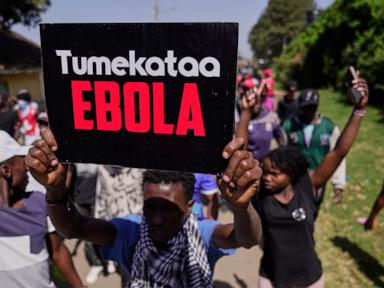
The media is elite at manufacturing a specific brand of hysteria. Right now, every major headline covering Kenya is obsessing over a standard bureaucratic clash. High Court judges are holding pen sessions. Activists are printing press releases. Health Minister Aden Duale is facing a contempt of court charge because he refused to halt construction on a US-backed Ebola quarantine center at Laikipia Air Base.
The immediate public reaction is entirely predictable. Commentators are screaming about sovereignty. Local rights groups like the Katiba Institute are crying foul over a lack of public consultation. The Law Society of Kenya is busy declaring that the rule of law is collapsing because an executive branch official looked a judge in the eye and chose action over paperwork. You might also find this connected coverage insightful: Why the Keir Starmer Resignation Was Entirely Predictable.
They are all missing the point.
The panic over this 50-bed isolation facility is built on a foundation of scientific ignorance and terrible risk management. The lazy consensus states that the Kenyan government is behaving like a rogue colony, importing foreign pathogens to satisfy Washington. The reality is far colder. Pathogens do not care about judicial directives. They do not wait for public participation forums. While Nairobi lawyers argue over legal definitions, an Ebola outbreak is moving through the Democratic Republic of Congo and crossing into Uganda. Kenya is the economic and logistical engine of East Africa. Pretending an airborne or highly contagious viral threat will respect national borders because a judge signed an injunction is not just naive. It is dangerous. As extensively documented in detailed articles by NPR, the effects are widespread.
The Legal Fetish in a Biological Emergency
Lawyers believe that the world runs on paper. They think that if you file the right petition, you can freeze reality. When the High Court ordered a temporary freeze on the Laikipia facility, the legal community expected the Ministry of Health to park its bulldozers and sit on its hands for months while lawyers debated zoning laws and local consultation protocols.
I have spent decades watching governments mismanage public crises because they chose bureaucratic compliance over survival. When an outbreak hits a regional hub, the timeline changes from months to hours. Aden Duale saying "We will not stop it" to parliament is not a breakdown of democracy. It is a rare moment of administrative maturity.
Consider the raw mechanics of regional transmission. The current outbreak in the DRC has spiked past 670 cases. It has breached Uganda. Jomo Kenyatta International Airport handles millions of passengers annually. The northern corridor transport highway sees thousands of long-haul truck drivers crossing from Central Africa into the heart of Kenya every single day.
If a highly lethal hemorrhagic virus hits Nairobi, you do not want to be in the middle of a two-week judicial review deciding where to put the quarantine beds. You want an operational, isolated, military-grade facility already running. Building that facility inside an active military compound like Laikipia Air Base is logistically perfect. It provides immediate security, controlled access, and prevents the exact civilian cross-contamination that doomed urban centers during the West African Ebola epidemic years ago.
Dismantling the Colonial Bio-Hazard Myth
The core of the activist argument relies on a heavy dose of anti-imperialist rhetoric. Critics claim the United States is using Kenya as a dump for its own bio-risks, extracting safety for American citizens while leaving Kenyans to handle the fallout. The narrative implies that the 50 isolation beds are a Trojan horse designed to bring infected foreigners into a clean country.
Let us look at the math and the structural design of global health security. The United States pledged 13.5 million dollars to back Kenya's broader epidemic preparedness alongside this facility. The site will be managed by trained personnel using strict international containment protocols.
Opposing this setup because it targets the evacuation and treatment of Western personnel or regional partners is short-sighted. It ignores how resource distribution works during a pandemic.
Imagine a scenario where a localized outbreak occurs along the border. Which nation is better equipped to handle initial containment: a state relying entirely on an overstretched, underfunded public medical system, or a state that has a fully funded, specialized isolation center built to military specifications? By hosting the facility, Kenya secures access to high-level diagnostic equipment, specialized training, and a direct line to global stockpiles of experimental therapeutics.
The Western personnel managing these sites are not tourists. They are human shields against global viral spread. When things go wrong, these are the specialists who deploy to track patient zeros. Rejecting their infrastructure out of national pride is an expensive way to look foolish on the international stage.
The Flaw of Public Consultation in Epidemiology
The Katiba Institute won its initial injunction by arguing that the project was developed secretly without involving the public. On paper, public participation sounds wonderful. It is a staple of modern constitutional law. In the real world of disease control, it is an absolute disaster.
You cannot run a public referendum on the placement of an infectious disease ward. If you ask a local community whether they want an Ebola facility in their backyard, the answer will always be an absolute, unyielding no. It is the classic Not In My Backyard phenomenon, driven entirely by biological terror.
If governments allowed public consultation to dictate epidemic infrastructure, no isolation center would ever be built. Every community would vote to push the facility to the next town. The result would be a total paralysis of preventive infrastructure.
Epidemiology is not a democratic science. It requires top-down, authoritative execution. When the health ministry bypasses public town halls to build an isolation center on a restricted military base, they are not undermining the public. They are protecting the public from its own worst impulses. The local protests in Nanyuki, which unfortunately turned violent, prove exactly why public consensus is a broken metric for national security. The mob responds to fear. The state must respond to data.
The Price of Judicial Overreach
The High Court of Kenya has developed a reputation for interventionism. While an independent judiciary is critical for a functional society, there is a point where judicial activism becomes a threat to national survival. The courts have repeatedly blocked infrastructural projects, tax laws, and now, emergency medical installations.
The maximum penalty Duale faces for contempt is a minor fine or a theoretical jail sentence. The real penalty for complying with the court’s delay is an unmitigated health disaster. If the minister bows to the court, construction halts. The supply lines freeze. The American funding potentially shifts to a more cooperative regional partner like Rwanda or Djibouti. Kenya loses the infrastructure, loses the funding, and remains completely exposed to the regional vectors coming out of the DRC.
The judiciary operates under the assumption that its orders exist in a vacuum of infinite time. They do not. They operate in a world where viral replication curves are exponential.
[Day 1: 1 Case] -> [Day 10: 14 Cases] -> [Day 20: 190 Cases] -> [Day 30: 2,600 Cases]
This is the mathematical reality of uncontrolled transmission. A court case cannot injunct an exponential curve. When a minister prioritizes physical containment over a judicial stamp, they are acknowledging that the laws of physics and biology supersede the civil procedure rules of 2010.
The True Risk of the Sovereign Purist Argument
The most vocal critics argue that Kenya has never recorded an official case of Ebola, so the country should not invite trouble. This is a profound misunderstanding of how modern transit hubs function. Kenya has stayed clear of Ebola not because of luck, but because the virus has historically been contained in remote, forested regions of Central Africa.
That geography is changing. Urbanization and rapid transit networks mean an infected individual can travel from a village in the Congo to the middle of Nairobi in less than twelve hours. The absence of a historical footprint is zero guarantee of safety.
Relying on old data to justify current negligence is the fastest way to collapse a health system. The sovereign purists want a clean, untainted nation free of foreign medical interventions. But if an outbreak crosses the border without an established treatment center, those same purists will be the first to blame the government for failing to prepare.
Building a 50-bed unit does not create a crisis. It contains it. The true downside of this contrarian position is clear: it strains domestic legal precedents and damages public trust in judicial supremacy. That is a real political cost. But compared to the alternative of an unmonitored, unequipped response to a lethal outbreak, it is a price worth paying every single day.
Stop treating the Laikipia facility as a legal scandal. It is a necessary piece of defensive infrastructure built in the wrong era of political panic. The health ministry needs to finish the build, pay the contempt fine, and ensure the beds are ready before the regional numbers turn truly ugly.
High Court orders Kenya government to release details of Ebola facility provides essential background on the fierce local opposition and the initial legal challenges that sparked this executive-judicial standoff.