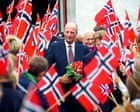
Europe's oldest reigning monarch didn't care much for modern royal exit strategies. King Harald V of Norway passed away at Oslo University Hospital at the age of 89, leaving behind a 35-year reign defined by quiet resilience, sharp humor, and an absolute refusal to abdicate. While neighboring European crowns traded coronations for retirement announcements, Harald stayed put. He maintained that his constitutional oath to the Storting, Norway's parliament, was a life contract.
The Royal Court confirmed he died peacefully on Friday morning, August 28, 2026, following treatment for haemolytic anaemia and a subsequent bloodstream infection. Prime Minister Jonas Gahr Støre voiced the grief of a shaken nation, noting that the king had spent over three decades helping Norwegians see the best in themselves. Yet his passing also hands the crown to Crown Prince Haakon at a genuinely rocky moment for the house of Glücksburg.
A Childhood in Exile and an Olympic Sailor
Harald's life story reads like a twentieth-century history syllabus. Born in 1937, he was the first prince born on Norwegian soil in centuries. When Nazi Germany invaded Norway in 1940, three-year-old Harald and his family fled. He spent a large portion of World War II living in Washington, D.C., taking shelter under the wing of the Roosevelt administration while his grandfather and father led the resistance from London.
When he returned to a liberated Norway in 1945, he didn't grow up behind palace walls. He went to ordinary public schools, studied at Oxford, and developed a fierce passion for competitive sports. You don't often picture a king representing his country in competitive sailing at three separate Olympic Games—Tokyo in 1964, Mexico City in 1968, and Munich in 1972. But Harald was a sailor down to his bones. He continued racing international regattas well into his eighties, famously telling reporters that sailing was simply who he was.
The Nine-Year Wait for Queen Sonja
If you want to understand Harald’s stubborn streak, look at his marriage. For nearly a decade, he told his father, King Olav V, that he would marry Sonja Haraldsen or he would never marry at all. The problem? Sonja was a commoner.
In the 1960s, a crown prince marrying outside the aristocracy risked triggering a constitutional crisis that could have wiped out the monarchy altogether. The couple waited nine agonizing years while politicians debated the future of the crown. When they finally wed in 1968, it fundamentally changed the DNA of the Norwegian royal house. It made them approachable, grounded, and deeply popular with a public that values egalitarianism above all else.
The Unifying Grandfather of a Modern Nation
When Harald took the throne in January 1991 following his father's death, skeptics wondered if a quiet, unassuming man could fill the shoes of Olav V, the legendary "People's King" who used to ride public trams during the oil crisis. Harald answered by being entirely himself.
He didn't rule from a distance. When right-wing extremist Anders Behring Breivik murdered 77 people in 2011, Harald stood before a traumatized nation and delivered a raw, tearful speech about grief, community, and standing up for democracy. Years later, in a 2016 address that went viral globally, he famously defended modern Norwegian identity by declaring that Norwegians are girls who love girls, boys who love boys, and people who believe in God, Allah, or nothing at all. He made it clear that Norway belonged to everyone.
The Stormy Transition to King Haakon VIII
King Harald’s death opens a complex chapter for his successor. Fifty-three-year-old Haakon automatically becomes King Haakon VIII, having already spent months acting as regent while his father fought failing health.
Yet the new king steps into office amid heavy turbulence. The royal family has faced harsh public scrutiny following revelations regarding Crown Princess Mette-Marit's past correspondence with Jeffrey Epstein, alongside legal troubles involving Mette-Marit's son from a previous relationship. Prime Minister Støre previously broke protocol to call out the crown princess's poor judgment, leaving the monarchy's reputation bruised just as the old guard passes away.
Haakon lacks his father's decades-long reservoir of untouchable goodwill. But he inherits the same fundamental playbook: show up, listen to the people, and avoid pretending to be above ordinary human mistakes. As flags across Oslo fly at half-mast, the nation isn't just burying a king. They're saying goodbye to the last anchor of an entire generation.


