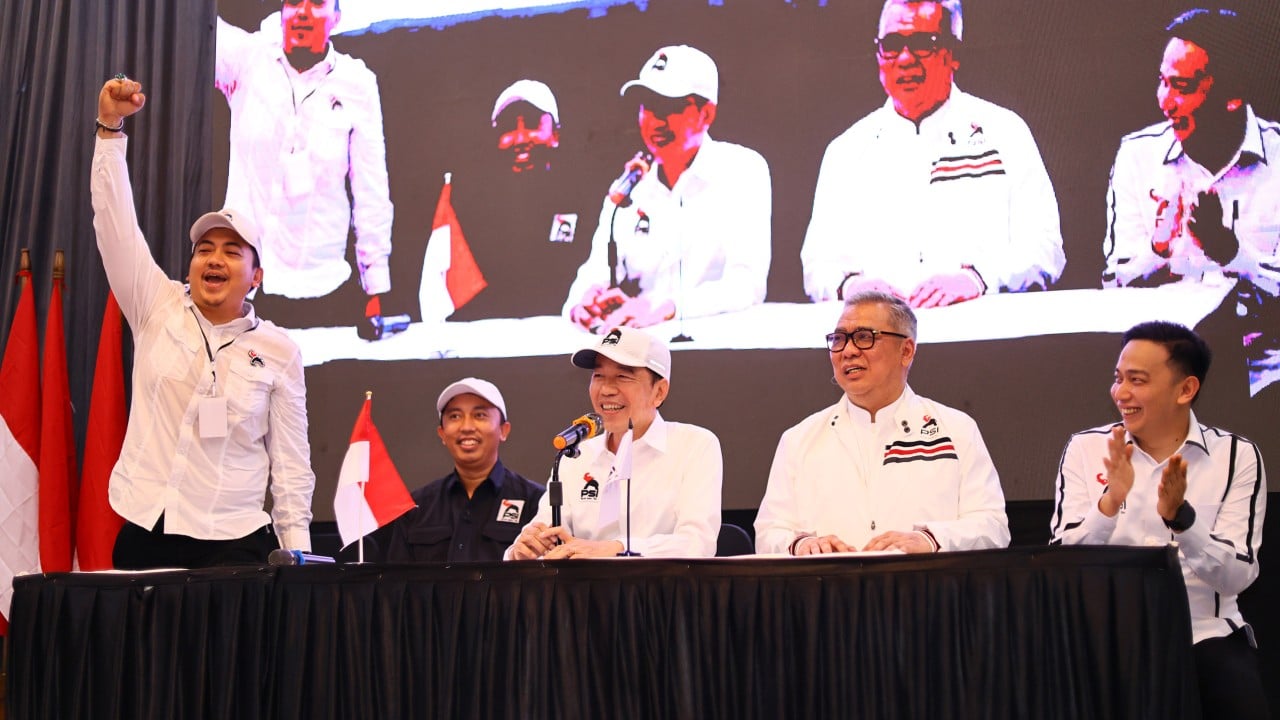
The air inside the Pondok Rimbawan hall in Bandar Lampung was thick, smelling of heavy rain, stale clove cigarettes, and the specific, electric anxiety that only surrounds immense power. On the stage stood a man who, by all conventional laws of democracy, should have been resting. He had served his two terms. He had retired to his hometown. He had smiled for the legacy portraits.
Yet there was Joko Widodo.
He was not wearing the official uniform of the party filling the room. He does not even hold a membership card. But as the former Indonesian president looked out at the sea of young, desperate faces wearing the red of the Indonesian Solidarity Party, known as PSI, nobody doubted who was running the show.
"If the goal is simply to get into parliament, I am confident we can," Widodo told the crowd. His voice was calm, carrying that signature, folksy Javanese cadence that had disarmed rivals for a decade. "But the target we are aiming for is a big one."
Outside, the reality of a fractured nation battered against the walls. Hundreds of protestors clashed with police at the nearby Adipura Monument, their shouts cutting through the tropical humidity. They carried banners mocking the spectacle. They screamed about unresolved scandals, about food prices, about the audacity of a retired leader hitting the campaign trail years before the next ballot is cast.
To understand why a retired titan is sweating in a regional convention hall, you have to look past the political speeches and into the primal architecture of family survival.
The Bloodline in the Ballot Box
Power is addictive, but legacy is terrifying. When Widodo, universally known as Jokowi, stepped down from the presidency, he left behind a country transformed by infrastructure but deeply haunted by the rapid erosion of its democratic norms. More importantly, he left behind a family deeply entrenched in the machinery of state.
His eldest son, Gibran Rakabuming Raka, sits as the Vice President of Indonesia, sharing the palace with President Prabowo Subianto. His youngest son, the 31-year-old Kaesang Pangarep, is the chairman of PSI—installed at the helm of the party despite having zero prior political experience.
Consider the vulnerability of this arrangement. In Indonesian politics, alliances are sandcastles built on shifting tides. The current peace between the Prabowo camp and the Widodo clan is a marriage of convenience. By the time the 2029 election arrives, that marriage could easily end in a brutal, public divorce. If Prabowo decides to drop Gibran from the ticket for a second term, the Widodo dynasty loses its shield.
That is why the quiet tour through Lampung matters. It is an insurance policy written in shoe leather.
Jokowi is building an independent political machine capable of blackmailing or bargaining with whoever holds the presidency in 2029. To do that, he needs a political party. He cannot rely on his old home, the PDI-P, after a bitter falling out that saw him effectively abandon the party that built him.
During his tour, Jokowi participated in a traditional ritual where he placed his foot upon the head of a slaughtered buffalo. On Indonesian social media, the imagery was instantly weaponized. Netizens did not see ancient culture; they saw a metaphor. The symbol of the PDI-P is a bull. To the public, the message was unmistakable: the former president was stepping on his past to build his future.
The Mirage of the Youth Movement
PSI was founded on a promise to break the wheel. It marketed itself as the party of the youth, a secular, progressive alternative to the oligarchs and generals who have choked Indonesian democracy since the fall of Suharto. They promised transparency, digital-savvy governance, and an end to feudal loyalty.
Then they handed the keys to the president’s son.
The strategy failed its first massive test. Despite the full, shadow backing of the presidency, PSI collapsed in the legislative elections, scraping together just 2.8 percent of the national vote—well short of the 4 percent threshold required to enter the national parliament in Senayan.
Imagine the psychological toll of that failure on a family accustomed to winning. The Widodo brand was supposed to be bulletproof. Instead, it was rejected at the legislative level, leaving Kaesang holding an empty shell of a party.
The current political safari is an admission of weakness disguised as an act of strength. Jokowi is using his remaining personal charisma to breathe life into a brand that cannot survive without him. He visited small market stalls, spoke with local vendors, and smiled for selfies, attempting to transfer his fading presidential mystique into a vessel for his children.
But can a father’s popularity be inherited like land or money?
The Heavy Cost of Staying
The tragedy of the political survivor is that they eventually become the obstacle. By refusing to step into the twilight, Jokowi is changing the very nature of Indonesian governance. He is normalizing a reality where former presidents do not become elder statesmen; they become permanent faction leaders.
The doubts among the public are growing louder. Even those who praised his highway systems and modern ports are watching this tour with a sense of quiet exhaustion. The country faces deep structural hurdles, from budget strains to controversial military drills for civilian trainees. Yet the man who led them for ten years is spending his retirement organizing regional party coordination meetings for a fringe political group.
The next election is years away. The dust has barely settled on the last transition of power. But the machinery is already grinding, fueled by the existential dread of a family that knows exactly how cold the world gets once you step out of the palace gates.
Jokowi’s gamble is immense. If he succeeds in dragging PSI over the finish line in 2029, he cements his family as a permanent dynasty in Southeast Asia's largest democracy. If he fails, he will have spent his final years of public goodwill on a desperate, vanity campaign, proving that even the most masterful politicians eventually misread the room.
The music inside the Lampung hall eventually stopped, and the motorcade moved on to the next town, leaving behind a trail of exhaust, empty plastic cups, and a crowd wondering if they had just witnessed the beginning of a new era, or the long, slow retreat of a king who cannot bear to lose his crown.