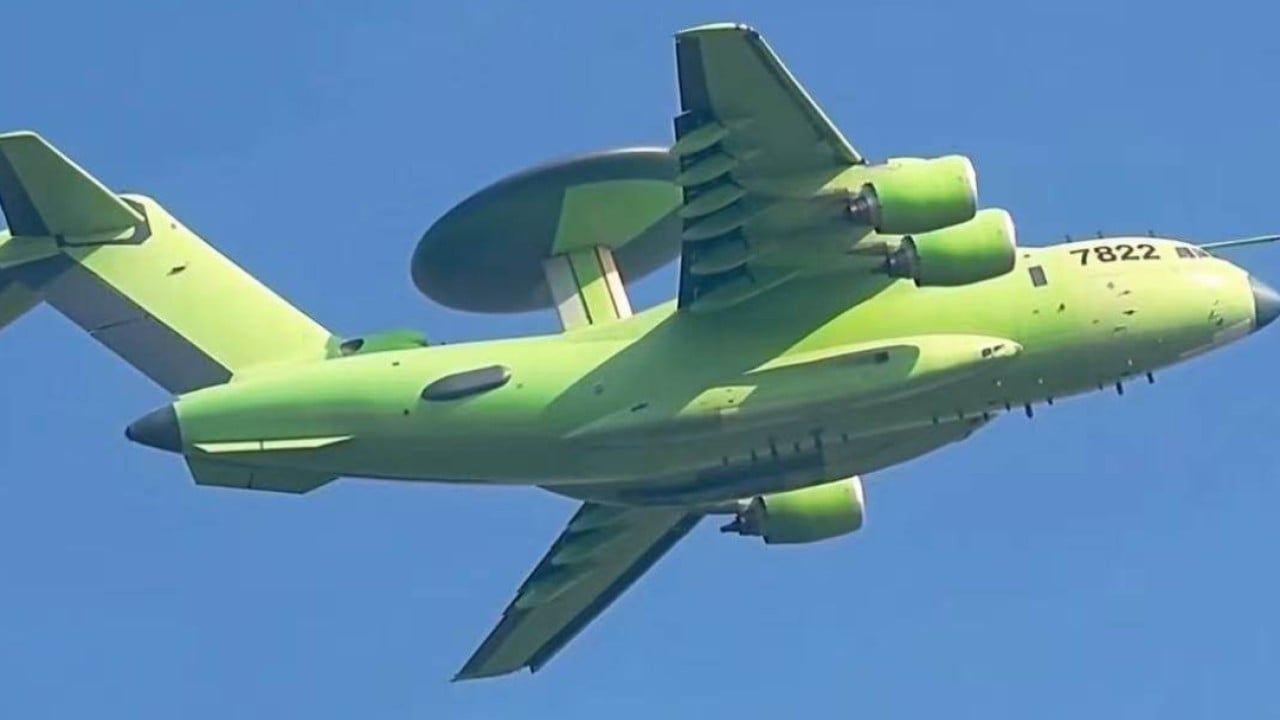
Counting aircraft from commercial satellite imagery turns aerospace intelligence into a problem of inventory inference, where four airframes parked near an assembly line can signal either an early serial run or a concentrated flight-test surge. When commercial orbital imagery captured four KJ-3000 airborne early warning and control (AEW&C) aircraft around Xi'an in October 2026—roughly twenty-two months after the type's late-December 2024 maiden flight—the core analytical question shifted from whether China had built a larger radar jet to whether it had solved the supply-chain and airframe-scaling bottlenecks that constrained its earlier KJ-2000 program.
Competitor coverage of the KJ-3000 often treats a small batch of spotted airframes as proof of imminent mass deployment or reduces the aircraft to a checklist of rumored radar specs. That framing misses how airborne battle management actually scales. A high-end AEW&C fleet is governed by four interlocking constraints: Airframe Sovereignty, Power-Thermal-Aperture Coupling, Orbital Inventory Ambiguity, and Networked Kill-Chain Integration. Understanding the KJ-3000 requires separating verified engineering and imagery facts from educated hypotheses, then tracing how each constraint shapes operational capacity over the western Pacific.
Deconstructing the Production Claim and Airframe Economics
The clearest structural reason the KJ-3000 matters is historical rather than purely electronic. China's previous large jet-powered AEW&C aircraft, the KJ-2000, relied on Russian Ilyushin Il-76 airframes. Only four KJ-2000s were completed. When external airframe supply is scarce or irregular, a fleet cannot maintain continuous, multi-orbit coverage across wide maritime theaters while absorbing routine depot maintenance.
Basing the KJ-3000 on the domestic Xi'an Y-20B heavy transport airframe—powered by indigenous Shenyang WS-20 turbofan engines—removes that foreign supply dependency. In industrial terms, the shift moves the program from a bespoke modification of scarce imported hulls to a derivative built atop an established domestic production line.
Known Facts Versus Educated Hypotheses
Rigorous analysis requires drawing a sharp boundary between what can be corroborated and what remains inferred from open-source observation and defense assessments:
- Verified airframe and timeline milestones: The KJ-3000 was first observed flight testing in late December 2024 on a Y-20B-derived airframe equipped with WS-20 engines and a dorsal radome. Additional prototypes and airframes—including examples wearing factory primer and serials such as 7821—were documented in 2025 and 2026.
- Orbital sighting count: Commercial satellite imagery from October 5, 2026, showed four KJ-3000 aircraft across the Xi'an-Yanliang complex, with three near the Xi'an Aircraft Company (XAC) factory area and one near flight-test facilities.
- Analytic debate over serial production: Defense analysts are divided on whether four visible airframes confirm full serial production. One assessment holds that four airframes so soon after first flight points toward serial production; another notes that the count could reflect known prototypes and test articles coinciding at the same facility.
- Sensor and radar architecture claims: Open reporting and U.S. Department of Defense assessments associate the KJ-3000 with digital radar capabilities, anti-jamming, passive detection, and target identification, as well as infrared search and track (IRST) and electronic/communications intelligence features. Specific internal hardware details—such as exact gallium nitride (GaN) transmit/receive module counts, dual-band configurations, or exact detection ranges—remain unverified in public sources.
Why Four Aircraft Do Not Automatically Equal a Fleet
A common analytical error is equating the presence of four airframes on an airfield with an operational squadron. In aerospace manufacturing, early airframes serve multiple roles that do not map one-to-one to frontline readiness:
- Test and evaluation articles: Different airframes may carry distinct instrumentation, radome configurations, or mission-system baselines to retire aerodynamic, structural, and electromagnetic integration risks in parallel.
- Work-in-progress clustering: Aircraft undergoing avionics integration, radome calibration, or flight-test preparation naturally cluster near manufacturing and test ramps during transition phases.
- Low-rate initial production (LRIP) ambiguity: Even when serial assembly begins, early output rates are typically modest while tooling, supplier deliveries, and acceptance testing ramp up.
The operational test of serial production is not a single snapshot of four jets. The decisive indicator is sustained multi-month growth in distinct airframe serials alongside operational unit integration.
The Power, Thermal, and Aperture Coupling Framework
Airborne radar performance is an exercise in resource budgeting under strict physical limits. An AEW&C aircraft is fundamentally a flying electrical power plant and heat sink carrying a sensor array high enough to extend the radar horizon against low-altitude targets.
Competing commentary often treats a larger radome as an automatic leap in detection range. In practice, radar capability is coupled across three subsystems that constrain one another:
- Aperture geometry and scan mechanics: Unlike earlier Chinese AEW&C designs such as the KJ-500 and KJ-2000 that used fixed radomes housing three arrays, observations of the KJ-3000 indicate a rotating dorsal radome housing two active electronically scanned array (AESA) faces. A rotating two-face arrangement trades instantaneous 360-degree electronic staring from three fixed sectors for mechanical rotation combined with electronic beam steering, changing how dwell time, scan rate, and power distribution are managed across azimuths.
- Electrical generation margin: High-power AESA modes, electronic support measures, and data links draw substantial electrical power. Moving to higher-bypass WS-20 turbofans on a Y-20B airframe provides greater propulsion efficiency and stronger electrical generation capacity than older engines, easing the power ceiling for mission systems.
- Thermal dissipation: Every watt of radio-frequency power that does not radiate cleanly—along with heat from high-density digital signal processors—becomes waste heat. High-altitude flight reduces ambient air density, making dedicated cooling architecture—such as the prominent air intake near the base of the tailfin noted on the KJ-3000—essential to prevent thermal throttling during sustained high-duty-cycle missions.
The Physics of Horizon and Survivability
Increasing altitude and endurance changes the geometry of air and maritime surveillance. A higher cruising ceiling pushes the line-of-sight horizon further out against low-flying cruise missiles, low-observable aircraft, and surface combatants. Meanwhile, an aerial refueling probe above the cockpit allows longer loiter times or deeper transit legs without sacrificing fuel margin for mission payload.
Yet a large transport-derived radar jet is not stealthy. Its large radar cross-section and high-power emissions make it a high-value target for long-range air-to-air missiles, surface-to-air defenses, and electronic warfare. That vulnerability explains why modern AEW&C design emphasizes standoff geometry, anti-jamming and passive sensing (such as electronic support and infrared search and track to detect thermal signatures when active radar is contested or against low-RCS targets), and escort/screen integration.
Tiered Fleet Architecture Instead of a Single Silver Bullet
Popular coverage frequently frames the KJ-3000 as a replacement that renders smaller AEW&C aircraft obsolete. A better analytical model views force design as a tiered sensor portfolio where platforms are matched to runway constraints, threat exposure, and mission distance.
Turboprop and smaller AEW&C platforms—such as the KJ-500 family and other specialized types—offer distinct operational advantages in regional theaters. They can operate from shorter or more dispersed airfields, including island outposts or austere bases closer to flashpoints like the Taiwan Strait or South China Sea, where heavy four-engine transports face runway length, taxiway weight, or vulnerability trade-offs.
The KJ-3000 occupies the heavy, long-endurance tier. Its value lies in operating further back in safer airspace or over broader ocean expanses where long transit legs, higher cruise altitude, aerial refueling, and heavy mission suites pay off. Rather than replacing shorter-range platforms across the board, a larger jet expands the top of the pyramid, giving commanders a heavy battle-management node for wide-area maritime and air pictures while smaller platforms handle tighter regional orbits.
Cause-and-Effect in Maritime Battle Management
When analysts talk about "feeding targeting data" to long-range strike systems, they often compress a complex chain of dependencies into a single phrase. In operational reality, turning radar detections into engagement-grade tracks requires tight synchronization across several links:
- Detection and track correlation: Sensors must separate real targets from clutter, decoys, and jamming, then maintain consistent tracks across time.
- Data-link throughput and resilience: Raw or processed track data must move over tactical data links without saturation or severe jamming disruption, even when aircraft operate at standoff ranges.
- Command-and-control authority: Operators aboard the aircraft or at ground/naval nodes must assign shooters—such as fighters, surface ships, or missile batteries—while avoiding friendly-fire conflicts.
- Sensor-shooter handoff: The final firing solution often depends on mid-course updates or seeker acquisition from the shooter or forward sensors, especially against maneuvering or low-observable targets.
If any link in that chain degrades—through communications jamming, data-link latency, or the loss of the AEW&C orbit itself—the theoretical detection range of the radar matters far less.
Strategic Risks, Blind Spots, and Limitations
No single airframe resolves the structural friction of high-intensity air warfare. Even if the KJ-3000 enters steady serial production, several operational limitations constrain what it can achieve:
- Concentration risk: High-value heavy aircraft are few in number compared to fighters or missiles. Losing even one or two creates an immediate gap in wide-area coverage and command bandwidth.
- Standoff versus penetration trade-off: Pushing the KJ-3000 far back to protect it from long-range threats reduces its close-in visibility against low-altitude targets masked by terrain or Earth curvature unless forward sensors bridge the gap.
- Electronic warfare contestation: Digital radar and anti-jamming features raise the cost and complexity of jamming, but electronic warfare is an iterative measure-countermeasure race rather than a permanent immunity.
- Sustainment burden: Four-engine heavy jets with complex mission avionics and rotating/electronic sensor suites require skilled maintenance crews, spare parts pipelines, and tanker support for extended operations.
Strategic Action for Defense Planners and Analysts
For defense planners, capability analysts, and industry observers tracking the program, the right move is to stop treating a single satellite sighting as a settled verdict on fleet size and instead build an indication-and-warning tracking protocol around observable scaling milestones.
Track three concrete indicators over the next twelve to twenty-four months: airframe serial progression across commercial imagery at Xi'an and flight-test bases, tanker and support pairings observed during training sorties that reveal planned endurance profiles, and integrated exercise patterns pairing heavy AEW&C orbits with stealth fighters, long-range air defense, and maritime strike units. Pair those observable fleet metrics with counter-AEW&C investment—long-range stand-off munitions, passive and multi-spectral sensing, resilient resilient data links, and distributed command nodes—so operational plans remain resilient whether the KJ-3000 scales into a large fleet or faces the slower ramp typical of complex heavy-avionics programs.