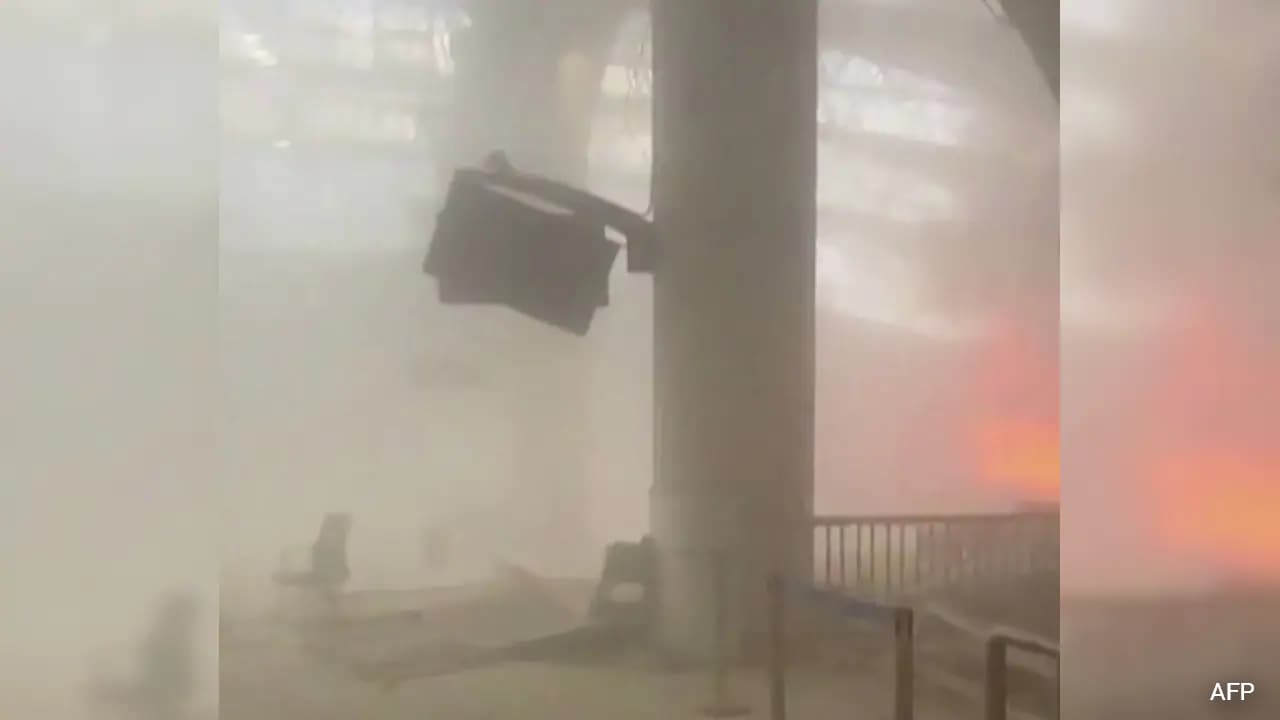
Mainstream media outlets scrambled to blast out the footage: thick, gray smoke billowing through the sleek terminal of Kuwait International Airport, accompanied by frantic headlines attributing the chaos to an Iranian drone strike. The narrative was instant, neat, and terrifying. It fit perfectly into the geopolitical doom-scrolling of the modern news cycle.
There is just one problem. The narrative is completely hollow.
While defense analysts and talking heads immediately used the incident to sound the alarm on regional drone warfare and escalating state-sponsored aggression, they missed the glaring structural reality of the situation. The true vulnerability exposed at Kuwait Airport wasn't a failure of missile defense shields or anti-drone jamming tech. It was a failure of basic, unglamorous civil engineering and hyper-reactive crisis communication.
We are obsessed with the cinematic threat of the drone. We are blind to the reality of critical infrastructure fragility.
The Myth of the Omnipresent Drone Strike
Every time smoke rises in the Middle East, the immediate reflex of modern journalism is to blame an unmanned aerial vehicle (UAV). It sells clicks. It fuels defense budget lobbying. But anyone who has spent years analyzing aviation security and infrastructure resilience knows that treating every localized disruption as an act of high-tech war is a dangerous distraction.
Let's dissect the logistics. For a drone strike to penetrate the airspace of a heavily fortified Gulf aviation hub and cause internal terminal smoking without triggering automated air defense arrays, catastrophic structural collapses, or mass external blast damage defies basic military physics. Airfields are ringed with multi-layered detection systems.
When you look at the actual mechanics of airport disruptions globally, the numbers tell a radically different story. Over 90% of terminal evacuations and smoke incidents trace back to localized utility failures:
- HVAC electrical fires running through ventilation shafts.
- Substation blowouts due to extreme thermal loading (a massive issue in the Arabian Peninsula).
- Negligent construction accidents in adjacent terminal expansions.
By instantly painting the Kuwait incident with the brush of regional warfare, the industry completely ignores the unsexy, systemic failure of infrastructure maintenance. I have watched airport authorities spend tens of millions of dollars on cutting-edge electronic countermeasure systems to intercept micro-UAVs, while their primary backup generators are cooled by failing, decades-old water pumps. We are buying titanium locks for a house with cardboard windows.
Why the Aviation Industry Loves Geopolitical Scapegoats
Blaming an adversary nation for an operational shutdown is a brilliant corporate get-out-of-jail-free card. If an airport closes for twelve hours because a cheap electrical transformer melted due to poor maintenance, the airport authority faces a public relations nightmare, massive fines, and plummeting stock values for contracted operators.
But if you hint that the shutdown was caused by a hostile foreign drone? Suddenly, the narrative shifts from "incompetent management" to "heroic national resilience in the face of terror."
The Reality Check: Security theater is expensive, but accountability is harder. It is far easier for executives to point toward the sky and blame foreign actors than it is to admit that their facility's internal fire suppression and smoke-extraction zoning failed to isolate a standard localized accident.
When smoke fills a terminal, the primary threat to life isn't the initial flash; it's the toxic mix of burning synthetic materials carried through the building by poorly designed or improperly managed HVAC systems. Modern terminals are architectural marvels of glass and open space, which unfortunately act as massive chimneys if the airflow dynamics are not perfectly managed during a crisis. If a terminal fills with smoke, the facility's engineering failed long before any theoretical projectile could have hit it.
The Danger of Hyper-Reactive Anti-Drone Mandates
In the wake of videos like the Kuwait airport footage, Western and Middle Eastern aviation authorities inevitably rush to mandate new, incredibly expensive anti-drone procurement protocols. This knee-jerk reaction causes two distinct, severe vulnerabilities that security professionals rarely admit publicly.
1. Capital Allocation Suffocation
When a budget is hijacked by the fear of high-tech threats, the foundational security budgets get slashed. Perimeter fencing, employee background screening, cyber-security patching for baggage handling systems, and basic fire safety upgrades are put on the back burner.
2. Signal Pollution and False Positives
Deploying massive electronic warfare (EW) jamming suites and radar arrays around civilian airports creates an incredibly noisy radio frequency environment. These systems frequently trigger false positives from migratory birds, commercial photography drones operating miles away, or even certain weather phenomena. The result? Cry-wolf syndrome among air traffic controllers and security personnel, leading to operational paralysis.
Imagine a scenario where an airport spends $50 million on an advanced automated jamming grid. During a period of high tension, the system flags a cluster of false positives. The airport shuts down operations, strands thousands of passengers, and costs airlines millions in diversions—all for a ghost on a radar screen. The economic damage is identical to a real strike, achieved entirely through our own paranoia.
Dismantling the Public Obsession with "Airspace Insecurity"
The public constantly asks: Are international airports completely defenseless against drone swarms?
The brutal, honest answer is that no civilian infrastructure is 100% invulnerable to a concerted, military-grade kinetic attack. If a state actor wants to launch a heavy ballistic missile or a swarm of low-altitude cruise missiles at a civilian target, a commercial airport's primary defense is the national military's air defense network (like Patriot batteries or the Iron Dome), not the airport's internal security team.
Therefore, configuring standard airport operations around the assumption that they must individually survive a military siege is completely flawed.
Instead of obsessing over stopping a missile that requires a state-level military response, airports must focus on resilience and redundancy. Can your terminal isolate smoke within a 50-meter radius? Can your digital systems reroute air traffic to a secondary runway within nine minutes of a localized disruption? Can your communications team issue factual, transparent updates within fifteen minutes to stop a social media panic from tanking your regional economy?
In the case of the Kuwait footage, the communication engine failed completely. The vacuum of immediate, verifiable data from official channels allowed speculative social media accounts to weaponize the video, turning a localized smoke event into an international security crisis for hours. The damage wasn't done by a drone; it was done by a smartphone running a Twitter clone.
Stop Looking at the Sky, Look at the Basement
The contrarian truth of modern aviation security is that the next major disruption will not look like a sci-fi movie. It will look like a flooded basement, a severed fiber-optic cable dug up by an errant backhoe, or a corrupted software update distributed to automated passport gates.
We must stop validating the lazy consensus that every plume of smoke is the opening salvo of World War III. Until the aviation industry shifts its focus away from high-margin defense gadgets and back toward the boring, rigorous disciplines of structural redundancy, compartmentalized HVAC engineering, and aggressive crisis-communication protocols, we will remain entirely at the mercy of the next social media panic.
Invest in better smoke dampers. Maintain the electrical grids. Fire the panic-mongering PR teams. Everything else is just noise.


