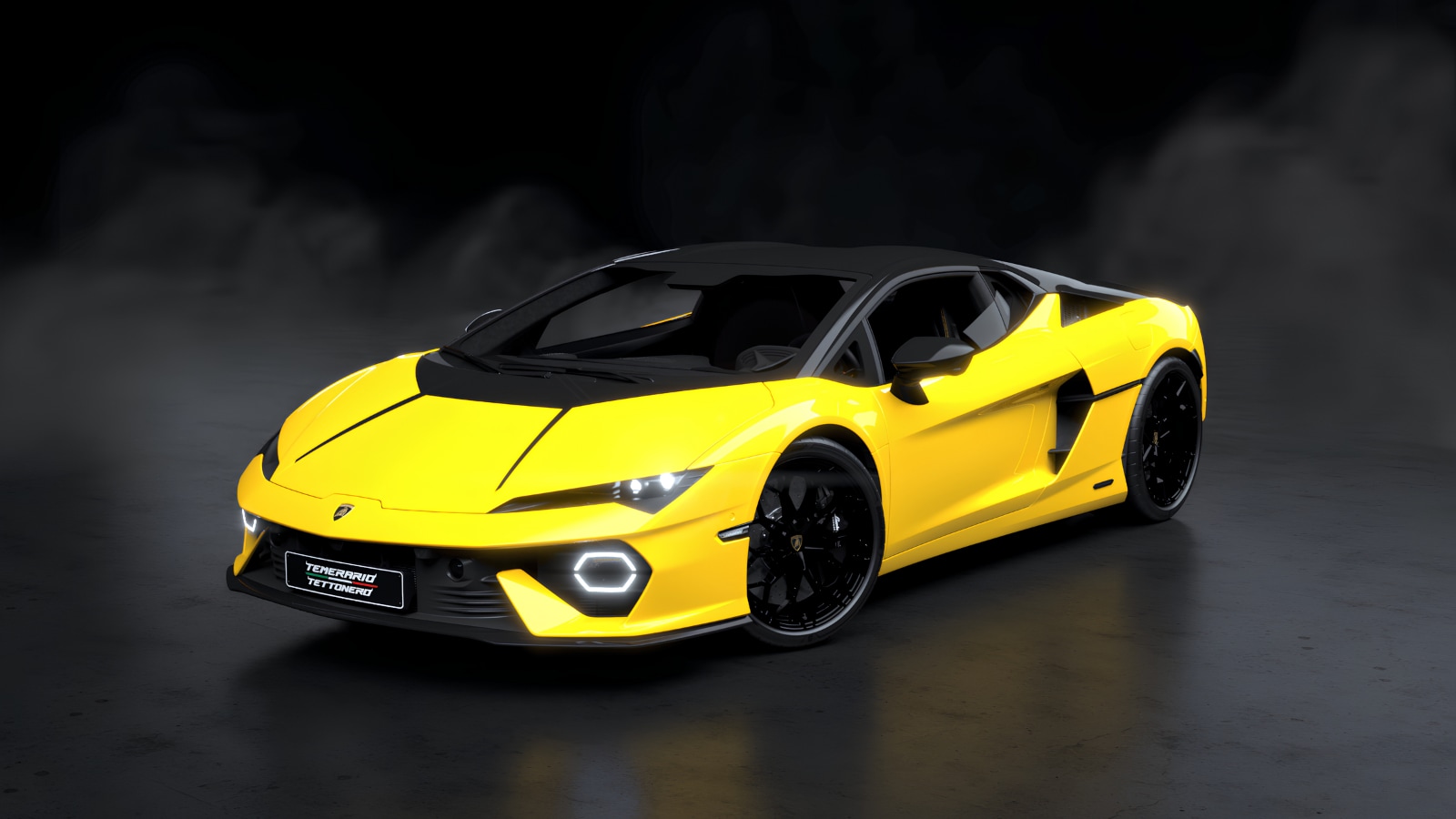
Everyone covering the Lamborghini Temerario Tettonero Capsule is staring at the wrong numbers. They recite the press release like gospel—920 total horsepower, a 10,000 rpm redline, matte black roof contrast, bespoke Ad Personam stitching—and call it a technical triumph.
It isn't. It is a masterclass in margin engineering dressed up as mechanical rebellion. Discover more on a connected issue: this related article.
When you strip away the marketing gloss from Sant'Agata Bolognese, the Tettonero Capsule reveals an uncomfortable truth about modern exotic cars. Automakers have hit a physical ceiling on usable street performance. So instead of building lighter, sharper machines, they sell aesthetic theater to distract you from the weight penalty sitting behind your spine.
The 920hp Illusion and the Weight Problem Nobody Mentions
Let's look at the hardware first. The standard Lamborghini Temerario replaced the beloved, naturally aspirated V10 Huracán with an all-new 4.0-liter twin-turbocharged V8 paired with three axial-flux electric motors. On paper, that hybrid powertrain generates 920 CV (907 brake horsepower). More journalism by The Next Web explores similar views on the subject.
That sounds violent. It sounds like progress.
Now look at the curb weight. The Temerario carries a dry weight of roughly 1,690 kilograms (3,726 pounds). Once you add fluids, fuel, and a driver, you are piloting a two-ton mid-engine sports car. For context, the outgoing Huracán Tecnica weighed 1,379 kilograms dry. Lamborghini added over 300 kilograms of batteries, copper windings, cooling loops, and turbo plumbing, then threw 920 horsepower at the problem to mask the inertia.
I have spent enough time in engineering briefings and pit lanes to recognize this exact playbook. When a manufacturer cannot beat the laws of physics, they overwhelm the spec sheet. High horsepower figures sell allocation slots to collectors who rarely push past six-tenths on a canyon road. Meanwhile, the Tettonero Capsule—which translates roughly to "black roof"—takes this exact mechanical package and adds a curated visual trim layer via Lamborghini’s Ad Personam studio.
You get exposed carbon fiber accents. You get darkened exhaust tips. You get a contrasting Nero Noctis roof paired with aggressive exterior hues and custom interior badging. What you do not get is a single millimeter of wider track, a stiffer spring rate, or a gram of meaningful unsprung weight reduction.
What the Tettonero Capsule Actually Is
Automotive journalists love treating "Capsule" editions as special-series track weapons. They are not. In Lamborghini’s product taxonomy, a Capsule collection is an aesthetic curation program designed to capture aftermarket customization dollars before the car ever leaves the factory floor.
Think about the economics of exotic car manufacturing. Developing a new cylinder head or homologating a bespoke aero package costs tens of millions of euros in crash testing, emissions compliance, and tooling. Mixing a unique paint scheme, specifying contrast Alcantara stitching, and slapping a matte black finish on the roof panel costs almost nothing in R&D while commanding a massive premium over base MSRP.
Ferrari does it with Tailor Made. Porsche does it with Sonderwunsch. McLaren does it with MSO.
Lamborghini simply institutionalized the process with Capsule editions. By packaging specific color-blocking formulas under an evocative Italian name, they solve choice paralysis for wealthy buyers while locking in higher gross margins per chassis. There is nothing wrong with making money. Sant'Agata is a business, not a charity. The problem is pretending that a two-tone paint job changes the dynamic soul of a 920-horsepower plug-in hybrid.
The Engineering Reality Behind the 10,000 RPM Redline
To be fair to Lamborghini’s powertrain engineers, the L411 V8 inside the Temerario is a genuine piece of mechanical art. Most turbocharged engines run out of breath around 7,000 rpm because exhaust backpressure chokes the cylinders and turbine inertia limits response.
Lamborghini bypassed that trap using three specific architectural choices:
- A flat-plane crankshaft. Instead of the traditional 90-degree cross-plane layout used in American muscle cars, a flat-plane crank spaces firing impulses evenly at 180-degree intervals. This eliminates exhaust scavenging interference between cylinder banks and reduces rotational mass.
- Titanium connecting rods. At 10,000 revolutions per minute, piston speeds reach extreme limits where steel rods would stretch or snap under tensile load. Titanium cuts reciprocating weight by roughly 40 percent compared to steel.
- Hollow-cast finger followers with DLC coating. Borrowed directly from motorsport valvetrains, Diamond-Like Carbon coatings reduce friction so the valves do not float when the tach needle sweeps past nine grand.
Then comes the hybrid intervention. An axial-flux electric motor sits sandwiched between the V8 crankshaft and the eight-speed dual-clutch transmission. Its primary job is not fuel economy—the Temerario’s tiny 3.8 kWh battery pack offers barely a few miles of silent electric crawling. Its real job is torque fill.
Turbochargers need exhaust gas volume to spool. At low engine speeds, large turbos lag. The axial-flux motor delivers instant electric torque the millisecond your right foot twitches, bridging the gap until the twin turbos hit peak boost pressure of 2.5 bar (36.2 psi).
It works seamlessly. Too seamlessly.
Why Perfection Makes Bad Supercars
Here is the contrarian truth that veteran test drivers whisper over espresso after the press junkets end: modern hybrid supercars are getting dangerously boring at legal speeds.
When you combine all-wheel drive (via two additional electric motors powering the front axle), instantaneous electric torque vectoring, and computer-controlled magnetorheological dampers, you erase the friction between human error and mechanical consequence. The car corrects your sloppy turn-in. It meters out power so smoothly that the rear tires rarely break traction unless you deliberately disable every electronic nanny.
In an older mid-engine Lamborghini—even an early Gallardo or a rear-wheel-drive Huracán—you had to earn your speed. You waited for the cam profile to switch over. You managed weight transfer under braking because the chassis talked back through the steering column.
In the Temerario Tettonero Capsule, the electronic architecture filters out the ragged edges. The front electric motors pull the nose out of corners with clinical precision. You feel less like a pilot wrestling a wild animal and more like a systems operator approving inputs on a very fast server.
Does a black roof and custom interior trim fix that emotional detachment? Of course not.
Dismantling the Common Questions Buyers Ask
If you are evaluating a Temerario—or debating whether a Tettonero specification holds real collector value—you are probably asking the wrong questions. Let's look at what buyers actually search for and dismantle the faulty assumptions underneath them.
Does the Tettonero Capsule make the Temerario faster?
No. Not by a single tenth of a second. The 0–62 mph sprint remains 2.7 seconds, and top speed stays pinned at 213 mph (343 km/h). Any journalist implying that the Capsule package sharpens lap times is confusing aggressive styling with aerodynamic downforce. Unless you tick the separate Alleggerita (lightweight) package—which sheds roughly 25 kilograms through carbon wheels, a titanium muffler, and thinner glass—the Tettonero is mechanically identical to the base car.
Will a Capsule edition hold better resale value than a standard spec?
Usually, yes, but not for the reason you think. In the secondary exotic market, "safe" resale specs—white over black, silver over red—tend to stagnate because every third car on the broker market looks identical. A factory-curated Ad Personam specification stands out in auction listings and proves the original buyer spent serious money on options. However, do not mistake a visual trim package for a numbered limited edition like an STO or a Performante. When Lamborghini eventually releases a hardcore, track-focused Temerario variant in three or four years, standard and Capsule models alike will take a depreciation hit.
Is the twin-turbo hybrid V8 actually better than the old V10?
By every objective metric—thermal efficiency, power-to-displacement ratio, low-end torque, and emissions compliance—the hybrid V8 obliterates the 5.2-liter V10. By the only metric that actually matters on a Sunday morning drive—visceral acoustic drama—it is a step backward. You cannot cheat physics. Two turbine wheels spinning inside the exhaust stream act as mufflers. Even with sound symposers piping induction noise into the cabin and a high-revving flat-plane crank, a turbocharged V8 will never replicate the banshee wail of ten naturally aspirated cylinders screaming toward 8,500 rpm.
The Hidden Downside of My Own Argument
To be completely transparent, slamming Lamborghini for building a heavy hybrid wrapped in luxury trim ignores the regulatory reality choking every automaker in Europe.
Euro 7 emissions standards and fleet-wide CO2 targets left Sant'Agata with two choices: electrify the powertrain or shut down the factory. A naturally aspirated V10 simply could not survive the regulatory guillotine without massive financial penalties that would price the car out of existence. Within those suffocating legal constraints, engineering a 10,000-rpm twin-turbo V8 that avoids the flat, lifeless drone of competitors' engines is nothing short of miraculous.
And if buyers are willing to pay an extra $50,000 to $80,000 for Ad Personam paintwork and carbon trim—funding the R&D required to keep internal combustion alive for another decade—then the Tettonero Capsule serves a vital purpose.
What You Should Actually Do If You Have an Allocation
If you have the means and the allocation slot to spec a Lamborghini Temerario, stop falling for showroom cosmetics. Do not let a dealer talk you into blowing your option budget on contrasting roof paint and embroidered headrests while leaving the dynamic hardware untouched.
- Prioritize the Alleggerita package over aesthetic capsules. If you want the car to feel alive, shedding unsprung and rotational mass is non-negotiable. Carbon fiber wheels and lightweight body panels do more for steering feel and turn-in response than any paint scheme ever could.
- Treat Ad Personam as surgical, not structural. Specify paint and interior materials that satisfy your personal taste, not what you think a hypothetical second owner five years from now might prefer. Trying to time the collector market on a non-numbered production supercar is a losing game.
- Drive it hard enough to wake up the hybrid system. On public roads at 40 mph, the Temerario feels overly insulated. Take it to a track day where you can actually stretch the V8 past 8,000 rpm and feel the front axial-flux motors vectoring torque across the apex. That is where the engineering justifies the weight.
Stop buying supercars for how they look parked outside a hotel with a matte black roof. Buy them for what happens when the tachometer needle crosses nine grand—and strip away every single gram that gets in the way.