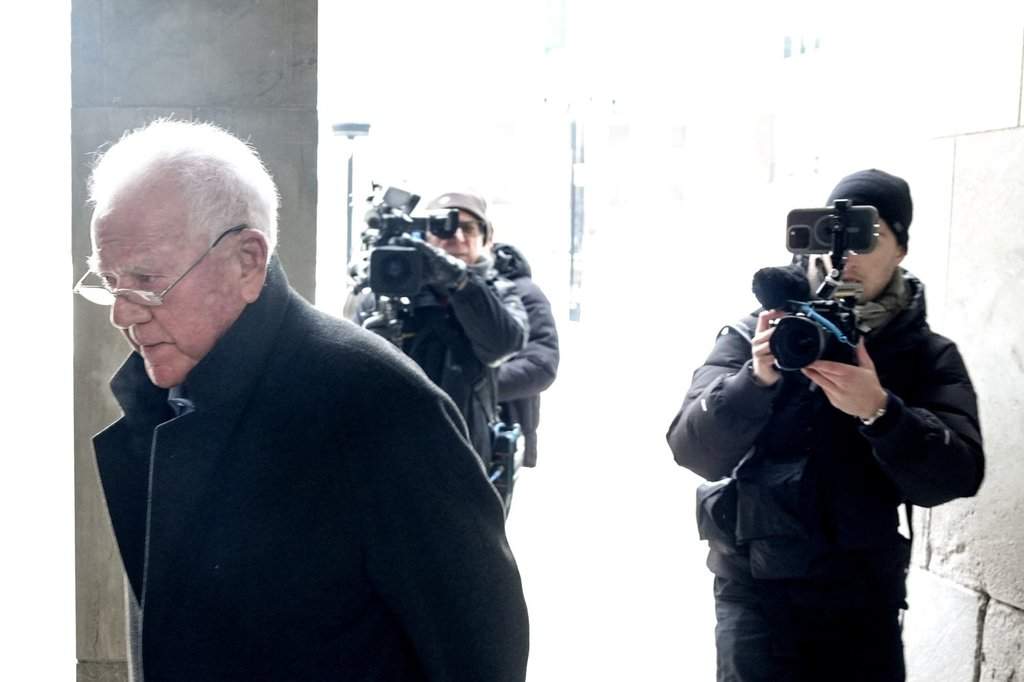
The air inside a courtroom has a specific weight. It is thick with the scent of old wood, industrial floor cleaner, and the invisible, suffocating pressure of a legacy being dismantled brick by brick. For Frank Stronach, the billionaire whose name is synonymous with the Canadian Dream—the immigrant who arrived with a few dollars and built a global empire—the Brampton courthouse has become the final arena.
But this isn’t a boardroom battle for Magna International. There are no balance sheets here. Instead, there is the voice of a woman, the tenth and final complainant, recounting a story from decades ago that feels, to her, as vivid as a fresh wound.
He sits there. Still. A man used to being the most powerful person in any room now finds himself at the mercy of a process that does not care about his net worth. The defense is up. The cross-examination of this final witness marks a grim milestone in a case that has peeled back the curtain on the private conduct of one of the country’s most storied figures.
The Anatomy of a Memory
Cross-examination is a surgical procedure. It is not always about calling someone a liar; often, it is about the slow, methodical erosion of certainty. Stronach’s legal team isn’t just fighting a set of allegations; they are fighting the way the human brain preserves trauma.
The defense lawyer leans in. The questions are precise. They focus on the gaps—the "I don't recalls" and the "I'm not sures." In a trial like this, time is the greatest enemy of the truth. When an event happened thirty or forty years ago, the defense looks for the fraying edges of the narrative. They ask about the lighting. They ask about the sequence of doors. They ask why, if this happened, the witness didn't scream, or why she stayed in contact.
These questions feel cold. To a spectator, they can feel like an attack. But in the eyes of the law, they are the tools used to test if a story can hold its own weight. The lawyer isn’t just questioning a woman; he is questioning the reliability of a human life's timeline.
Consider the physics of power. When a man like Stronach enters a room, the gravity shifts. For the women coming forward, the allegations describe a world where that gravity was used to pin them down. The final complainant spoke of a night in the late 1980s, a time when Stronach was at the zenith of his influence. She described a scenario that has become a hauntingly familiar refrain in this trial: an invitation that felt like an opportunity, which allegedly curdled into something dark.
The Weight of the Tenth Voice
There is a psychological phenomenon in serial cases often referred to as the "tipping point." One voice is a scandal. Two is a pattern. Ten is an avalanche.
By the time the tenth woman took the stand, the trial had moved beyond a simple "he said, she said." It had become an examination of a culture. The defense’s strategy remained consistent: isolate each incident. Treat each woman as a silo. If you can discredit one, you might be able to discredit them all. But the challenge for the defense is that while memories might be fuzzy on the specifics of a date or a floor number, the emotional resonance—the feeling of the "last room in the hallway"—remains agonizingly consistent across the board.
The final witness was asked about her silence. Why wait? Why now?
The answer to that question is rarely found in a law book. It’s found in the reality of 1980s corporate culture, where a man like Stronach was more than a boss; he was a titan. To speak out then wasn't just a risk; it was professional suicide. The "why now" is answered by the collective courage that has defined the last few years of global discourse. She isn't just speaking for herself anymore; she is the final note in a chorus that has finally found its frequency.
The Defense of a Legacy
Stronach has denied every single one of these claims. His lawyers argue that these are not memories, but fabrications or distorted recollections fueled by a modern climate of resentment toward powerful men. They point to the lack of physical evidence. They highlight the inconsistencies.
It is a grueling, necessary friction. The justice system is designed to be a meat grinder for testimony. If a story survives the cross-examination of a high-powered defense team, it is considered "proven." But "proven" and "true" are sometimes different languages.
The defense lawyer pushed the final complainant on the details of her exit from the room. He questioned the geography of the house. He suggested that her version of events was physically impossible based on the layout of the property.
She held firm.
There is a specific kind of silence that falls over a courtroom when a witness refuses to be moved. It’s a silence that suggests that while a lawyer can argue about the architecture of a house, they cannot argue with the architecture of a woman's soul. She remembered the door. She remembered the feeling of the handle. She remembered the way the air felt when she finally got outside.
Beyond the Verdict
As the final witness stepped down, the legal phase of this specific chapter drew toward its close. But the human phase—the part that actually matters to the people living through it—is far from over.
For Frank Stronach, the man who built an empire on the "Fair Enterprise" philosophy, the irony is staggering. He spent his life creating a system he believed was just, only to find himself judged by a system that demands a different kind of accountability. He is 92 years old. In the twilight of a life defined by extraordinary success, he is forced to sit in a beige room and listen to the ghosts of his past speak their truth.
The trial isn't just about whether a crime was committed in a technical sense. It is an autopsy of power. It asks us to consider what happens when the people we elevate to the status of icons are revealed to be deeply, perhaps dangerously, human.
We often think of justice as a scale, perfectly balanced. But in cases like this, it’s more like a mirror. It forces the defendant to look at who they were when they thought no one was watching. It forces the complainants to relive their smallest, most vulnerable moments in front of a room full of strangers. And it forces the public to decide what we value more: the brilliance of a man’s achievements or the dignity of the people he encountered along the way.
The final witness left the stand, walking past the man she had accused, her footsteps echoing in the quiet room. Stronach didn't look up. He remained a statue of the man he used to be, while the world he built continued to turn outside the courthouse doors, oblivious to the fact that for ten women, the world had stopped moving decades ago.
The gates of the Magna empire are made of steel, but the walls of a courtroom are made of words. And as the final words of the final witness faded into the record, the weight of the air in the room didn't lighten. It stayed heavy, pressing down on everyone involved, a reminder that some things, once broken, can never be built back to their original form.
Justice is not a destination. It is the grueling, painful process of looking at the wreckage and refusing to look away.


