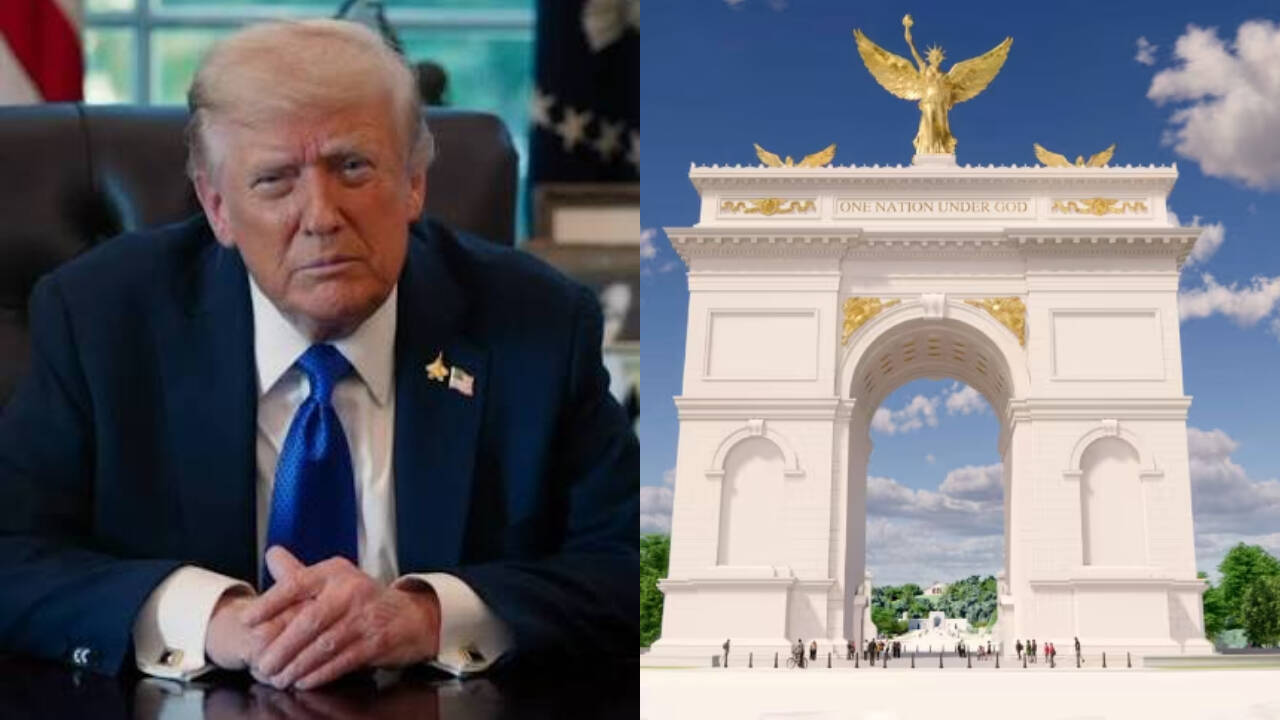
Everybody watching the federal docket this week is staring at the wrong target.
Legacy media outlets are treating the court challenges surrounding the proposed Arlington Arch like a standard political boxing match. On one side, you have the administration pushing to break ground on a massive neoclassical monument near Arlington National Cemetery. On the other, you have historic preservation groups and local plaintiffs filing last-minute injunctions to stop the bulldozers. The lazy consensus assumes this fight is about aesthetics, presidential ego, or partisan friction.
It is none of those things.
The real story hiding beneath the legal briefs is a fundamental breakdown in how federal infrastructure projects bypass statutory review. If you think a temporary restraining order is going to permanently halt concrete from pouring along the Potomac, you haven't paid attention to how the Commemorative Works Act actually operates under executive pressure.
The Myth of the Airtight Injunction
I have spent twenty years watching federal construction projects steamroll municipal opposition in Washington, D.C. I have seen preservation societies burn millions of dollars on environmental impact litigation, only to watch heavy machinery roll onto the site the following Monday morning.
The standard media narrative treats a federal lawsuit like a brick wall. In reality, when a project carries direct executive backing, a preliminary injunction is barely a speed bump.
To understand why, look at the legal mechanics plaintiffs rely on to stop federal monuments. Almost every challenge leans on two statutes:
- The National Environmental Policy Act (NEPA), which requires agencies to assess environmental and cultural impacts before taking major action.
- Section 106 of the National Historic Preservation Act, which mandates consultation with state historic preservation officers and the public when a project affects historic properties.
Here is the dirty secret administrative lawyers rarely admit in press releases. Neither statute gives a judge the power to veto a monument because it is ugly, historically tone-deaf, or politically divisive. Both laws are strictly procedural. They only require the government to follow the steps, check the boxes, and file the paperwork.
If an agency rushes the review, a judge can pause construction for sixty days while the agency rewrites its environmental assessment. Once that paperwork is filed, the legal barrier evaporates. Fighting a federal monument with procedural injunctions is like trying to stop a freight train by complaining about the conductor's handwriting on the manifest.
The Commemorative Works Act Loophole
When Congress passed the Commemorative Works Act (CWA) in 1986, the goal was simple. Lawmakers wanted to stop the National Mall and its surrounding vistas from turning into a cluttered flea market of marble statues and vanity memorials.
Under normal rules, building a major monument in the capital requires a brutal, multi-year gauntlet:
- Explicit congressional authorization.
- Site and design approval from the Commission of Fine Arts (CFA).
- Approval from the National Capital Planning Commission (NCPC).
- A mandatory waiting period—often decades—before honoring specific historical events or figures.
So how is construction on the Arlington Arch threatening to begin this week without spending five years in committee hearings?
By exploiting the boundary lines of federal jurisdiction and reclassifying the project's core legal identity. When a structure is framed not as a standalone commemorative work governed strictly by the CWA's Reserve rules, but as a gateway infrastructure improvement, transportation enhancement, or privately funded gift to the Department of the Interior, the statutory guardrails bend.
This is the nuance every surface-level news report misses. The court hurdles making headlines right now are not about whether an arch belongs near Arlington Memorial Bridge. They are about whether the executive branch can rebrand a monumental structure to sidestep the exact agencies Congress created to police Washington's skyline.
The Private Money Trap
There is another layer to this fight that journalists routinely gloss over: the funding mechanism.
Critics love to complain about taxpayer waste whenever a massive federal build hits the news. That argument fails completely here, and leaning on it hands an easy victory to the project's defenders. When monumental projects are financed through private foundations or patriotic gift funds rather than direct congressional appropriations, the traditional legislative choke point—the House and Senate Appropriations Committees—loses its leverage.
Imagine a scenario where a private non-profit raises nine figures, hires a pre-approved neoclassical architecture firm, and hands the turnkey engineering plans to the National Park Service.
In that scenario, the government isn't spending tax dollars to pour the concrete. It is simply accepting a "gift" of public infrastructure. Once the paperwork is structured as a philanthropic donation rather than a federal procurement contract, half the standard oversight triggers vanish overnight.
To be fair, private-public partnerships have funded some of the most beloved landmarks in American history, including the Statue of Liberty's pedestal and the restoration of the Washington Monument. Blocking private capital from funding civic architecture carries real downsides—namely, leaving public spaces starved of maintenance and stalling legitimate civic improvements in bureaucratic purgatory for decades.
The danger isn't private money itself. The danger is using private money to buy an express lane past public accountability.
Why Preservationists Keep Losing the Narrative
If you ask ten people on the street what the Arlington Arch controversy is about, nine of them will tell you it is a culture war spat over architectural styles.
That perception is a strategic disaster for the plaintiffs trying to halt construction. Over the past few years, the debate between classical architecture and modernism in federal buildings has turned into pure tribal signaling. The moment preservation groups allow their legal objections to sound like an attack on classical design, they lose half the country—and more importantly, they lose judicial sympathy.
Federal judges are extraordinarily reluctant to act as art critics. As the Supreme Court established decades ago in Berman v. Parker, aesthetic determinations in urban planning belong to the legislative and executive branches, not the bench.
When plaintiffs argue that a massive triumphal arch disrupts the solemn, understated sightlines leading to Arlington National Cemetery, they are making a valid architectural critique—and a terrible legal argument.
Let's dismantle the common questions people are actually searching for right now:
- Can a federal judge permanently block the Arlington Arch? Only if the plaintiffs prove the executive branch acted completely outside its statutory authority—not merely that it moved too fast or ignored aesthetic traditions.
- Does Arlington National Cemetery have veto power over nearby construction? No. The cemetery is administered by the Department of the Army, while surrounding parkways and approaches like the George Washington Memorial Parkway fall under the National Park Service. Jurisdictional friction between the Pentagon and the Interior Department is legendary, and it rarely stops an executive priority.
- Why is construction starting before lawsuits are resolved? Because filing a lawsuit does not automatically freeze federal action. Unless a judge grants the extraordinary remedy of a preliminary injunction—which requires proving imminent, irreparable harm before the merits are even heard—contractors are legally free to mobilize equipment and break ground.
The Irreversible Facts on the Ground
Veterans of Washington real estate and federal contracting know a brutal truth that never makes it into press coverage: excavation is destiny.
Once a contractor drives pilings into the riverbed or pours a reinforced concrete foundation, the legal calculus changes permanently. Judges apply a balancing test when deciding whether to halt a project. Before ground breaks, the cost of pausing is zero. The moment millions of dollars in steel, concrete, and mobilization fees are sunk into the earth, a judge has to weigh the plaintiff's procedural complaint against massive economic waste and physical disruption.
At that point, the court will almost never order the government to tear out a half-built foundation. Instead, the court will let the project finish while ordering minor cosmetic concessions—a few extra trees planted along the perimeter, a slightly modified plaque, or an updated traffic study filed after the fact.
That is why the timeline this week matters so much. The administration doesn't need to win the underlying lawsuit this week. It just needs to survive until the first concrete truck backs up to the trench.
How to Actually Hold Federal Builds Accountable
If civic watchdogs, urban planners, and taxpayers want to stop executive overreach on federal monuments, they need to abandon the current playbook immediately. Filing eleventh-hour NEPA lawsuits the week before mobilization is performative theater. It generates great fundraising emails for non-profits and zero results on the ground.
Real accountability requires hitting the structural vulnerabilities before a single contractor is hired:
- Attack the Gift Acceptance Authority: Challenge the specific statutory provisions allowing agencies to accept conditional private gifts that obligate the federal government to decades of future maintenance, security, and structural liability.
- Target Municipal and Utility Tie-Ins: Even federal monuments rely on local water, power, stormwater runoff permits, and traffic routing controlled by state and regional authorities—such as the Virginia Department of Transportation and Arlington County. That is where real operational leverage lives.
- Force Congressional Rider Restrictions: Instead of begging federal judges to interpret vague environmental rules, force lawmakers to attach explicit funding prohibitions to the annual Interior and Environment appropriations bills—banning the use of any federal employee salary to review, permit, or oversee the site.
Stop watching the courthouse steps for a dramatic ruling that saves the Washington skyline. Look at the mobilization permits, the utility easements, and the gift agreements. By the time a judge rules on the aesthetics of the Arlington Arch, the concrete will already be dry.