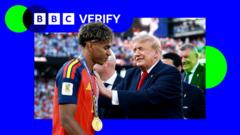
A Screen in the Dark
Her thumb flicked upward across the glass. It was three in the morning in a cramped apartment outside Lyon, and Maya could not sleep. Outside her window, rain slicked the cobblestones. Inside, the blue glow of her phone illuminated a face lined with exhaustion.
She was not looking for political drama. She just wanted soccer highlights.
Instead, a video played. High-definition pitch action. A packed stadium roaring under blinding floodlights. The crowd was a sea of chanting, waving fans. Then, the camera cut to a luxury box. There he was: Donald Trump, standing, gesturing, surrounded by security, looking directly toward the turf. The caption above the video was short, confident, and punctuated with fire emojis: Trump takes over the World Cup final. Look at this crowd reaction!
Maya paused. Something felt off. She checked the view counter. Four million. Five million. The numbers ticked upward in real time, a digital odometer running at breakneck speed.
She closed the app and tried to sleep. But the illusion had already done its work. Across three time zones, tens of thousands of people were already arguing in the comment sections, taking side-by-side political stands, and building entire worldviews around a moment that never actually happened.
The Anatomy of a Phantom Moment
Fabrication does not need to be sophisticated to be lethal. It just needs to arrive at the precise moment your guard is down.
During massive global events—when hundreds of millions of eyes converge on a single green pitch—the internet becomes a pressure cooker of emotion. We are hungry for commentary. We want drama. We crave confirmation that the world is moving in the direction we already suspect it is.
That night, as the match played out in reality, a parallel tournament was being contested across social feeds. Accounts with blue checkmarks dropped short, cropped video clips claiming the former president had arrived to a thunderous ovation—or, depending on which side of the political algorithm you inhabited, a chorus of deafening boos.
The clips were real footage, sure. But they were harvested from years past, chopped up, re-stitched, and dropped into the present like a temporal smoke grenade.
One viral post mashed together audio from an entirely different stadium riot with a ten-second clip of Trump attending a college football game years prior. Another used a completely fabricated overlay to simulate a live news banner. Within two hours, these posts had accumulated more views than most local news broadcasts reach in a month.
It was fast. It was cheap. And it worked.
Why Our Brains Fall for the Bait
Think of digital information like water pouring through a sieve. When the stream is a trickle, your mind has time to inspect each drop. You check the source. You look at the lighting. You notice that the banner font looks slightly off.
But when a global event happens, that trickle turns into a firehose.
Your brain starts taking shortcuts. Neuroscientists call this cognitive ease. If a video matches what you already feel—if it confirms your hopes or validates your outrage—your brain lets it slide right through the mesh. You do not verify. You retweet. You share. You send it to a group chat with a single line: Can you believe this?
By the time fact-checkers sit down at their desks, scrub the audio, trace the original keyframes, and draft a quiet, measured correction, the emotional footprint is already set in stone. The original post has twenty million impressions. The correction gets forty-three retweets.
Truth travels by foot. Falsehood flies on jet fuel.
The Human Cost of Silent Deception
It is easy to brush this off as victimless political noise. It feels distant. Abstract. A few million clicks on a screen.
It is not abstract.
Consider Elena, a high school social studies teacher who spent two hours the following morning trying to manage a classroom debate that had completely derailed. Half her students had spent the night watching recycled, out-of-context clips on short-form video apps. They were convinced of a reality that did not exist, using manufactured moments as ammunition against one another.
When she tried to explain that the videos were miscaptioned, a student looked at her with genuine, unironic skepticism: "How can it be fake? I saw it with my own eyes."
That is the true casualty of mass-scale viral deception. It does not just trick people; it erodes our shared reality until even the ground beneath our feet feels negotiable. When everything can be a lie, nothing can be trusted—not the news, not the institutions, and certainly not each other.
Stopping the Cycle Before the Next Whistle
We cannot code our way out of human nature. The algorithms are built to maximize engagement, and nothing engages human beings quite like outrage and spectacle.
The defense does not start with better software. It starts with a pause.
It starts in the quiet room at three in the morning, when the thumb hovers over the share button. It starts when we recognize that itch in our chest—that sudden surge of vindication or anger—as a warning sign rather than an invitation to react.
Maya put her phone face down on the nightstand. The rain was still falling outside. In the dark, without the glow of a hyper-optimized feed pushing phantom narratives into her head, the quiet returned.
The stadium lights were off. The crowd had gone home. And for the first time that night, reality was allowed to just be what it actually was.