Riad Bouchaker, a 52-year-old naturalized Irish citizen originally from Algeria, has been sentenced to life in prison for the November 2023 knife attack outside a primary school on Parnell Square East in Dublin. The brutal assault left three young children and a care worker critically injured, while simultaneously acting as the flashpoint for the worst civil unrest the Irish capital has seen in decades. A court handed down the maximum sentence following his conviction for attempted murder and serious assault, closing the criminal chapter on an afternoon that permanently altered Ireland’s social and political fabric.
The facts of the case are stark. On the afternoon of November 23, 2023, as children were lining up to leave Gaelscoil Coláiste Mhuire, a 30-centimeter kitchen knife was used to inflict catastrophic injuries on innocent bystanders. A five-year-old girl suffered devastating brain injuries that required months of intensive hospital care and ongoing rehabilitation. Two other children, a five-year-old boy and a six-year-old girl, sustained serious wounds. Leanne Flynn, a care worker who threw herself between the attacker and the children, was stabbed repeatedly while trying to shield them from harm.
Bystanders intervened immediately. Caio Benicio, a Brazilian delivery driver passing by on his motorbike, used his helmet as a weapon to strike the assailant and knock him to the ground. Other members of the public joined in to disarm and restrain Bouchaker until emergency services arrived. This raw display of civic courage stood in sharp contrast to what unfolded on the streets of Dublin just hours later.
Anatomy of a Misinformation Firestorm
Within minutes of the emergency response, rumors began circulating on encrypted messaging apps and mainstream social media platforms. Unverified claims asserted that the perpetrator was an undocumented migrant who had recently arrived in the country, that the children had died, and that the state was actively covering up the details of the attack. None of these claims were true at the time they were posted, yet they spread faster than official Gardaí communications could counter them.
The mechanics of this digital contagion reveal a critical vulnerability in modern crisis response. Far-right agitators, many of whom had spent months organizing protests outside asylum-seeker accommodation centers across Ireland, seized upon the tragedy. They utilized voice notes on WhatsApp and livestreams on Telegram to summon followers to the city center. The message was clear and incendiary. Come to Parnell Square.
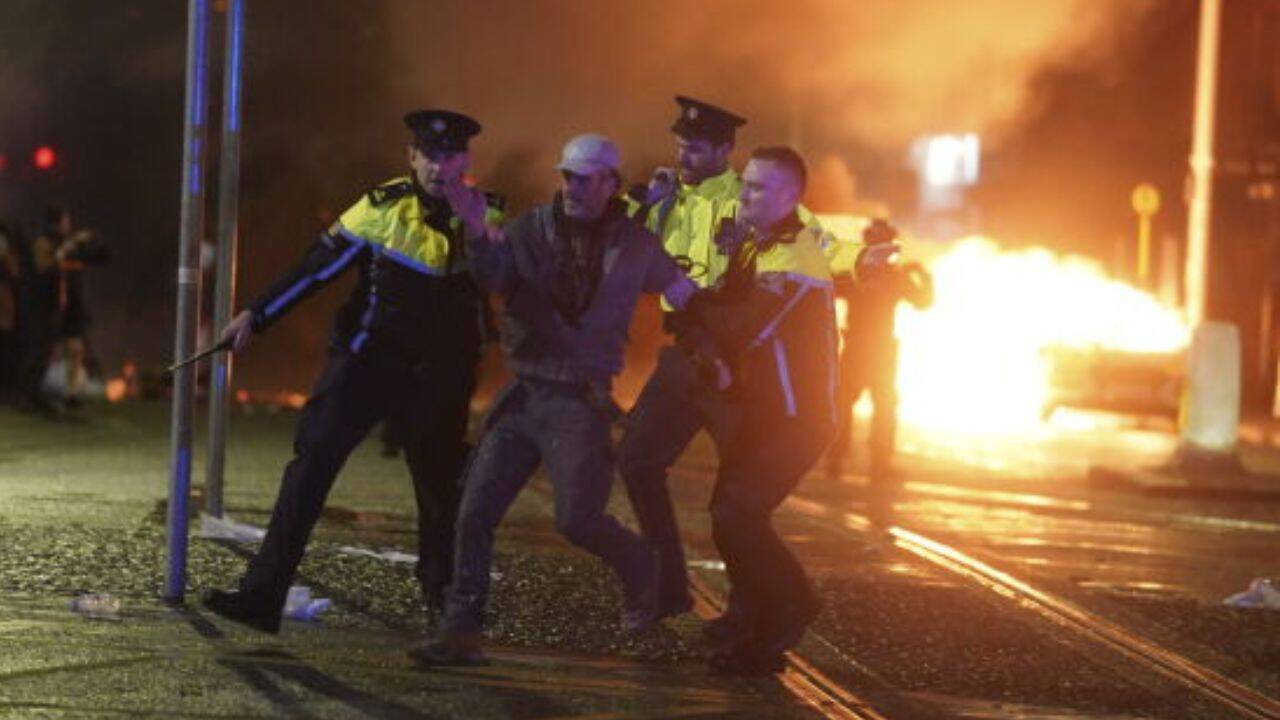
By early evening, a crowd had gathered near the crime scene, rapidly escalating from angry vocal protests into targeted violence. Rioters attacked Gardaí officers with fireworks, bottles, and metal poles. Public infrastructure became a primary target. Dublin Bus vehicles, Luas trams, and Garda patrol cars were set ablaze, sending thick plumes of black smoke over the River Liffey. Looting quickly followed, with opportunistic criminals smashing windows along O'Connell Street and Henry Street, stripping high-end retail stores of merchandise while riot police struggled to regain control of the thoroughfare.
The Intelligence and Policing Deficit
The scale of the destruction exposed severe operational shortcomings within An Garda Síochána. For years, security analysts and rank-and-file officers had warned that the force was under-resourced and ill-equipped to handle coordinated public disorder. When the violence erupted on November 23, the initial response was overwhelmed. Frontline officers lacked adequate protective gear, and the deployment of the Public Order Unit was delayed by traffic gridlock and logistical bottlenecks.
Garda Commissioner Drew Harris later attributed the chaos to a "lunatic, hooligan faction driven by far-right ideology." While accurate in describing the instigators, that assessment glossed over the intelligence failures that allowed such a volatile mobilization to catch the state off guard. Authorities had monitored online rhetoric escalating throughout 2023, including anti-immigrant demonstrations outside Leinster House and arson attacks on properties rumored to house asylum seekers. Yet, the operational doctrine remained reactive rather than preventative.
Following the riots, the Irish government moved to rectify these tactical gaps. Strong public-order policing tools, long resisted in a country proud of its unarmed community policing model, were suddenly fast-tracked. Water cannons were borrowed from the Police Service of Northern Ireland, stronger incapacitant sprays were issued to frontline personnel, and round-headed batons were introduced for riot squads. The state realized, belatedly, that traditional Irish policing methods were insufficient against mobs radicalized online.
The Man Behind the Blade
Understanding the Parnell Square attack requires separating the political exploitation of the event from the actual profile of the perpetrator. Riad Bouchaker was not a recent arrival crossing the border illegally. He had lived in Ireland for over two decades, having gained Irish citizenship years prior. Court proceedings painted a picture of a man who had become increasingly isolated, erratic, and detached from reality.
Before the attack, Bouchaker had come to the attention of authorities, though not for ideological extremism. In May 2023, just six months before the Parnell Square stabbings, he had been arrested in connection with another knife incident in Dublin city center. However, he was not prosecuted for that offense after medical assessments determined he was suffering from severe mental health issues, stemming in part from a brain tumor that had been surgically removed years earlier.
This detail highlights a systemic failure that sits entirely outside the immigration debate. Ireland’s mental health services and forensic psychiatric facilities have faced chronic underfunding and bed shortages for decades. Individuals exhibiting acute psychiatric distress frequently fall through the cracks between the criminal justice system and the health service. When Bouchaker walked onto Parnell Square East with a knife in November 2023, he was a man whose deteriorating mental state had already triggered warning signs that the state failed to contain.
The Legal Reckoning
The path to a life sentence was neither swift nor straightforward. Due to the severity of the head injuries Bouchaker sustained when bystanders intervened to stop him, his initial court appearances were delayed while he underwent extensive medical treatment. Questions regarding his fitness to plead dominated early procedural hearings, requiring exhaustive psychiatric evaluations by both defense and prosecution experts.
Ultimately, the court determined he was fit to stand trial. Prosecutors presented overwhelming physical and eyewitness evidence, including CCTV footage capturing the terrifying speed of the assault and DNA evidence linking Bouchaker directly to the weapon. The defense focused heavily on his diminished mental capacity and neurological history, attempting to mitigate his culpability.
The sentencing judge rejected the notion that his medical history excused the calculated nature of the violence, noting the extreme vulnerability of the victims and the lifelong trauma inflicted upon the survivors and their families. Under Irish law, a life sentence for attempted murder is discretionary rather than mandatory, reserved for the most egregious crimes where the intent to kill is undeniable and the harm inflicted is catastrophic. By imposing the maximum penalty, the judiciary underscored the gravity of an attack targeting young children outside their school gates.
The Shift in Irish Political Discourse
The legacy of November 23, 2023, extends far beyond the walls of the Central Criminal Court or the charred asphalt of O'Connell Street. For decades, Ireland was viewed across Europe as an anomaly—a Western democracy without a significant anti-immigrant or nationalist political movement. Economic prosperity, a shared history of emigration, and a proportional representation electoral system seemed to insulate the country from the populist surges seen in the United Kingdom, France, and Germany.
That consensus shattered on the night of the riots. The events exposed deep-seated grievances within working-class communities in Dublin and rural towns, where decades of chronic housing shortages, strained healthcare systems, and neglected public services collided with a rapid increase in asylum applications following the invasion of Ukraine and global displacement crises.
Bad-faith actors successfully weaponized these legitimate socio-economic frustrations. By framing the housing crisis solely as a consequence of immigration rather than years of failed state policy, agitators gained traction among demographics that felt ignored by the political establishment in Dublin. Subsequent local and European elections saw independent candidates campaigning on explicitly anti-immigration platforms make measurable gains, forcing mainstream parties like Fine Gael, Fianna Fáil, and Sinn Féin to recalibrate their messaging on border enforcement and asylum processing.
The Accountability Vacuum for Tech Platforms
While dozens of rioters have since been arrested, charged, and sentenced for public order offenses, arson, and looting, the digital infrastructure that facilitated the chaos remains largely intact. Irish media regulators and government ministers summoned executives from major social media companies in the aftermath of the violence, demanding explanations for why incitement to violence was allowed to trend unchecked during an active emergency.
The platforms cited their existing moderation policies and the challenges of policing encrypted networks. Yet, the reality remains unchanged. Algorithms designed to maximize engagement inherently prioritize outrage, fear, and tribalism. During the Dublin riots, those algorithms acted as force multipliers for street violence, turning a localized, horrific crime into a city-wide insurrection within hours.
Ireland serves as the European headquarters for most of the world's largest technology firms, placing Dublin in a unique regulatory position through the Digital Services Act. However, enforcement mechanisms move at a bureaucratic pace that is fundamentally mismatched with the real-time speed of digital radicalization.
The Human Cost Left Behind
Amid the geopolitical debates, policing reforms, and courtroom verdicts, the primary victims of Parnell Square East have borne the quietest, heaviest burden. The five-year-old girl who suffered the most severe injuries spent over 280 days in Temple Street Children's University Hospital before finally being discharged to continue her recovery at home. Her family has documented the grueling reality of relearning basic functions, navigating complex neurological care, and adapting to a completely altered future.
Leanne Flynn, the care worker who intervened, also endured a prolonged physical and psychological recovery, having sustained life-threatening stab wounds while protecting the children in her charge. The wider community of Gaelscoil Coláiste Mhuire—parents, teachers, and classmates—has had to rebuild a sense of safety in a space that was violently violated.
The public response to the victims offered a counter-narrative to the hatred seen on the night of the riots. An online fundraising campaign established for the injured children and the care worker raised hundreds of thousands of euros within days. Separately, a fundraiser set up to "buy a pint" for Caio Benicio, the delivery driver who halted the attack, generated over €360,000, reflecting a profound public desire to reward genuine heroism over destructive rage.
The life sentence handed down to Riad Bouchaker delivers formal justice for the crimes committed outside that schoolhouse door, yet the deeper fractures exposed in Dublin—between neglected mental health systems, reactive policing, and a volatile digital public square—remain unresolved.