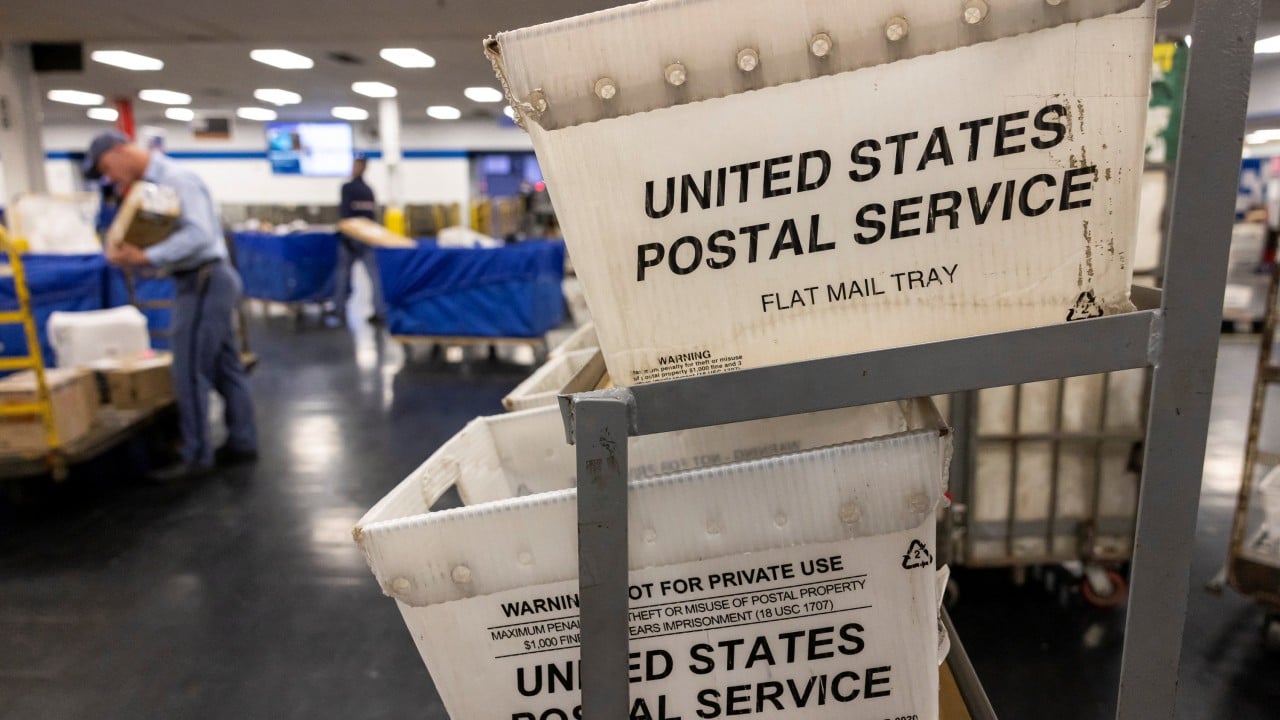
Moving millions of mail-in ballots through a national postal network during the final seventy-two hours before an election deadline is not a standard distribution problem. It is an acute exercise in reverse logistics under hard temporal constraints. Unlike commercial parcel delivery, where a twenty-four-hour delay represents a minor service-level breach, a ballot arriving after the statutory poll-closing window suffers a total loss of utility. To understand how the United States Postal Service executes this final sprint, one must examine the operational shift from standard batch-processing economics to high-touch, manual exception handling.
The Structural Friction of Standard Mail Processing
Standard postal operations rely on economies of scale, automated optical character recognition, and hub-and-spoke consolidation. Under normal operating conditions, a piece of First-Class Mail enters a collection box, travels to a Processing and Distribution Center, gets sorted by high-speed Delivery Bar Code Sorters, and moves via consolidated truckload to a local delivery unit. This architecture optimizes cost per piece, not minimum transit time for individual items. For another perspective, read: this related article.
Election mail breaks this optimization model in three distinct ways:
- Asymmetric Flow Dynamics: Standard mail moves primarily from centralized commercial senders to dispersed residential addresses. Ballot logistics require a synchronized two-way surge. Outbound ballots must reach dispersed voters simultaneously, while inbound completed ballots must converge from millions of residential endpoints onto a small number of county election boards within a compressed window.
- Non-Standard Physical Specifications: Return ballot envelopes vary widely in weight, thickness, and paper stock across thousands of local jurisdictions. Heavy cardstock, multiple privacy sleeves, and irregular dimensions frequently trigger jams in automated sorting equipment, forcing items out of the high-speed stream and into manual sorting bins.
- Hard Statutory Deadlines: Commercial logistics operate on rolling delivery windows. Election logistics operate on a cliff. In jurisdictions requiring receipt by Election Day rather than a postmark, the network must achieve near-zero latency during the final three days of the cycle.
When the calendar hits the final week before an election, relying on automated batch processing creates unacceptable tail risk. A single missed dispatch truck at a regional hub can strand thousands of ballots beyond the statutory cutoff. Further reporting on the subject has been provided by Associated Press.
The Extraordinary Measures Protocol
To eliminate tail risk, postal operations abandon standard routing protocols and deploy a specialized operational overlay known internally as Extraordinary Measures. This framework trades financial efficiency for speed and visibility, effectively creating a parallel network inside the existing infrastructure.
The architecture of this late-stage intervention rests on four operational mechanisms:
Bypassing Regional Consolidation Hubs
Under normal protocols, a ballot mailed in a suburban town might travel fifty miles to a regional sorting facility, get processed overnight, and travel forty-five miles back to the county election office just five miles from its origin. During the final sprint, local postmasters intercept ballots at the retail or collection level. Local offices perform manual front-end sorting, pulling election mail directly from the incoming stream and dispatching it straight to the destination county board of elections via dedicated local couriers. This eliminates at least two handling touches and twenty-four to forty-eight hours of transit time.
Dedicated Transportation Networks
Standard mail moves on scheduled, consolidated freight routes that wait until trucks reach capacity thresholds before departing. In the final days of an election cycle, postal logistics managers decouple ballot transport from standard freight schedules. If a single tray of ballots sits at a processing facility, management authorizes a dedicated box truck or passenger van to run that single tray directly to the local election office. Utilization rates drop to near zero; velocity becomes the sole metric.
Physical Sweep Protocols
Automated systems cannot detect a ballot trapped behind a sorting belt or stuck at the bottom of a canvas hamper. To counter physical attrition, facilities institute mandatory, timed sweeps of all processing floors, collection boxes, and dock areas. Supervisors sign off on physical verification logs confirming that every piece of election mail has cleared the building before the final daily dispatch. This introduces human redundancy into an otherwise automated pipeline.
Real-Time Telemetry and Exception Tracking
Modern ballot envelopes feature Intelligent Mail barcodes that allow the postal system to track individual pieces as they pass through sorting machines. During the final sprint, data analysts monitor scan gaps—instances where an outbound or inbound ballot receives an origin scan but fails to register an expected downstream scan within a defined threshold. Operations teams use these telemetry alerts to physically locate delayed trays on the warehouse floor and expedite them manually.
The Last-Mile Bottleneck and Human Capital Constraints
While automated sorting centers handle millions of pieces per hour, the final transfer of custody between the postal service and local election officials remains heavily dependent on manual labor. This interface represents the highest point of friction in the entire lifecycle of a mail-in ballot.
Each local election jurisdiction operates under distinct state laws regarding chain of custody, signature verification, and intake documentation. Postal clerks cannot simply drop pallets of mail at a county courthouse loading dock. Every transfer requires documented handoffs, physical counts, and verification of postmarks.
Postmarking itself presents a subtle operational hazard. High-speed cancellation machines apply ink postmarks automatically, but ballots bypassed from automated machines for local hand-delivery do not pass through these cancellers. In states where a valid postmark determines whether a late-arriving ballot is counted, postal workers must manually hand-stamp thousands of envelopes. A failure to apply a legible manual postmark invalidates an otherwise timely ballot, shifting the failure mode from transit delay to administrative defect.
Furthermore, the final sprint coincides with peak seasonal volume for commercial e-commerce. Postal carriers and plant operators must execute manual ballot sweeps while simultaneously managing rising parcel volumes. Fatigue among carriers and clerks increases the probability of sorting errors, requiring supervisory audits at every handoff node.
Systemic Vulnerabilities and Operational Limits
No logistical overlay can completely neutralize upstream variables outside the carrier's control. Three structural vulnerabilities limit the effectiveness of late-stage postal interventions:
- The Voter Latency Curve: Regardless of how fast the network moves, transit time cannot drop below physical transport limits. When large cohorts of voters deposit ballots into blue collection boxes on the afternoon of Election Day in states without postmark grace periods, no logistical intervention can move those ballots across a county before polls close at 7:00 PM or 8:00 PM.
- Address Hygiene and Undeliverable Mail: Outbound ballot velocity depends entirely on the accuracy of state voter registration rolls. Outdated addresses trigger the Undeliverable-As-Addressed workflow, requiring manual return-to-sender processing. Each undeliverable ballot consumes disproportionate manual labor and obscures accurate turnout telemetry.
- Jurisdictional Fragmentation: The United States does not run a single national election; it runs over ten thousand local elections simultaneously. Envelope designs, barcode placements, and return addresses vary across counties. When a voter drops a ballot in a collection box outside their home county, the postal network must route that single piece across regional boundaries, subjecting it to standard long-haul transit timelines where local bypass protocols cannot apply.
Strategic Allocation of Late-Stage Capacity
Managing the final seventy-two hours of election mail requires treating the postal network not as a utility, but as a triage system. Operations leaders cannot apply maximum manual intervention to every piece of mail simultaneously without collapsing baseline network throughput.
The optimal operational play relies on dynamic resource allocation triggered by statutory deadlines. In states enforcing strict Election Day receipt cutoffs, postal management must shift one hundred percent of local courier capacity to intra-county interception forty-eight hours prior to poll closing, sacrificing inter-regional transit speed for local capture. Conversely, in states honoring postmark deadlines, operational priority must pivot from physical transport velocity to rigorous manual cancellation auditing at every retail and collection point, ensuring every late-entering envelope receives an indisputable timestamp before entering the long-haul pipeline.