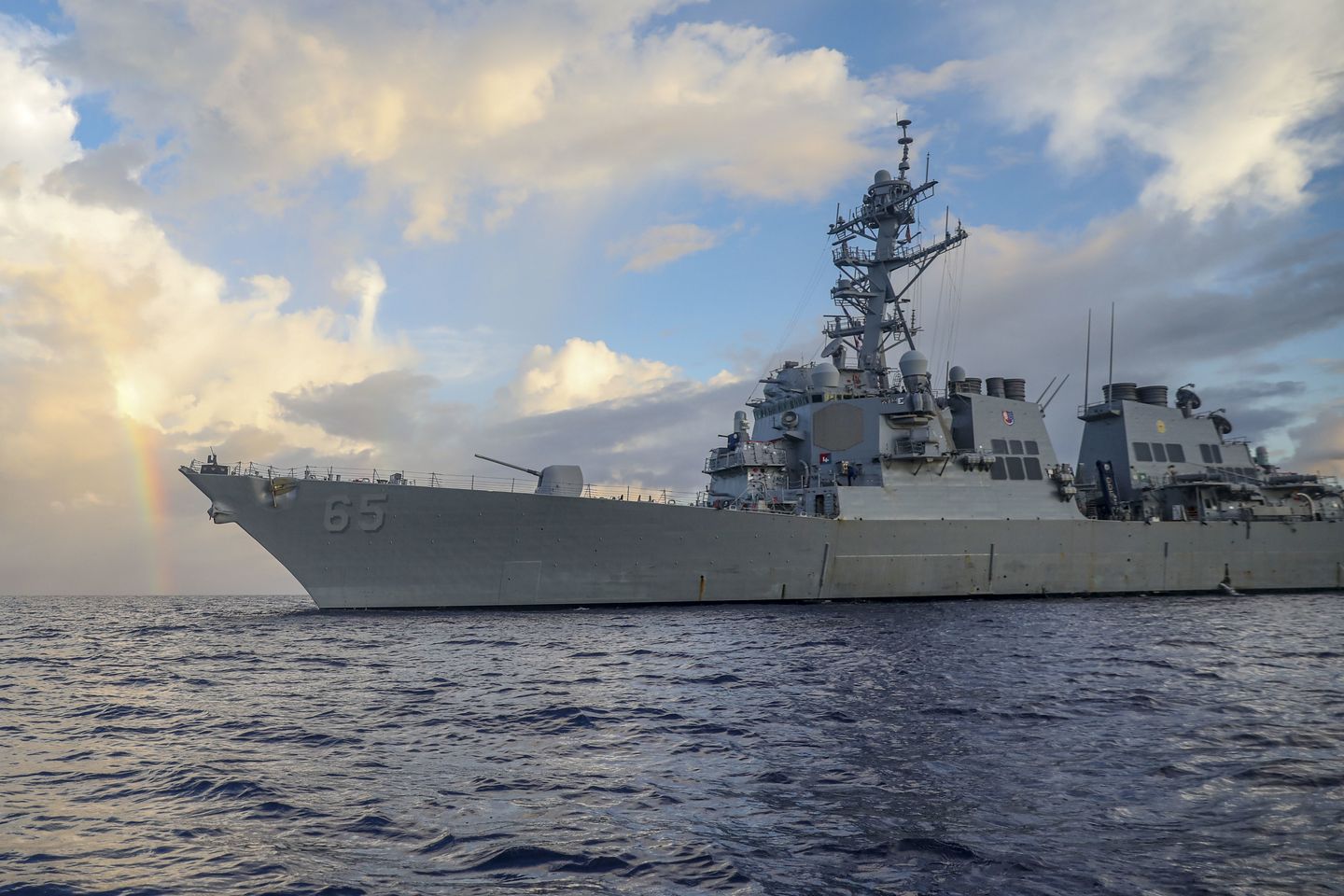
Salt does not merely coat a hull; it claims it. It works its way into microscopic seams, scales over glass, and leaves a chalky residue that smells of ancient depths and sulfur. When a multi-billion-dollar guided-missile destroyer stops moving in the contested expanse of the South China Sea, the salt stops being a background detail. It becomes a witness.
For ninety-six hours, the vessel was a ghost ship of sorts. Not because its crew had vanished, but because its electronic heartbeat—the roaring pulse of gas turbine engines and the ceaseless hum of combat management systems—was replaced by a profound, unnatural stillness.
Four days without power.
To understand what that means, you have to look past the dry maritime incident reports. You have to step inside the skin of a nineteen-year-old machinist’s mate standing three decks below the waterline in total, suffocating blackness.
The Anatomy of Silence
Modern warships are not built for silence. They are built for noise, vibration, and perpetual motion. Every cubic inch of air is forced through massive ventilation trunks. Every bulkhead hums with electrical current feeding radar arrays, sonar domes, fire-control computers, and climate control units designed to keep sensitive microprocessors from baking in their own heat.
When the power dies, the noise cuts out first.
It is a jarring, physical sensation. The sudden drop in ambient decibels feels like falling down an elevator shaft. Then comes the heat. Without cooling systems, the steel labyrinth of a destroyer begins to trap body heat, residual machinery warmth, and the oppressive ambient humidity of the tropics. The temperature in the berthing compartments climbs steadily, turning steel berths into ovens.
Consider what happens next: the air gets thick.
Imagine standing in a windowless room where the oxygen is slowly thinning, lit only by the amber glow of emergency battery-backed lanterns. This was the reality for sailors who suddenly found themselves cut off from the outside world, their state-of-the-art radar screens blank, their communications arrays dark, and their primary weapons systems offline in one of the most volatile geopolitical choke points on Earth.
In naval engineering, redundancy is religion. Every critical system has a backup, and every backup has a safeguard. Yet, systems fail. Whether triggered by an anomalous surge, a catastrophic switchboard failure, or a cascading mechanical glitch, the total loss of propulsion and primary electrical generation reduces a floating fortress into an isolated island of steel.
The Weight of the Horizon
Above deck, the South China Sea stretches out in all directions, deceptive in its calm. It is a body of water crisscrossed by commercial shipping lanes, bristling with regional naval patrols, and watched by a dozen different shores through the lens of long-range optics and satellite surveillance.
To be dead in the water here is not merely an engineering inconvenience. It is a vulnerability.
Think about the psychological toll on the crew. A warship at sea is an organism. Its survival depends entirely on the collective synchronization of hundreds of individuals performing repetitive, high-stakes tasks. When the engine stops, the rhythm breaks. Sailors do not panic—military training beats the instinct of panic out of you long before you ever set foot on a gangway—but they feel the weight of exposure.
Every watchstander knows the stakes. They know the airspace above them is monitored. They know commercial freighters are steaming past on invisible horizons, their radar scopes registering an anomaly—a stationary dot where a fast-moving naval asset ought to be.
Down in the bowels of the ship, teams work in shifts by flashlight. The air smells of sweat, stale coffee, and the metallic tang of ozone as electricians probe massive circuit breakers that refuse to reset. There is no air conditioning. Shirts are discarded. Hands are blistered and blackened by grease. Every minute stretches into an hour. Every hour feels like a shift in tectonic plates.
The Human Cost Behind the Headlines
We consume news as shorthand. A headline flashes across a screen: Navy destroyer stuck in South China Sea for 4 days without power. We read the sentence in two seconds, register the geopolitical friction, and scroll to the next distraction.
We rarely pause to think about the perishable food rotting in warm galleys. We rarely think about the sanitation systems failing, forcing sailors to ration every drop of potable water while working manual labor in hundred-degree compartments. We rarely think about the families back home in San Diego or Yokosuka staring at silent phones, wondering why their sailor’s scheduled message never arrived.
This is the hidden cost of modern military readiness. It is not just about multi-billion-dollar defense budgets or high-altitude strategy meetings in Washington. It is about a twenty-year-old damage controlman eating a warm MRE in the dark, wondering when the generators will cough back to life. It is about leadership tested not in the fiery flash of combat, but in the slow, grinding endurance of a technical crisis far from home.
When the auxiliary diesel generators finally caught, sputtering into a heavy, soot-filled roar that sent vibrations shivering back up through the keel, the reaction was not cinematic cheering. It was a collective exhalation.
Lights flickered. Consoles booted up with their familiar, synthetic chime. The ventilation fans whined, dragging fresh, cooler air down into the metallic lungs of the ship. The invisible shield of power and capability settled back over the vessel, erasing the vulnerability of the past ninety-six hours.
Out on the deck, the salt still clung to the rails, indifferent to the crisis that had just passed. The destroyer cut a clean white wake through the gray-blue swell, moving forward once more into the vast, watching sea.


