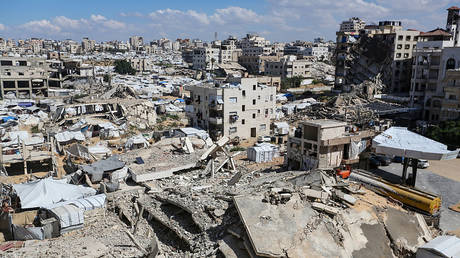
Time does not move straight here. It circles. It loops back on itself like a wounded animal seeking the place where it was born.
Outside, the air smells of crushed concrete and old iron. It is a sharp, metallic odor that clings to the lining of your throat long after you have stopped running. For most of the world, the calendar has ticked forward through twelve months of meetings, elections, shifting markets, and the quiet accumulation of ordinary days. But here, inside the small, crowded rooms where strangers share blankets and the floorboards vibrate with distant thunder, time stopped somewhere around a Tuesday in October.
Nearly a year has passed since the war began its heavy, grinding work. And still, the sirens do not announce the arrival of death; they merely confirm what everyone already knows.
When you look
The Calendar That No Longer Counts Days
news
Time used to move differently before the fences went up. There were mornings when the smell of damp earth and roasting coffee beans would drift down narrow alleyways, and the only sound worth measuring was the distant clatter of a tin cup or the lazy bray of a neighbor's donkey. Today, time is measured in smoke. It is measured in the hollow thud of a distant shell striking concrete, and the quiet, frantic rustle of a mother counting out the remaining grains of flour at the bottom of a sack.
Nearly three hundred and sixty-five rotations of the earth have passed since the diplomatic cables started humming about a ceasefire. A full year. In the language of headlines, it is a milestone. In the language of statistics, it is a marker of escalation and endurance. But numbers on a screen do not bleed. They do not capture the profound weight of a calendar that has stopped functioning as a tool for planning planting seasons or school terms, and has instead become an unyielding archive of empty chairs.
Consider what a year actually means when the roof above your head has shifted three times. A child who was learning to form the letters of the alphabet in the autumn of 2023 has now spent an entire developmental cycle ducking sounds that shatter glass and nerves. This is not just a conflict zone. It is an ecosystem of endurance where the ordinary rules of human existence have been compressed into a brutal, daily negotiation for water, shelter, and breath.
The dry wire reports speak of ongoing military maneuvers, of targeted strikes in crowded neighborhoods, and of the agonizingly slow crawl of negotiators sitting in air-conditioned rooms thousands of miles away. They parse verbs. They debate clauses. They issue statements about humanitarian pauses that fracture before the ink on the agreement is dry. Meanwhile, down on the ground, the reality is starkly tactile. It smells of sulfur and ruined plaster. It feels like the suffocating heat of a makeshift tent pitched on a patch of dust that used to be a backyard.
We have grown dangerously accustomed to the vocabulary of catastrophe. We hear phrases like infrastructural collapse and systemic displacement so often that they begin to sound like meteorological data—unfortunate, perhaps, but inevitable. Yet every single digit in the casualty tolls represents a universe extinguished. It is a baker who knew the exact proportions of salt and water to make a crust sing. It is a student who dreamed of building bridges over rivers she had never crossed. It is a grandfather who kept the keys to a house that no longer has a door.
As the shadow of this grim anniversary stretches across the region, the most terrifying aspect is not the violence itself, but the numbing routine of it. The world adjusts its gaze. News segments shorten. Scroll speeds increase. The human mind, overwhelmed by the sheer volume of suffering, builds scar tissue around its empathy. We look away because looking hurts, and because the promised cessation of hostilities always seems to be hovering just out of reach like a mirage on a scorching asphalt road.
To understand the true cost of this protracted stalemate, you have to look past the military briefings and the political posturing. You have to look at the hands of a surgeon working by the flickering light of a dying mobile phone because the generators ran out of fuel hours ago. You have to listen to the silence in a room where three brothers used to argue over football teams.
There is an arithmetic to war that goes far beyond body counts. It is calculated in the erasure of futures, the fracturing of generational memory, and the normalization of the unthinkable. The ceasefire that remains eternally "near" is a cruel ghost. It taunts those who huddle beneath tarps with the possibility of tomorrow, while today brings another siren, another collapse, another name added to a ledger that grows heavier with every setting sun.
The sun goes down over the coast, painting the plumes of smoke in shades of bruised purple and gold. Somewhere in the dark, a child shifts in their sleep, dreaming of a place where walls do not crumble and where days are counted in laughter instead of sirens. The world outside keeps turning, waiting for a signature on a paper, while beneath the falling dusk, another hour quietly slips away into the ash.