Malaysia is playing a dangerous game of "pretend" with its food security.
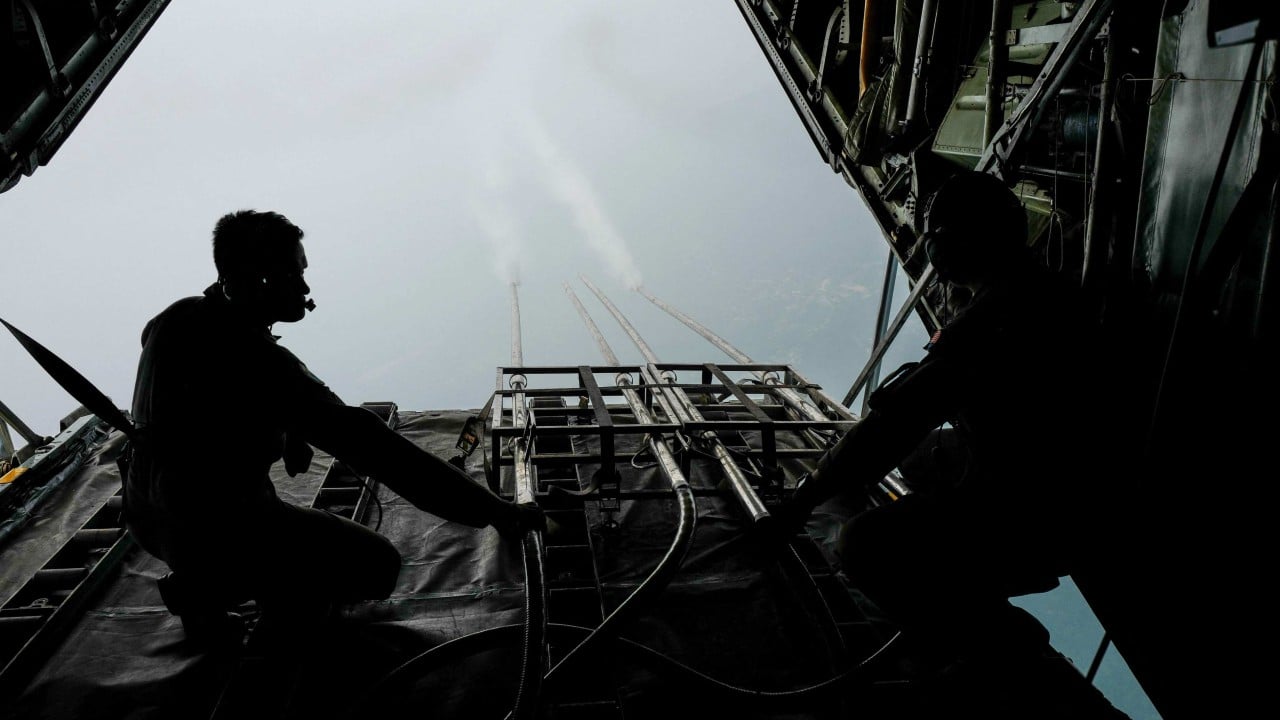
The recent headlines are predictable. Drought parches the northern rice bowl. The government panics. The Royal Malaysian Air Force scrambles C-130s to spray sodium chloride into the atmosphere. The media treats it like a heroic rescue mission. It isn't. It is an expensive, bureaucratic rain dance that masks a refusal to fix a broken agricultural system.
Cloud seeding is the ultimate placebo of the climate crisis. It allows politicians to look like they are "doing something" while ignoring the fact that their irrigation infrastructure belongs in the 1970s. We are burning jet fuel to chase moisture that may or may not exist, all while the real solutions sit gathering dust on a desk in Putrajaya.
The Thermodynamic Lie
Let’s get the science straight before the PR departments spin it further. Cloud seeding—specifically the glaciogenic or warm-cloud seeding used in Southeast Asia—requires specific conditions to work. You need moisture. You need the right updrafts. You need cloud depth.
If the sky is clear and the humidity is low, you can fly a fleet of planes over Kedah until the wings fall off and you won't get a drop of rain.
How It Works (And Why It Fails)
The process involves dispersing particles—usually salt or silver iodide—to act as cloud condensation nuclei (CCN). The theory is simple: water vapor needs a surface to cling to so it can form a droplet heavy enough to fall.
$PV = nRT$
In a drought, the $T$ (temperature) is high, and the $n$ (amount of gas/vapor) is often insufficient for the pressure $P$ and volume $V$ to reach the dew point. Cloud seeding does not create water. It merely attempts to squeeze water out of a sponge that is already bone-dry.
When the Malaysian government announces a "successful" seeding operation because it rained two days later, they are often claiming credit for a natural weather shift they didn't cause. In the industry, we call this "post hoc ergo propter hoc" logic—after this, therefore because of this. It's a fallacy that costs taxpayers millions.
The Rice Bowl is Leaking
The competitor articles love to focus on the "heroic" pilots. They rarely focus on the 40% to 50% water loss in the Muda Agricultural Development Authority (MADA) canals.
I have stood on the banks of these irrigation channels. They are clogged with silt, cracked by heat, and managed by systems that lack basic IoT monitoring. We are trying to "make rain" for fields that lose half their water to evaporation and seepage before it even reaches the roots of the paddy.
Investing in cloud seeding while ignoring irrigation efficiency is like trying to fill a bucket with a hole in the bottom by waiting for a thunderstorm. It is a spectacular failure of engineering priorities.
The Real Cost of a Rain Dance
A single cloud seeding mission isn't just about the salt. It involves:
- Military-grade logistics and fuel.
- Meteorological monitoring and radar standby.
- Opportunity costs of assets that could be used for actual disaster relief.
Meanwhile, the price of precision drip irrigation and automated sluice gates—technologies used successfully in water-scarce regions like Israel or parts of Australia—is deemed "too high." We prefer the gamble of the skies over the certainty of the ground.
Data Is Not the Enemy (Your Interpretation Is)
People often ask: "But doesn't the data show a 10% to 15% increase in rainfall from seeding?"
Here is the brutal honesty: even if you get that 15% increase, it is almost never enough to break a drought. A 15% increase on "next to nothing" is still "next to nothing." During a severe El Niño event, the atmospheric stability is so high that seeding is effectively neutralized.
We are using a scalpel to try and stop a forest fire.
Furthermore, cloud seeding is a "beggar-thy-neighbor" technology. If you successfully induce rain over a rice field in Kedah, are you stealing moisture that would have naturally fallen over a catchment area in Perak? The atmosphere is a closed system. We are tinkering with the water cycle without a full map of the unintended consequences.
The Silicon Valley of Rice (That Isn't Happening)
The "lazy consensus" says we need more rain. The contrarian truth is that we need rice that doesn't need as much rain.
While Malaysia spends its energy on atmospheric chemistry, other nations are doubling down on:
- Aerobic Rice Varieties: Strains that grow in non-flooded soil like wheat.
- AWD (Alternate Wetting and Drying): A technique that reduces water use by 30% without sacrificing yield.
- Subsurface Drip Irrigation: Delivering water directly to the root zone to eliminate evaporation.
These aren't "cool" like flying planes into storm clouds. They don't make for great evening news segments. But they actually secure the food supply.
The Sovereignty Myth
Relying on cloud seeding is a surrender of sovereignty. It acknowledges that our entire food security strategy is dependent on the whims of a changing climate. It is a reactive, "hope-based" policy.
If Malaysia wants to save its rice crop, it needs to stop looking up and start looking down. Stop the salt. Stop the sorties. Start the dredging. Fix the pipes. Build the reservoirs.
We are currently paying for a magic trick to distract us from the fact that the well is dry.
Cloud seeding is the "thoughts and prayers" of the agricultural world. It is a ritual performed by a government that has run out of ideas and is hoping the sky will bail them out of decades of infrastructure neglect.
The rice is dying because we treat water as an infinite gift rather than a finite resource that requires world-class management. No amount of sodium chloride in the stratosphere can fix a lack of political will on the ground.
Ground the planes. Fix the pipes.