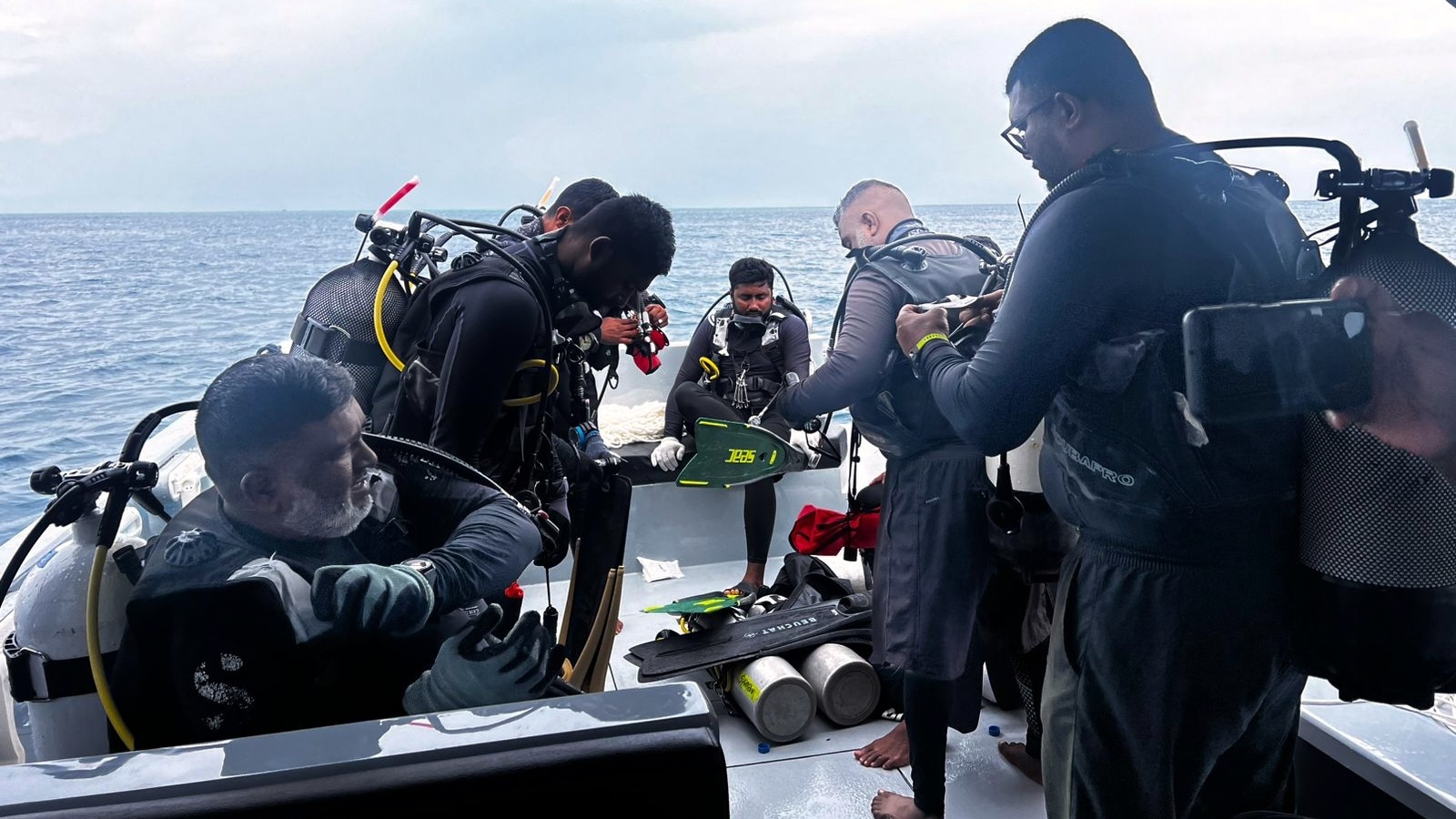
Underwater caves don't forgive mistakes. When you drop below the surface, the margin for error shrinks with every foot of depth. That reality hit home in the most devastating way possible in the tranquil waters of the Maldives.
Italy’s Foreign Ministry confirmed that specialized recovery teams located the bodies of four Italian scuba divers. They were trapped deep inside a treacherous underwater cave system in the Vaavu Atoll. This discovery brings a grim end to a four-day search operation that has already cost the life of a local military rescuer. Recently making news lately: The Tenerife Beach Safety Reality Tourists Need to Know Now.
It is the worst single diving accident in the history of the Maldives. The tragedy leaves the global diving community reeling and asking hard questions about safety limits, risk management, and the deceptive allure of deep overhead environments.
The Disastrous Timeline in Vaavu Atoll
The incident began on a Thursday morning near Alimathaa Island, a spot famous for its vibrant marine life and intense channel currents. Five Italian nationals, passengers on the luxury 36-meter liveaboard yacht Duke of York, geared up for a descent. Further insights regarding the matter are explored by Condé Nast Traveler.
They weren't casual tourists. The group included highly educated marine professionals. Monica Montefalcone was an associate professor of ecology at the University of Genoa and a passionate advocate for marine protection. Alongside her was her daughter, Giorgia Sommacal, marine biologist Federico Gualtieri, researcher Muriel Oddenino, and an experienced diving instructor, Gianluca Benedetti.
Montefalcone and Oddenino were in the Maldives on an official scientific mission to study climate change and tropical biodiversity. But this specific dive wasn't part of their university work. The University of Genoa later clarified the excursion was undertaken privately.
They targeted a cave system sitting at a depth of roughly 50 meters (164 feet).
By Thursday afternoon, the maritime coordination center received a distress call. The divers hadn't surfaced. Later that evening, rescuers recovered Gianluca Benedetti's body near the mouth of the cave. The other four remained missing, swallowed by the dark, multi-chambered cavern.
A Recovery Mission Marred by Death
Trying to find the remaining divers turned into a nightmare. The cave system is notoriously complex, divided into three large chambers connected by suffocatingly narrow passages. Rough weather and heavy swells hammered the site, making the entries highly unpredictable.
The local Maldivian forces paid a terrible price trying to bring the Italians home. On Saturday, Mohamed Mahudhee, a dedicated member of the Maldivian National Defense Force, suffered severe underwater decompression sickness during a high-risk search attempt. He was rushed to a hospital in the capital city of Malé but didn't survive. His death forced authorities to pause the operation. It proved just how hostile the environment was, even for trained military personnel.
Recognizing the extreme danger, the Maldives government and the Divers Alert Network Europe brought in heavy reinforcements. Three elite Finnish diving experts arrived on Sunday to spearhead the push into the deep overhead environment.
Using advanced closed-circuit rebreathers, which recycle exhaled gas and scrub carbon dioxide to extend dive times, the Finnish team finally penetrated the deepest section of the cave.
On Monday, Ahmed Shaam, a Maldives government spokesman, announced they found the four remaining bodies. They weren't scattered. They were clustered together in the third segment of the cave, the largest and innermost chamber. The local government is currently executing a staggered plan to recover the bodies over several days. Meanwhile, the Maldivian ministry of tourism has indefinitely suspended the operating license of the Duke of York.
The Danger of Exceeding Recreational Limits
To understand how a team of marine scientists and an instructor ended up in this situation, you have to look at the numbers. And the numbers don't lie.
The recreational diving limit in the Maldives is strictly set at 30 meters (98 feet). Most major global certification agencies, like PADI or SSI, cap absolute recreational limits at 40 meters (130 feet) for deep-certified divers.
When you drop to 50 meters, you cross a invisible but deadly line into technical diving. This realm demands specialized gas mixtures, redundant equipment, and extensive decompression planning. At that depth, breathing standard air becomes hazardous due to nitrogen narcosis. This condition mimics severe alcohol intoxication, slowing reaction times and stealing your ability to think clearly.
When you combine that depth with a cave environment, the danger multiplies exponentially.
- Silt-Outs: A single misplaced kick of a fin can stir up fine sediment from the cave floor. In seconds, visibility drops to zero. It's like being blindfolded in a maze.
- No Direct Ascent: In open water, if you panic, you can theoretically make an emergency ascent to the surface, risking bends but surviving. In a cave, there's a solid rock ceiling above you. Your only exit is the way you came in.
- Complex Orientation: The Vaavu Atoll caves aren't straight tunnels. They are jagged, twisting structures formed through coral reef architecture. It's shockingly easy to lose track of which narrow opening leads back to the sea.
While the exact cause of death for the group is still under official investigation, experts point to the lethal combination of depth, potential disorientation, and gas management failure. If a team encounters a problem at 50 meters inside a cave, their breathing gas vanishes rapidly under the high pressure. Panic accelerates that consumption.
Surviving the Deep Means Respecting the Rules
If you're a diver, or someone planning to explore the deep channels of the Indian Ocean, this tragedy offers heavy, non-negotiable lessons. You don't mess with the ocean's boundaries.
First, know your personal limits and stick to local regulations. The Maldives' 30-meter rule exists for a reason. The remote nature of these atolls means advanced medical care and recompression chambers are hours away by boat or floatplane. Pushing past those boundaries is gambling with your life.
Second, understand that eco-expertise or open-water experience doesn't translate to cave diving competence. Cave diving requires entirely separate certifications, specific guidelines, and different psychological conditioning. Never enter an overhead environment without a continuous guidelines tethered to the open ocean.
Never let a beautiful location fool you into complacency. The waters around Alimathaa Island are stunning, but the currents and underwater geography don't care about your vacation plans or your academic credentials. Treat the ocean with the absolute reverence it demands, or it will take everything from you.