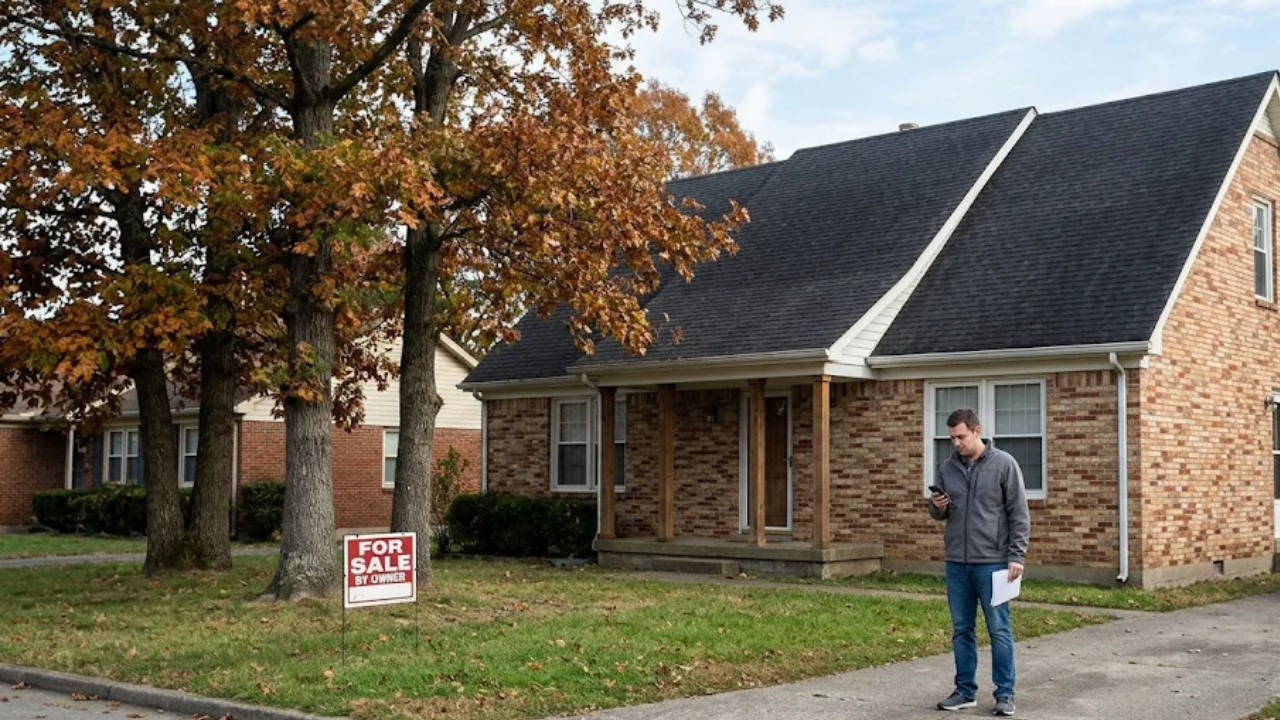
Imagine standing on a patch of grass you mowed every Saturday for twelve years, holding a pen over a stack of crisp legal papers, and being told you owe eighty-five thousand dollars to keep standing there.
Impossible.
That word feels sturdy until you meet a real estate contract dressed up in the quiet clothes of rescue, and suddenly the ground beneath your boots belongs to someone else who is charging you rent on your own memories.
In Kentucky, a homeowner found himself trapped inside that exact nightmare—a bizarre, suffocating loop where he alleges an agent effectively sold him back his own house while pressuring him to hand over an extra eighty-five thousand dollars. On paper, it sounds like a clerical glitch or a bad joke told at a county fair. In reality, it is the logical endpoint of an industry blind spot where financial desperation meets aggressive equity stripping, and where the person holding the clipboard knows every rule of the maze while the person holding the deed is just trying not to lose their roof.
To understand how a grown man ends up paying a ransom for a house he already owned, you have to strip away the sterile jargon of property law and look at what happens when a human being runs out of breathing room.
The Anatomy of a Slow-Motion Ambush
Most people think property theft looks like a forged signature in the dead of night or a shadowy hacker rerouting a wire transfer from an offshore laptop. Real estate predation rarely wears a ski mask. More often, it wears a clean blazer, carries a warm cup of coffee to your kitchen table, and speaks in the soothing cadence of someone who is here to save you from the bank.
Picture a hypothetical homeowner—let’s call him Arthur, though his story echoes the real Kentucky dispute and thousands of quiet foreclosures across the American heartland. Arthur isn't reckless. He worked with his hands, paid his mortgage through lean winters, and built up a modest cushion of home equity—the slow, quiet wealth that working people rely on when everything else fails. Then comes a rough patch. A medical bill, a layoff, a sudden spike in escrow taxes. Suddenly, the monthly payment is three months behind, and the certified letters start arriving with red ink on the envelopes.
Panic makes the edges of the world blurry. When you are staring at a foreclosure notice, you do not read forty-page closing disclosures with the sharp eyes of a corporate litigator. You look for a lifeline.
Enter the middleman.
In scenarios like the one alleged in Kentucky, the pitch begins with a promise of relief. The agent or investor offers a way out—a creative restructuring, a temporary bridge, a wholesale rescue that will stop the foreclosure clock and let the owner stay right where they are. The paperwork moves fast. Urgency is the sharpest weapon in any predatory transaction; if you give a frightened person forty-eight hours to show a contract to a cousin who works in title law, the deal dies. So the signatures happen at the dining room table, surrounded by unpaid bills and the hum of the refrigerator.
Only later does the math reveal its teeth.
Through a tangle of assignments, net listings, or dual-capacity sales—mechanisms where an agent blurs the line between representing a client’s best interest and acting as a principal profiting from the spread—the homeowner discovers that the house they thought they were saving has been transferred, flipped, or encumbered in a transaction that treats them like a brand-new buyer. Worse still, the price tag has ballooned. That eighty-five-thousand-dollar demand isn't a random figure pulled out of thin air; it is the exact shape of the homeowner’s own built-up equity, carved out and handed back to them as a bill.
They didn't steal the bricks. They stole the value trapped inside them, and then asked the owner to pay for the privilege of keeping the keys.
Why Smart People Sign Bad Paper
If you have never sat across from a licensed professional while your credit score is collapsing, it is easy to ask why anyone would sign a document they didn't fully grasp. We like to believe we would pause, adjust our glasses, and demand an itemized ledger.
I used to think that too, until I watched a close family member nearly sign away forty thousand dollars in equity during a bridge-loan panic a few years back. Sitting in that fluorescent-lit office, watching the broker slide tab after sticky-tab across the table—"Initial here for tax verification, sign here for standard disclosure, initial here so we can lock the rate before five o'clock"—I felt the physical weight of the pressure. The room smelled like stale toner and peppermint. Every question we asked was met with a practiced sigh, as if our caution were an insult to the broker's generosity. By page eighteen, your brain stops processing nouns and verbs; you are just trying to survive the meeting without looking foolish or ungrateful.
That is the psychological engine behind every equity-stripping scheme. It relies on two deeply human reflexes: shame and trust.
Shame keeps homeowners silent. Falling behind on a house feels like a moral failure in a culture that treats homeownership as the ultimate proof of adulthood. People do not call their neighbors or their siblings to say, I'm ninety days delinquent and I don't understand this purchase agreement. They try to fix it quietly, behind closed doors, which isolates them from the very people who might spot the trap.
Trust does the rest of the work. When someone holds a state license—when their business card carries the familiar emblems of a brokerage or a real estate association—our brains file them alongside doctors, pharmacists, and structural engineers. We assume a baseline of fiduciary duty. We assume that an agent legally bound to protect a client’s financial interest cannot simultaneously orchestrate a deal that extracts eighty-five thousand dollars from that client’s pocket.
Consider what happens next when that assumption breaks.
The Mechanics of the $85,000 Squeeze
To understand how an agent can allegedly sell a man his own home and demand an extra eighty-five thousand dollars, you have to look at the mechanics of distressed property arbitrage and undisclosed dual agency. While the specific legal filings in the Kentucky case lay out the exact sequence of deeds and demands, the underlying architecture is painfully familiar to consumer protection attorneys across the country.
Think of home equity like water stored in a cistern behind your house. Every month you pay down your mortgage principal, the water level rises a fraction of an inch. Over ten or fifteen years, that cistern holds tens of thousands of gallons—your rainy-day reserve.
Now suppose a leak threatens the foundation, and you hire a licensed plumber to patch it. Instead of fixing the pipe, the plumber quietly runs a hose from your cistern into his own truck, sells your water back to you at retail prices, and tacks an eighty-five-thousand-dollar service fee onto the invoice, threatening to condemn the house if you refuse to pay.
In real estate, that hose is built out of paper. Here is how the squeeze typically operates when guardrails fail:
- The Equity Assessment: Before a predatory operator ever knocks on a door, they already know the numbers. Public property records show what you paid, what your remaining mortgage balance is likely to be, and what neighboring houses recently sold for. If your house is worth $260,000 and you owe $140,000, you are sitting on $120,000 of visible equity. You aren't a person in trouble; you are an unlocked safe.
- The Straw or Intermediary Transfer: Through a confusing chain of agreements—often framed as a "subject-to" deal, a lease-option, or a distressed-asset rescue—the title or the equitable interest in the property is routed through an entity controlled by or aligned with the agent. The homeowner believes they are signing a loan modification or a temporary hold. In truth, they have surrendered control of the deed.
- The Mark-Up and Re-Sale: Once the intermediary controls the paper, the property is priced back to the original owner—or refinanced through a hard-money lender—at its full market value rather than the payoff amount of the old loan. The difference between what was owed and the new inflated price—in the Kentucky allegation, that staggering eighty-five-thousand-dollar gap—becomes pure profit for the orchestrators, disguised as fees, commissions, or buyout costs.
It is legal alchemy. Nothing physical changed. The paint on the shutters is the same. The crack in the driveway is still there. Yet through three sheets of notarized paper, the owner’s own net worth has been converted into someone else's commission check, and the owner is left holding a larger debt for the exact same house.
When the Watchdogs Blink
Why doesn't the system catch this before the ink dries?
Because real estate regulation was largely built for traditional, symmetrical transactions—a willing seller with a clean title meeting a willing buyer with a pre-approval letter, each represented by an advocate who gets paid a transparent percentage when both sides shake hands. That model works reasonably well when nobody is bleeding financially.
The moment distress enters the room, the guardrails bend.
State real estate commissions rely heavily on post-incident complaints. They do not sit at kitchen tables in rural Kentucky or suburban Ohio reviewing closing statements before a distressed owner signs them. By the time a homeowner realizes that the "rescue" cost them eighty-five thousand dollars, the closing has already funded, the wire transfers have cleared, and the agent has moved on to the next foreclosure list.
Even worse, the line between a real estate licensee and a private investor has grown dangerously blurry. Many agents operate personal LLCs on the side, flipping houses or wholesaling contracts. When an agent approaches a struggling homeowner, which hat are they wearing? Are they acting as a licensed fiduciary obligated by state law to put the client's financial welfare above their own? Or are they acting as an unregulated investor trying to buy low and sell high—even if the person they are selling high to is the original owner?
Courts and state legislatures have spent decades trying to untangle that ambiguity, and predatory operators thrive in the gray space between the two roles. They use the credibility of their license to get through the front door, and the ruthlessness of an unregulated speculator once the door closes.
How to Bulletproof Your Deed Before Panic Sets In
If you own a home—or love someone who does—the lesson of a story like this isn't to distrust every real estate professional. Most agents spend their careers fighting tooth and nail to protect their clients from bad appraisals, hidden foundation cracks, and predatory lenders. The lesson is that financial distress disables your natural defenses, and you have to build your rules before the storm hits.
Look closely at any transaction where money, title, or foreclosure relief is on the table, and apply four non-negotiable filters:
- Never sign a deed transfer to "save" a house. If someone tells you that signing over the title—even temporarily, even into a trust or an LLC—is necessary to fix your mortgage or stop a foreclosure, stop talking and pick up your keys. You do not cure a debt problem by giving away ownership of the asset.
- Separate the advisor from the buyer. Ask one blunt question before discussing numbers: Are you representing me as a licensed fiduciary, or are you trying to buy my property? Make them put the answer in writing. If an agent stands to profit from the spread between your mortgage payoff and the home's market value, they are not your advocate; they are your counterparty.
- Demand a HUD-1 or Closing Disclosure twenty-four hours early. Federal law requires lenders to provide final closing figures three business days before closing on standard mortgages, yet private "rescue" deals and cash assignments routinely bypass those timelines. Never sign a real estate contract on the same day it is handed to you. Take it to a local real estate attorney—not one recommended by the agent—and pay three hundred dollars for a one-hour review. That single hour can save you eighty-five thousand.
- Call the servicer directly, even when you are afraid. Mortgage companies hate foreclosing; it is expensive, slow, and messy for them. Before you ever speak to a third-party rescue specialist, call the loss-mitigation department on the back of your mortgage statement or contact a HUD-approved housing counselor, whose services are free and legally barred from taking equity from your home.
The Weight of a Front Door Key
We talk about real estate in numbers—basis points, loan-to-value ratios, comparable sales, escrow balances—because numbers feel clean and manageable. They keep us at a safe distance from what a house actually is.
A house is where you measured your kid's height against the pantry doorframe with a dull pencil. It is the place where you know which stair creaks at two in the morning and which window sticks when it rains in April. When someone uses the machinery of contracts and commissions to turn that sanctuary into a hostage—demanding tens of thousands of dollars just to let you keep what you already earned—the damage goes far deeper than a bank ledger. It breaks a person's faith that playing by the rules means anything at all.
The Kentucky homeowner fought back, bringing a quiet, tangled transaction into the harsh daylight of public scrutiny where contracts have to survive plain English. Not everyone gets that chance. Somewhere tonight, another kitchen light is burning past midnight, another stack of crisp white pages is resting beside an unpaid bill, and a tired homeowner is reaching for a pen, trusting that the person across the table knows the difference between saving a neighbor and selling them their own front porch.