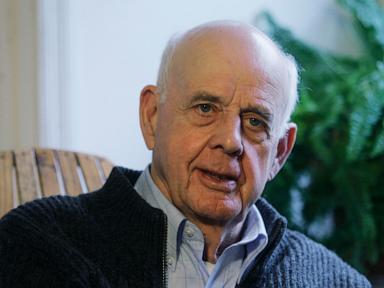
The dirt does not care about your stock portfolio.
It does not check the quarterly earnings reports, nor does it log into the global marketplace to see whether wheat futures are up or down. The dirt simply waits. It absorbs the rain, holds the roots, and remembers every heavy tractor tire that ever compressed its lungs. For ninety-two years, Wendell Berry listened to that dirt. And while the rest of the modern world strapped itself into a rocket ship of digital acceleration, constant connectivity, and endless urban expansion, Berry planted his feet firmly in the hills of Henry County, Kentucky, and stayed put. For a closer look into similar topics, we suggest: this related article.
He died at ninety-two. The news arrived quietly, the way a heavy frost settles over a tobacco barn in late October. No flashing banners on the cable networks could adequately capture what left the room when he drew his final breath. We lost a writer, yes. We lost a poet, an essayist, an agrarian prophet who spent decades warning us that a culture disconnected from its local soil is a culture hurtling toward a cliff. But more than that, we lost an anchor.
Step back for a moment. Imagine the noise of a typical Tuesday in the twenty-first century. The pinging notifications, the glowing screens, the grocery store aisles lined with food harvested a thousand miles away by invisible hands and preserved with unpronounceable chemicals. Now, walk out onto a patch of earth. Any patch. A crack in a city sidewalk where a stubborn dandelion fights for light, or a sprawling acre of depleted farmland sprayed into submission by corporate agriculture. For additional context on this topic, detailed reporting can be read at The Spruce.
Berry looked at that modern setup decades ago and diagnosed a sickness. He called it the "great divorce."
He did not write from an ivory tower. This is crucial. When people talk about Berry, they sometimes make him sound like an academic hermit shaking his fist at the clouds. That is a lazy caricature. He was a working farmer. He drove a team of horses long after everyone else had switched to fossil-fuel-guzzling machinery that tore up the topsoil. He used a horse-drawn plow not out of mere nostalgia or theatrical rebellion, but because a horse leaves the land intact enough to heal. A tractor, in the wrong hands, treats the earth like an enemy to be conquered.
Listen. The fundamental error of our age is the belief that we can consume without consequence.
Berry spent his life dismantling that illusion. In essays like The Unsettling of America—a book that should be handed to every high school graduate alongside their diploma—he laid bare the machinery of industrial agriculture. He showed how the logic of the factory was applied to the farm, turning living ecosystems into mere assembly lines. Seeds became patents. Animals became units of production. Neighbors became competitors.
And humans? Humans became consumers, untethered from place, floating in a placeless ether of convenience.
Consider what happens to a community when the local farm dies. It is not just an economic transaction. It is a slow unraveling of memory. When the family farm is swallowed by a conglomerate, the old stories go with it. The names of the creeks, the shapes of the hills, the knowledge of which bottomland floods in the spring—all of it gets paved over by indifference.
Berry knew these people. He grew up among them, left briefly to study and teach, and then felt the irresistible pull of home calling him back. He returned to Kentucky not to escape the world, but to dive deeper into it. He understood a profound truth that Silicon Valley venture capitalists still refuse to grasp: you cannot love humanity in the abstract if you refuse to care for the specific neighbor standing right in front of you.
His poetry carried the weight of river stones. It was unpretentious, rhythmic, and grounded in the physical reality of sweat and muscle. He wrote about the curve of a scythe, the smell of woodsmoke, the quiet dignity of a marriage that endures through decades of drought and debt.
“There is no escaping. The only celebration is to participate in the slow and difficult care of our world.”
That sentence contains the entire architecture of his philosophy. We spend our lives trying to escape. We build digital metaverses, we chase early retirements on sunny beaches, we outsource our food, our clothing, our entertainment, and our community to distant corporations, all in the desperate pursuit of frictionless ease.
Yet friction is what keeps us human. The calloused hand, the aching back from hauling hay, the difficult conversation across the fence with a neighbor you disagree with—these are the very things that tether us to reality. When we engineer all the friction out of life, we engineer out our souls.
Critics sometimes dismissed him as a romantic throwback. They pointed out that his vision of local economies and horse-powered farming was incompatible with a global population of eight billion people. They called him a utopian.
They missed the point entirely.
Berry was never offering a rigid blueprint for modern civilization. He was offering a critique of direction. If your compass is broken, walking faster only ensures you get lost more efficiently. He was telling us to look down at our feet. He was asking a terrifyingly simple question: What will be left of this place after we are gone?
Look at the statistics of our current agricultural landscape. Topsoil erosion is accelerating at rates that should terrify us. Aquifers are running dry to water crops in deserts. Rural towns across the American heartland have hollowed out, leaving behind boarded-up storefronts and an epidemic of despair. The industrial food system is incredibly efficient at producing calories, but devastatingly effective at destroying community, health, and ecological stability.
Berry saw this coming half a century ago. He did not write op-eds screaming about the end of the world. He wrote quiet, persistent prose that demanded patience from his readers. He asked us to slow down long enough to realize that everything we eat, wear, and use comes from somewhere, and that somewhere is a living, breathing place that will either thrive or die based on our choices.
When a man lives to ninety-two, his life becomes an epic arc. Berry watched the tractors get bigger. He watched the small towns empty out. He watched the culture become increasingly fractured, screen-addicted, and rootless. Yet he never stopped planting. Every spring, he worked the ground. Every autumn, he harvested.
That consistency was his most radical act.
In a world addicted to disruption, consistency is revolutionary. In an economy that rewards perpetual growth at all costs, restraint is heresy. Berry chose restraint. He chose the local over the global, the community over the collective, the real over the virtual.
Think about the last time you ate something and actually knew the name of the person who grew it. Think about the last time you walked a mile of your neighborhood without looking at a glowing rectangle in your hand. If those questions make you uncomfortable, you are beginning to feel the ache that Berry spent his life trying to awaken in us.
We are lonely. We are exhausted. We are surrounded by abundance yet starving for substance.
The cure, Berry whispered through decades of essays and poems, is right beneath our fingernails. It requires returning to a scale we can comprehend. It requires learning the names of the trees, respecting the limits of the land, and accepting that we are part of a delicate ecological web, not its masters.
The hill in Henry County is a little quieter now. The horse is gone from the pasture. The desk where the handwritten pages piled up year after year sits in a house that feels suddenly vast and echoing.
Yet the soil remains. It holds the winter rain. It waits for the spring thaw. And somewhere out there, buried in the quiet corners of our cultural conscience, the words of the old farmer are still working their way down through the hardpan, waiting for the right moment to break the surface.