A single pixel on a screen in Washington does not bleed. It does not panic. It does not feel the suffocating humidity of a Gulf summer or hear the low, bone-rattling drone of a predator drone circling overhead. To the machine, a city is just a collection of coordinates, a cluster of probabilities, a knot of heat signatures waiting to be untangled by an algorithm.
We have entered the era of the bloodless map.
When Donald Trump revealed his vision of an artificial intelligence-driven war map—a digital grid designed to project dominance, predict movements, and neutralize threats before they materialize—the presentation carried the familiar sheen of Western techno-optimism. It promised total clarity. It offered the ultimate illusion: that war could be quantified, contained, and managed like a logistics problem at an Amazon fulfillment center.
But maps are dangerous things. They tell us where we are, but they rarely tell us who is waiting for us in the tall grass.
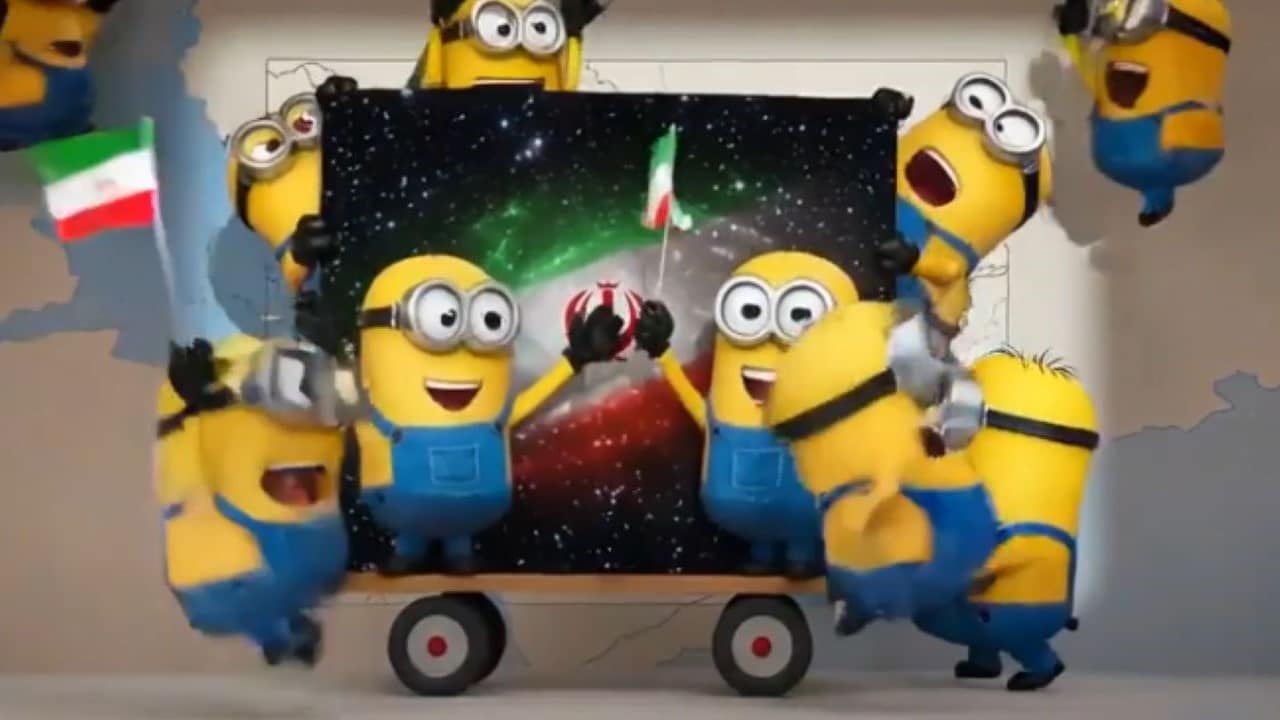
Thousands of miles away, inside the command centers of Tehran, that digital map was met not with fear, but with a strange, defiant kind of theater. The Iranian military responded with a video of their own, projecting an image of a vast, swirling galaxy. The message was theatrical, almost cinematic, but its subtext was lethal. They were mocking the grid. They were reminding the world that while Washington is busy trying to map the terrain with algorithms, the reality of conflict remains messy, human, and fundamentally unpredictable. They promised that any new aggression would be met with a response so fierce it would shatter the glass on those expensive new monitors.
This is not just a geopolitical spat between two old adversaries. It is a glimpse into a terrifying new psychology of warfare, where human lives are caught between the arrogance of the code and the pride of the missile.
The Illusion of the Flawless Grid
To understand how we got here, you have to understand the seductive lie of the smart map.
For decades, military planners have chased the ghost of total situational awareness. Imagine a young intelligence analyst sitting in a windowless room in Virginia. Let us call her Sarah. Sarah is twenty-six, drinks too much cold brew, and spends twelve hours a day staring at a satellite feed of the Iranian coastline. For years, her job was manual, tedious, and deeply human. She looked for anomalies. She noticed when a specific truck moved, or when a anti-aircraft battery changed its angle. She held the weight of interpretation in her own mind.
Then came the algorithms.
Now, Sarah’s monitor is overlaid with a glowing web of predictive AI. The software flags anomalies before she can see them. It assigns threat percentages to fishing boats. It draws red boxes around houses. It simplifies the chaos of the Persian Gulf into a series of binary choices.
The danger is that the glowing red box begins to feel more real than the family living inside the house.
When you look at a conflict through the lens of an AI map, the enemy ceases to be a collection of human beings with histories, grievances, and unpredictable breaking points. They become a pattern. And patterns can be optimized. This is what the Trump administration’s AI map represents: the ultimate corporate takeover of kinetic conflict. It promises a war without messy human error.
But the people on the other side of that map do not live in a simulation.
The Galaxy in the Bunker
When Iran released its "galaxy" video, Western commentators largely dismissed it as crude propaganda. It looked like something out of a late-night sci-fi movie. But to dismiss it is to completely misunderstand the nature of asymmetric defiance.
By countering a precise, digital war map with an image of a chaotic, infinite cosmos, Tehran was making a psychological point. They were saying: You think you can grid us. You think you can calculate our pain threshold. You think your code can predict how a mother will react when a drone strikes her neighborhood, or how a young commander will retaliate when his mentor is assassinated.
Warfare is not a math problem.
Consider what happens when the algorithm fails to account for the one variable it can never truly measure: the human will to survive, or the human desire for revenge. In 2020, when a U.S. drone strike killed Iranian General Qasem Soleimani, the analytical models predicted a series of calculated escalations. What they got instead was a chaotic, emotionally charged sequence of events that nearly triggered a catastrophic regional conflagration, culminating in the tragic, panicked shooting down of a civilian airliner.
The machine did not foresee the panic. It did not calculate the fog of war.
Iran’s recent rhetoric is a direct warning that a reliance on automated deterrence will only invite more volatile counter-strokes. If the West trusts a machine to draw the lines of engagement, the East will use the chaos of the unexpected to erase them. A stronger response from Tehran will not be a neat, algorithmic counter-move. It will be asymmetrical, jagged, and deeply destructive.
The Men Who Stare at Screens
There is a profound loneliness in modern statecraft. Decisions that once required hours of debate among seasoned diplomats are now accelerated by the speed of data processing. When an AI map suggests that an adversary is 87% likely to launch a missile within the next forty-eight hours, the pressure to act pre-emptively becomes almost irresistible.
Who has the courage to tell the machine it is wrong?
We have seen this psychological trap before. During the Cold War, early warning systems repeatedly flagged incoming Soviet missiles that turned out to be nothing more than sunlight reflecting off clouds or a flock of migrating geese. In those moments, it was only the stubborn, skeptical intervention of human beings—men like Stanislav Petrov, who chose to trust his gut over his radar screen—that saved the species from extinction.
Now, we are voluntarily removing those human speed bumps.
The new AI war maps do not just display information; they recommend action. They create a momentum of their own. If a commander refuses to follow the algorithm’s recommendation and an attack happens, that commander faces career ruin. If they follow the machine and innocent people die, it is shrugged off as a system error. The accountability evaporates into the cloud.
This is the real stakes of the dispute over Trump’s digital map. It is not about who has the better technology. It is about whether we are willing to hand over the moral weight of killing to software that cannot feel the consequences of its own decisions.
The Dust on the Glass
Step away from the television screens and the press releases for a moment. Travel down to the port cities along the Strait of Hormuz.
Here, the air smells of salt, diesel, and roasted saffron. Fishermen launch wooden dhows into waters that are simultaneously the most heavily monitored sea lanes on earth and the most fragile. These men do not know about the AI maps in Washington or the galaxy videos in Tehran. They know that when the political rhetoric spikes, the insurance rates on their boats go up. They know that if a stray missile misses its mark, their livelihood evaporates.
One of these fishermen might look up at the sky on a clear evening and see a satellite passing overhead—a tiny, moving star reflecting the sun.
To the satellite, the fisherman is a dot. A data point to be categorized, scrubbed, or targeted.
The tragedy of modern technological warfare is that it convinces the powerful that they can wage war without getting dirty. It turns the horror of conflict into a clean, aesthetic experience. You press a button in a trailer in Nevada, and a thousands miles away, a building turns to dust. The AI map updates its graphic. The red box disappears. The grid is satisfied.
But the dust does not stay on the screen. It settles into the lungs of the survivors. It buries itself in the rubble of crushed dreams and generational hatred.
The Iranian response, wrapped in the kitsch of a space video, is a crude reminder of an ancient truth: you cannot automate an empire into safety. Every action creates an equal and opposite human reaction. When you tell a nation that you have mapped their entire existence, you do not force them into submission. You merely dare them to find the blind spots in your code.
The machine can map the world, but it can never rule the heart. And until the engineers in Washington and the generals in Tehran remember that the ultimate weapon is not an algorithm but the human capacity for restraint, we will all continue to live at the mercy of a glowing screen, waiting for the pixel that breaks the world.