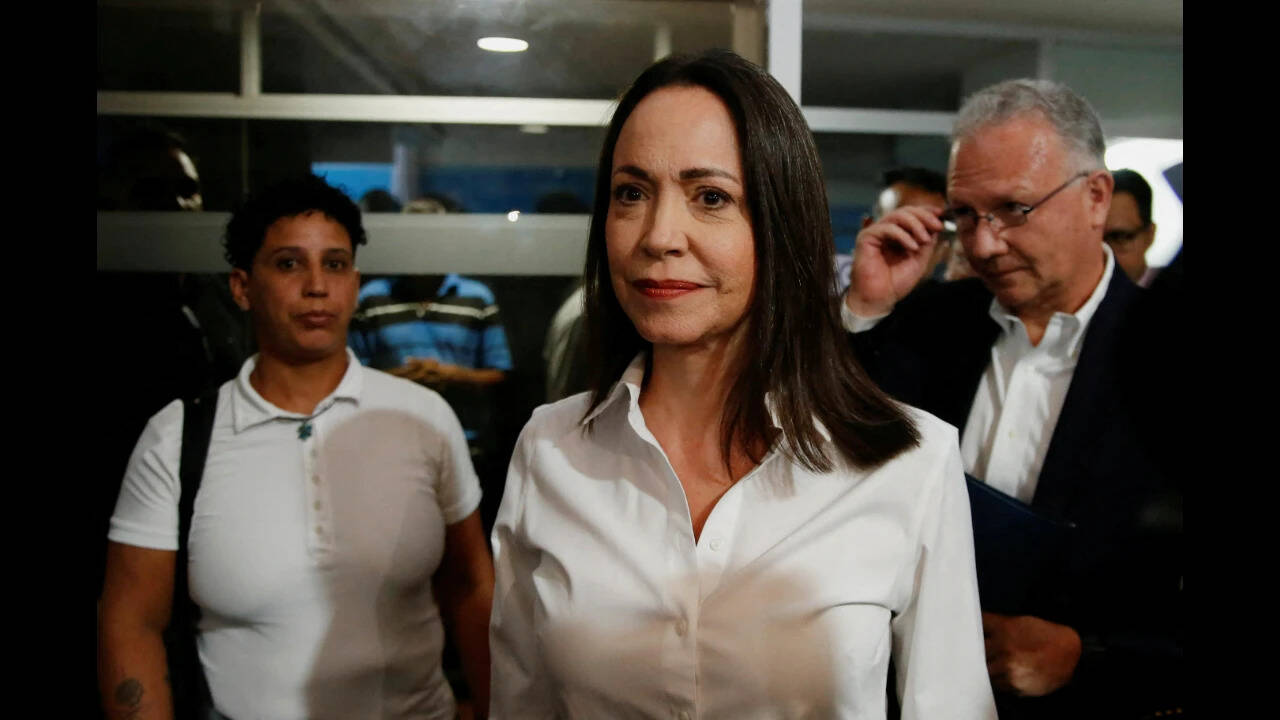
The international press loves a cinematic homecoming. They want the airport tarmac, the sea of white shirts, the tearful embraces, and the tidy narrative arc where the exiled hero returns to claim the crown.
Look at the coverage surrounding Maria Corina Machado's return to Venezuela. Every mainstream outlet is framing her arrival—and her defiant "I am here. With you" declaration—as the beginning of the end for Chavismo. They are selling you a fairy tale. They are recycling the exact same breathless script they used for Juan Guaido in 2019, Leopoldo Lopez in 2014, and Henrique Capriles in 2013. Discover more on a related topic: this related article.
Here is the cold, unvarnished reality from someone who has spent two decades tracking Latin American power dynamics and watching Western analysts get burned by their own wishful thinking: Physical presence in Caracas does not equal political leverage.
In fact, stepping back onto Venezuelan soil under the current security apparatus might be the single greatest tactical gift Machado could have handed Miraflores. More analysis by TIME explores related views on this issue.
The Myth of the Moral High Ground
Standard political commentary treats authoritarian regimes like fragile glass houses that shatter the moment a charismatic leader stands outside with a megaphone. That is a fundamental misunderstanding of how entrenched competitive authoritarianism works.
Political scientists Steven Levitsky and Lucan Way defined this exact system years ago. In a competitive authoritarian state, the playing field is not just tilted; the regime owns the stadium, pays the referees, and controls the scoreboard. When an opposition leader returns from abroad without first securing fractured loyalties within the coercive apparatus, they are not invading the fortress. They are walking voluntarily into a holding cell with better lighting.
Let’s look at the mechanics of what actually happened when Machado crossed back into the country.
- The Regime Permitted It: Nobody sneaks past the DGCIM (General Directorate of Military Counterintelligence) and SEBIN (Bolivarian National Intelligence Service) with an international press corps in tow unless the state decides the optics of an airport arrest are currently more expensive than the optics of a rally.
- The Trap of Street Mobilization: Mass protests feel intoxicating. They generate incredible photographs for wire services in New York and Madrid. They also burn through your most committed human capital while leaving the state's revenue streams—oil, gold, and illicit logistics—completely untouched.
- The Shift in Bargaining Power: From outside the country, an opposition leader is an untouchable diplomatic phantom who can lobby Washington, Brussels, and Bogota without a gun to their head. Inside Venezuela, every breath Machado takes is at the mercy of the state security forces. She is no longer just a negotiator; she is a potential hostage.
I have watched opposition movements across the hemisphere blow millions of dollars in international backing and decades of grassroots organizing because they confused crowd size with institutional power. A million people in the streets of Caracas cannot open a single locked door at the Ministry of Defense if the generals inside still believe their personal survival depends on the current administration.
Why Everyone Is Asking the Wrong Question
If you look at the trending queries right now, everyone is asking: "Will Maria Corina Machado's return trigger a regime collapse?" or "How will the military respond to Machado?"
Both questions are fatally flawed because they assume the Venezuelan state is a monolithic pyramid waiting for a single push to topple. It is not. It is a decentralized cartel of competing interests—military factions, regional governors, state-owned enterprise directors, and foreign creditors—bound together by shared legal liability.
The real question you should be asking is: What exit guarantees have been put on the table for the mid-level commanders who actually hold the rifles?
Until that question has a concrete, enforceable answer, a homecoming speech is just theater.
Let’s dismantle the two biggest lies circulating in the current news cycle:
Lie 1: "International pressure will protect her."
International condemnation is a mild inconvenience to a government that has already survived years of sectoral sanctions, diplomatic isolation, and criminal indictments. When you have already been designated as a pariah by the U.S. Treasury Department, another strongly worded statement from the Organization of American States does not keep you awake at night. If the ruling elite decides Machado’s presence threatens their grip on power, no amount of tweets from European foreign ministers will stop a midnight raid.
Lie 2: "The people's mandate is unstoppable."
Voters do not dismantle intelligence agencies. Ballots do not neutralize paramilitary colectivos. Electoral legitimacy is a powerful moral weapon, and Machado holds it unequivocally. But in a system where the Supreme Tribunal of Justice (TSJ) and the National Electoral Council (CNE) operate as administrative branches of the ruling party, a democratic mandate is merely an opening bid in a much uglier negotiation.
The Brutal Math of Regime Change
To understand why the celebratory coverage is so dangerous, you have to look at the incentives governing the Venezuelan Armed Forces (FANB).
In a normal democracy, the military answers to the constitution. In Venezuela, top brass have spent twenty-five years embedded in the economy. They run mining concessions in the Orinoco Arc. They manage food distribution networks. They oversee port customs.
Imagine a scenario where you are a division general in Maracay. You have three properties, a family living abroad, and your name is sitting on a sealed indictment in a U.S. federal court. Suddenly, Maria Corina Machado lands in Caracas promising justice, accountability, and a sweeping cleanup of state corruption.
Do you hand her the keys to the barracks? No. You double down on the status quo, because the status quo is the only thing keeping you out of a supermax prison.
This is the fatal flaw in the "maximalist" strategy Machado has championed for years. By framing the struggle purely as a battle between good and evil—with zero room for negotiated immunity or power-sharing—she rallies the base to a fever pitch while simultaneously terrifying the very people whose defection she needs to actually take office.
What Needs to Happen Next (And Why It Probably Won't)
I will give Machado credit where it is due: her courage is undeniable. Walking back into a country where your closest campaign aides have been systematically detained or forced into embassy asylum takes nerves of steel. She has accomplished what no other Venezuelan politician has managed in a decade—she unified a fractured, cynical electorate and forced the world to pay attention again.
Furthermore, there is a valid counter-argument to my skepticism. Asymmetric political warfare relies heavily on psychological momentum. If a leader stays in exile too long, they risk becoming irrelevant—a voice on a Zoom screen while the population suffers on the ground. By returning, Machado proves she has skin in the game. She forces the regime into a lose-lose dilemma: arrest her and ignite a domestic explosion while torpedoing any remaining hope of sanctions relief, or leave her free and watch her build an unstoppable parallel authority.
That is the tightrope she is walking. It is bold. It is historic. And it is hanging by a thread.
If this return is going to amount to more than a tragic footnote, the strategy must pivot immediately from emotional mobilization to ruthless institutional bargaining:
- Stop treating negotiations like treason: For years, hardliners labeled anyone who sat at a table with Miraflores as a collaborator. That purity test is political suicide. Power transitions in entrenched autocracies—from Chile in 1988 to Spain in 1975—always involve ugly compromises with the outgoing guard.
- Build a credible amnesty framework: Publicly and privately, the opposition must define exactly what a soft landing looks like for the military high command. If you corner a rat, it bites. If you build it a golden bridge, it runs.
- Decentralize leadership immediately: If the entire movement relies on one charismatic figure standing on top of a truck in Caracas, the state only has to neutralize one target to decapitate the resistance.
The cameras will eventually pack up. The trending hashtags will fade into the algorithm's graveyard. When the noise stops, Maria Corina Machado will still be standing in a city controlled by men with guns who have everything to lose.
Saying "I am here" gets you on the front page. Figuring out how to stay there—and actually govern—is the only fight that matters.


