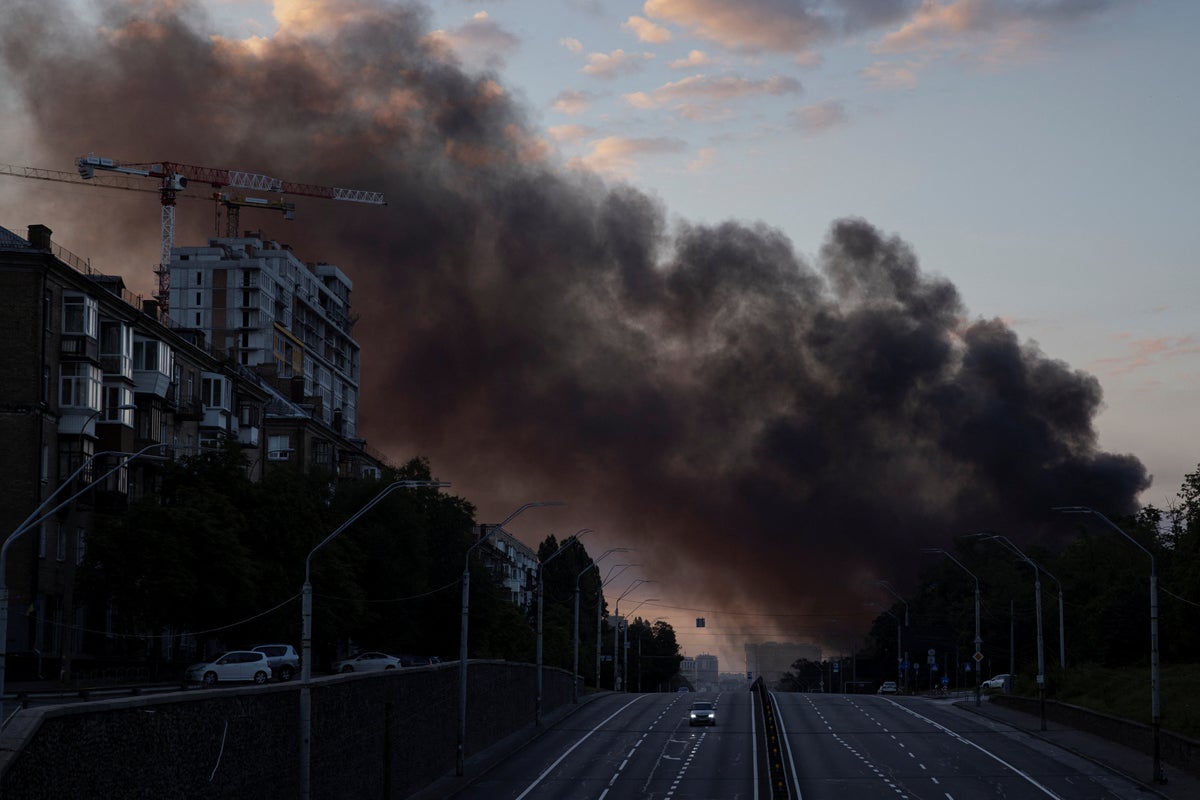
The skies over Ukraine just witnessed the most concentrated ballistic missile assault directed at the capital since the full-scale invasion began. Russia fired around four dozen ballistic and hypersonic missiles, including Iskander-M and Zircon systems, in a furious five-hour barrage that shook the foundations of historic districts and sent residents scrambling into subterranean metro stations.
Yet, looking only at the smoke rising from Kyiv's Shevchenkivskyi district misses the real strategic story unfolding right now. Hours before Russian missiles slammed into the capital, Ukrainian long-range strike drones were systematically blowing up critical infrastructure deep inside Russian territory. They torched three major oil depots in Stavropol Krai, battered a fuel facility, hit logistics complexes near Moscow, and severely damaged tankers belonging to the Kremlin's prized "shadow fleet" in the Black Sea.
This isn't just another routine weekend of trading fire. It's a brutal, high-stakes evolution of asymmetric warfare. Ukraine is systematically choking off Russia's economic lifeline and military logistics, while Moscow responds with raw, terrifying kinetic force to expose Ukraine's dwindling supply of western air defenses.
The Logistics War Getting Deep Inside Russian Borders
For months, the conventional narrative leaned heavily on static front lines. That view is completely outdated. Ukraine has shifted its focus to deep, economically devastating attritional strikes. The latest wave of Ukrainian drone operations shows a highly coordinated effort to starve the Russian war machine of fuel and supply components.
Look at the targets struck over the weekend. In Stavropol Krai, located in southern Russia, the town of Mikhailovsk saw its oil depot hit for the third time in just a matter of weeks. President Volodymyr Zelensky confirmed that three separate oil depots and an associated fuel facility were targeted in that region alone. Local footage verified heavy blazes ripping through the industrial sites.
At the same time, Ukraine took the fight directly to Russia’s supply chain. Drone strikes devastated massive fulfillment centers and logistics hubs in the Moscow and Tambov oblasts. These weren't random civilian targets. Ukrainian intelligence identified these sprawling hubs as primary distribution nodes used to funnnel sanctioned electronic components, drone manufacturing parts, and advanced navigation gear directly to front-line units. Early estimates from independent sources suggest the physical damage to these centers could top 100 billion rubles.
Choking the Shadow Fleet
Perhaps the most daring aspect of the Ukrainian offensive happened at sea. Kyiv’s forces managed direct hits on three tankers operating within Russia's "shadow fleet" in the Black Sea, including the vessels Asia and Nissos at the Caspian Pipeline Consortium terminal near Novorossiysk.
Ukrainian Deep Strike Targets (July 18-19)
------------------------------------------
• Stavropol Krai: 3 oil depots + 1 fuel facility torched
• Moscow Oblast: "Nafto-Service" oil depot & Wildberries hub hit
• Tambov Oblast: Major electronics/drone parts supply warehouse destroyed
• Black Sea: 3 shadow fleet tankers struck (loadings temporarily halted)
The shadow fleet is how Moscow bypasses international sanctions to sell crude oil and fund its military budget. Blasting these tankers right at the loading docks didn't just cause fires; it completely halted oil loadings at a terminal responsible for a massive chunk of regional exports. It tells us that Ukraine now possesses the maritime intelligence and precision drone range to threaten Russia's maritime trade routes at will.
The Brutal Calculation Behind Russia’s Ballistic Blitz
Moscow's answer to losing its oil and logistics nodes was swift, localized terror. Instead of spreading out its weekend missile production across multiple regions, the Kremlin concentrated almost its entire ballistic inventory on a single target: Kyiv.
The sheer volume of the assault was staggering. Out of 41 missiles tracked, a massive concentration consisted of high-speed Iskander-M ballistic missiles and cutting-edge Zircon hypersonics. These aren't slow-moving Shahed drones that can be picked off by mobile truck units with spotlights and machine guns. Ballistic missiles drop out of the stratosphere at extreme speeds, giving air defense teams mere minutes to react.
The results inside Kyiv were horrific. The barrage sparked major fires across five separate urban districts, tearing through residential buildings, an office block, industrial sites, and a local dormitory. At the Lukianivska metro station, which hundreds of citizens were using as a bomb shelter, a massive blast wave caved in the ceiling of the ground-floor vestibule, forcing authorities to close the transit hub entirely.
The Patriot Problem
The hard truth of this attack lies in the interception numbers. Ukraine's General Staff stated they brought down 108 out of 125 drones, but they managed to stop only 18 of the incoming missiles. That is a significantly lower interception rate for ballistic targets than what we saw last year.
Why the sudden drop? It points directly to a critical, exhausting shortage of Western air defense interceptors, specifically the missiles that feed the US-made Patriot and European SAMP/T systems. Patriot systems are incredibly effective, but their ammunition is finite, expensive, and takes months to manufacture.
Russia knows this. By launching dozens of advanced ballistic profiles simultaneously, they intentionally oversaturate the radar screens. They force Ukrainian commanders to make agonizing, split-second choices about which missile to shoot down and which asset to leave exposed. Every Patriot missile fired to protect a residential block is one less interceptor available to shield an electricity grid or a military factory.
A Double Crisis for Zelensky
This air war escalation arrives at a moment of intense domestic political friction within Ukraine. For the past several days, street protests have hit Kyiv following a major shakeup in the military leadership.
President Zelensky’s decision to sack the highly popular, modernizing Defense Minister Mykhailo Fedorov has sparked sharp public backlash. Many reform-minded Ukrainians and military volunteers view the removal of Fedorov—the man credited with building Ukraine’s dominant domestic drone industry—as a massive misstep. Demonstrators have openly demanded his reinstatement while calling for the removal of the more traditional, Soviet-style Commander-in-Chief, Colonel General Oleksandr Syrskyi.
This internal friction creates a dangerous distraction. Zelensky is stuck managing a political crisis in the capital while simultaneously pleading with Western partners to accelerate the delivery of anti-ballistic defenses. While a political agreement was recently reached with the US to eventually license the domestic production of Patriot interceptors within Ukraine, actual factory output isn't expected until the tail end of the year. Ukraine simply doesn't have that kind of time.
What This Escalation Tells Us About the Rest of the Year
The dynamics of this latest exchange show that the conflict has definitively broken out of its geographical cage. The front line in the Donbas still matters, but the strategic outcome is being heavily shaped by things happening hundreds of miles away from the trenches.
First, expect Ukraine to double down on its asymmetric infrastructure strategy. Kyiv realizes it cannot match Russia barrel-for-barrel in traditional artillery or infantry numbers. Their best path to leverage is making the war economically unsustainable for the Kremlin by hitting oil refineries, shipping terminals, and military logistics hubs until the domestic fuel crunch severely limits Russian armor mobility.
Second, Russia will keep exploiting Ukraine’s air defense gaps. Until Western allies find a way to surge massive quantities of interceptor missiles into the country, the capital and key industrial cities will remain deeply vulnerable to high-velocity ballistic saturation tactics.
If you want to understand where this war goes next, look directly at the sky and the sea. Watch the frequency of Ukrainian drone strikes on Russian fuel hubs, and monitor how quickly Washington and European capitals ship fresh air defense reloads to Kyiv. Those are the real metrics that will define the upcoming months of the conflict.