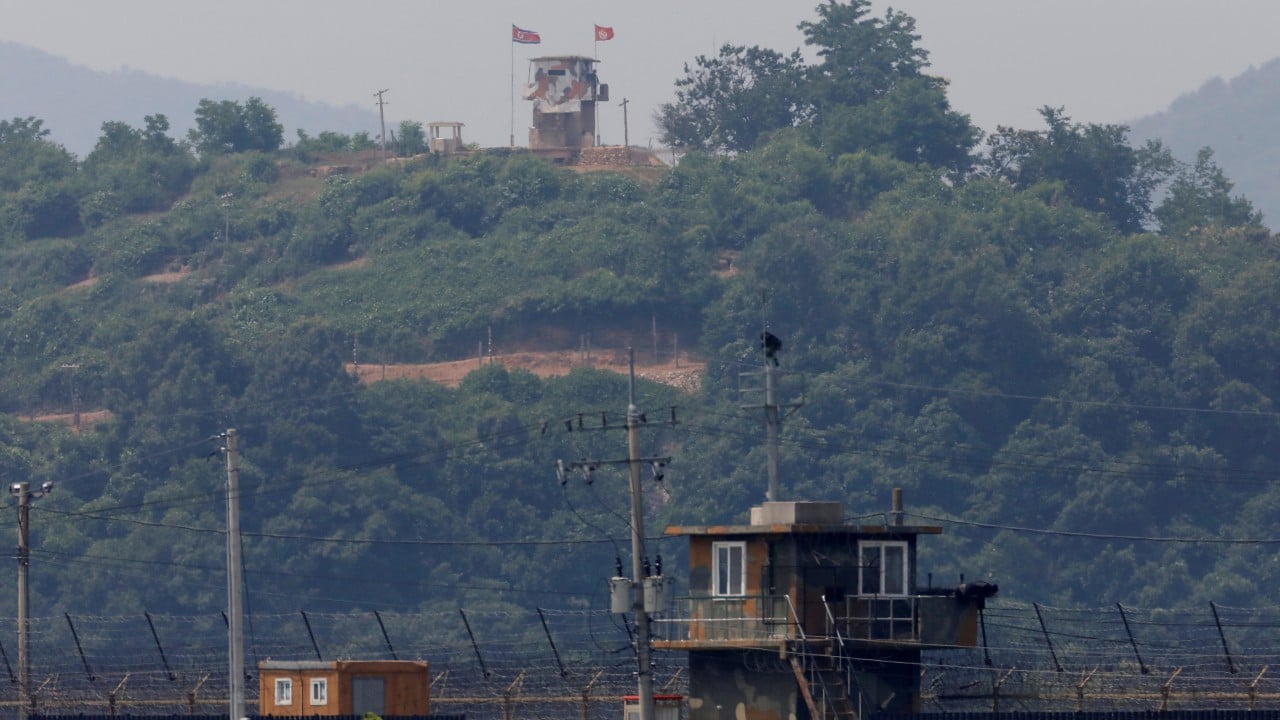
The spatial integrity of the 1953 Korean Armistice Agreement depends entirely on maintaining precise buffer zones along the Military Demarcation Line. When physical ordnance alters this buffer without diplomatic coordination, the operational calculus between Seoul and Pyongyang shifts from strategic deterrence to direct kinetic friction. The September 21 incident inside the western sector of the Demilitarized Zone, which resulted in injuries to South Korean military personnel, illustrates how low-threshold engineering operations rapidly compound into high-stakes diplomatic crises.
The Mechanics of Border Engineering and Hazard Proliferation
The Demilitarized Zone contains an estimated two million mines distributed across a heavily fortified corridor. This dense concentration transforms standard border maintenance into a high-risk operational environment.
When the Korean People's Army conducts engineering operations—such as constructing tactical roads, erecting barriers, or reinforcing border infrastructure—the placement of new ordnance or the unearthing of legacy explosives alters the baseline safety parameters of the zone.
The mechanics of the September incident highlight three distinct operational phases:
- The Deployment Phase: Engineering units alter terrain topography and emplacement patterns to restrict movement or fortify specific sectors.
- The Interception Phase: Reconnaissance patrols encounter modified terrain elements or unmarked hazards outside expected operational envelopes.
- The Escalation Phase: Post-detonation investigations trigger institutional demands for accountability, derailing bilateral communication channels.
The South Korean Joint Chiefs of Staff, operating in conjunction with the United Nations Command, identified resin anti-personnel mines near the blast site that deviated in composition from older legacy stock. This material discrepancy forms the core of Seoul's assessment that the placement was deliberate rather than an accidental migration of legacy munitions caused by seasonal monsoon rains or shifting topsoils.
The Diplomatic Impasse and Communication Bottlenecks
The strategic cost of the DMZ explosion extends far beyond the immediate physical casualties. It creates a structural bottleneck in interstate communication.
[Physical Detonation]
       │
       ▼
[Joint Forensic Investigation (UNC / JCS)]
       │
       ▼
[Attribution & Demand for Formal Apology]
       │
       ▼
[Pyongyang Denial & Counter-Accusation]
       │
       ▼
[Diplomatic Stalled Channels & UN Escalation]
When Seoul demanded a formal apology and acknowledged responsibility, the immediate effect was the paralysis of back-channel communications managed by the United Nations Command Military Armistice Commission. Pyongyang rejected the findings as fabrications intended to cover up internal political maneuvers, subsequently issuing counter-letters to the United Nations Security Council.
This dynamic exposes a recurring vulnerability in cross-border crisis management. When an incident is processed purely through public accusations, both states become politically locked into zero-sum positions. South Korea cannot ignore a breach of the armistice without signaling weakness along its primary border, while North Korea cannot accept liability without conceding culpability for violating the terms of the 1953 agreement.
Strategic Forecast for Border Security Protocols
The probability of future kinetic friction along the Military Demarcation Line remains high as long as both militaries pursue aggressive fortification strategies within confined geography. Because North Korea views structural engineering and border hardening as sovereign defensive measures against perceived external threats, instructions to its engineering corps will continue to prioritize physical barriers over armistice transparency.
To mitigate the risk of uncontrolled escalation, future operational responses must decouple technical de-escalation from political demands for public contrition. Establishing functional, closed-loop military communication channels specifically designated for engineering hazard notifications remains the only structural mechanism capable of preventing accidental detonations from cascading into state-level military confrontations.