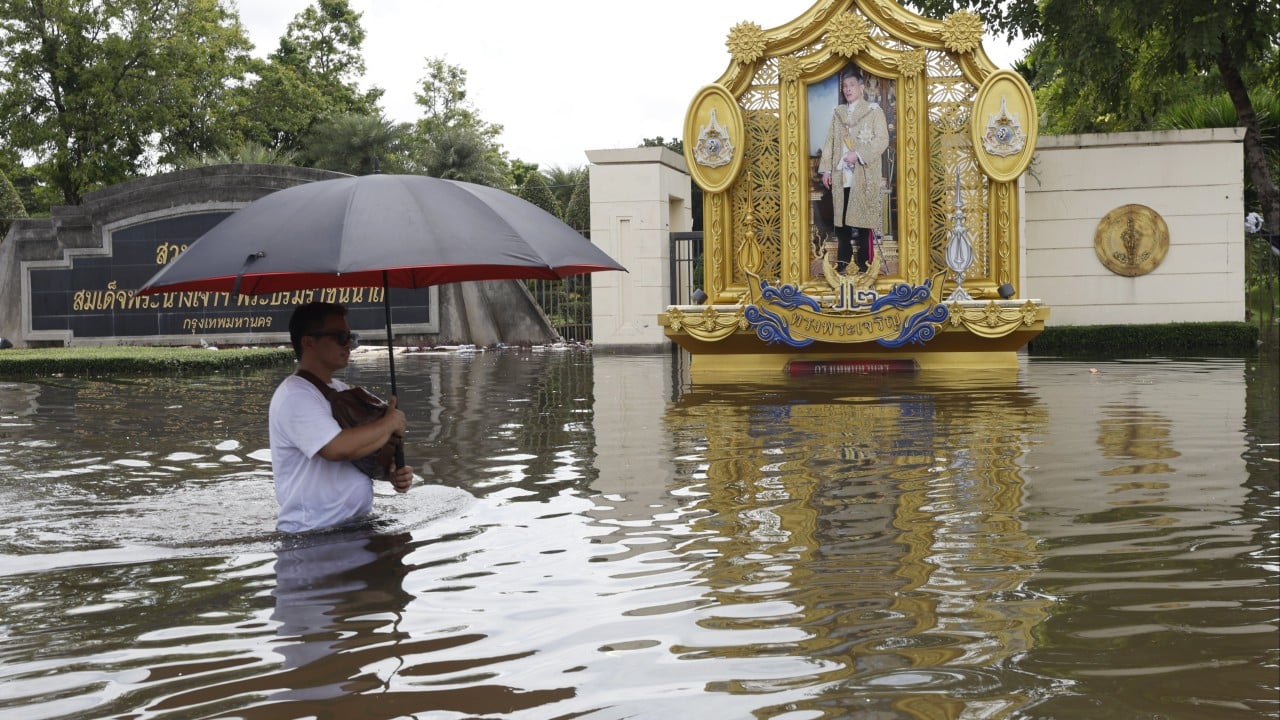
Macroeconomic shock propagation in emerging markets relies heavily on urban asset concentration. When severe flooding strikes the Bangkok metropolitan region ahead of high-level international summits such as the annual meetings of the International Monetary Fund and the World Bank Group, the evaluation models used by institutional authorities frequently diverge from the micro-level realities experienced by informal labor pools and small-and-medium enterprises. Macro projections often frame property damage at approximately 0.03 to 0.1 percent of gross domestic product, viewing remediation through post-disaster reconstruction cycles that theoretically offset losses. However, this aggregated perspective obscures the asymmetric distribution of financial shock across a heavily leveraged domestic economy.
The transmission channels of urban water accumulation operate through distinct mechanical vectors. The first vector is transport friction and logistics velocity. Empirical data from urban transit studies indicate that transport velocity degrades non-linearly with precipitation density. Every incremental millimeter of rainfall reduces average transit velocity, creating cascading bottlenecks across supply chains anchored in the capital. In a commercial hub responsible for roughly half of the national economic output, these mobility restrictions act as a persistent operational tax. Freight delivery schedules slip, perishable inventories spoil, and commercial foot traffic contracts sharply, starving cash-flow-dependent retail and service operators of daily revenue long before structural inundation of physical premises occurs.
The second vector is balance sheet fragility and debt servicing capacity. Thailand enters recurring flood cycles against a backdrop of elevated household debt and prolonged stagnation in smaller commercial credit access. For daily-wage earners, street vendors, and micro-entrepreneurs operating without liquidity buffers, a localized flood event represents an immediate truncation of income streams. When cash inflows drop to zero for consecutive days, fixed liabilities such as microloans, equipment financing, and commercial rents do not pause. Consequently, physical water accumulation rapidly transforms into systemic debt default risk, forcing the Bank of Thailand and commercial lenders to deploy emergency debt relief measures, including principal payment holidays and customized working capital facilities.
Institutional preparation for international summits highlights the operational divergence between macro-level continuity planning and micro-level disruption. Contingency frameworks designed for events like the International Monetary Fund and World Bank Group meetings establish multi-tier water threshold protocols—ranging from minor road pooling handled by local municipal traffic commands to high-level crisis management teams authorized to reroute delegates to mass rapid transit networks or initiate event termination if floodwaters breach primary structural thresholds. These protocols successfully insulate international delegations and maintain conference continuity, yet they operate entirely parallel to the localized economic friction experienced by the domestic workforce outside the protected five-kilometer conference perimeter.
Long-term climate projections compound these structural vulnerabilities through geographic and hydrological constraints. The upper Gulf of Thailand functions as a shallow, semi-enclosed basin where minor increases in sea level elevate tailwater levels at major river mouths. This backpressure restricts gravity drainage during high-volume inland runoff events, extending the duration of urban inundation. Under business-as-usual scenarios, climate-driven urban flood losses are projected to scale significantly by 2030, reinforcing the urgency of integrating micro, small, and medium-sized enterprise policies with specialized green finance and climate-resilient insurance mechanisms.
Mitigating structural exposure requires shifting institutional intervention from post-hoc disaster relief to preemptive balance sheet immunization. Economic resilience policies must couple rapid liquidity injections for vulnerable borrowers with structural investments in urban drainage modernization and coastal defense engineering, ensuring that capital protection strategies extend beyond localized diplomatic zones down to the granular level of domestic commercial activity.