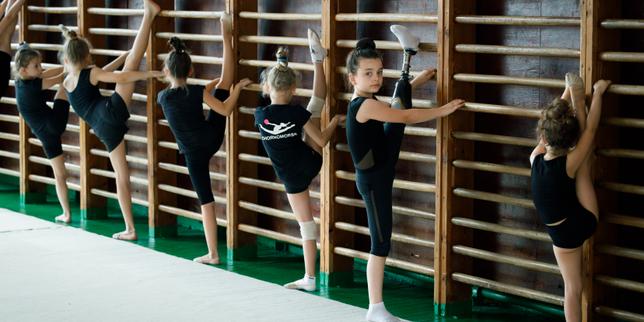
The return of a pediatric athlete to competitive rhythmic gymnastics following a traumatic lower-limb amputation represents more than a triumph of human volition. It is a complex engineering, neurological, and biomechanical optimization problem. When a Russian missile strike in Zatoka, Odesa, compromised the physical integrity of six-year-old Oleksandra Paskal in May 2022, the subsequent medical narrative shifted from basic life-saving interventions to the systemic recalibration of high-performance athletic movement.
Analyzing this trajectory requires stripping away sentimentality to evaluate the precise structural mechanics, neural adaptations, and sociopolitical signaling vectors that govern the rehabilitation of an elite pediatric gymnast operating with a prosthetic limb.
The Biomechanical Deficit Matrix in Rhythmic Gymnastics
Rhythmic gymnastics relies on extreme ranges of motion, precise kinetic energy transfer, and instantaneous stabilization. The amputation of a lower limb introduces a severe structural deficit that alters the athlete’s center of mass and disrupts bilateral symmetry.
To quantify the friction introduced by a unilateral transtibial or transfemoral amputation, one must evaluate three distinct mechanical vectors.
The Loss of Ankle-Foot Complex Articulation
The biological human foot and ankle complex contains 26 bones, 33 joints, and more than 100 muscles, tendons, and ligaments. This system acts as a variable-stiffness actuator capable of pre-activation, energy storage, and rapid plantarflexion. In rhythmic gymnastics, the foot is the primary tool for execution scoring, requiring extreme plantarflexion (relevé) to extend the aesthetic and functional line of the leg.
The replacement of this biological system with a passive or semi-active prosthetic introduces several structural limitations:
- The Energy Storage and Return Shortfall: Carbon-fiber running blades or articulating prosthetic feet can store and return elastic potential energy during linear progression, but they cannot actively generate mechanical work during non-linear, multi-planar athletic maneuvers.
- The Rigid Lever Arm: A prosthetic component possesses a fixed mechanical stiffness profile. Unlike a biological ankle, which modulates stiffness based on sensory feedback and anticipatory neural firing, the prosthesis lacks real-time compliance adaptation.
- The Angular Velocity Discrepancy: During turns (pirouettes) and leaps (grand jetés), the athlete must generate high angular velocity. The absence of active calf musculature (gastrocnemius and soleus) reduces the peak torque generation required to drive the body upward and forward.
Center of Mass Shift and Asymmetric Mass Distribution
A standard human lower limb constitutes approximately 16% of total body mass. A prosthetic replacement, even when optimized with lightweight carbon fiber and titanium components, typically weighs significantly less than the biological limb it replaces. This mass differential causes an immediate, structural shift in the athlete’s center of mass, moving it superiorly and laterally toward the intact limb.
Biological Center of Mass [Symmetrical Distribution]
       |
       v
   [  x  ]

Post-Amputation Center of Mass [Asymmetrical Shift]
     |
     v
   [x   ] -> Shifted toward intact limb due to prosthesis mass deficit
This structural shift alters the moment of inertia during aerial maneuvers. When executing a rotation, the gymnast must apply asymmetric force to achieve a clean vertical axis. Failure to compensate for this mass discrepancy results in rotational drift, forcing the intact limb to absorb higher-than-normal ground reaction forces upon landing.
Ground Reaction Force Attenuation
Biological joints act as low-pass filters that attenuate the high-frequency impact forces generated during landings. The meniscus, articular cartilage, and eccentric muscle contractions decelerate the body's mass over time, reducing peak stress on the skeletal framework.
A prosthetic limb lacks these active dampening layers. The impact force is transmitted directly through the rigid socket interface to the residual limb and the proximal joints (the knee and hip). In a growing pediatric athlete, this concentrated stress creates a structural bottleneck, increasing the risk of early-onset osteoarthritis, skin breakdown at the stump interface, and micro-fractures along the growth plates.
Neurological Recalibration and Proprioceptive Substitution
The primary challenge of executing high-level gymnastics with a prosthesis is not mechanical; it is informational. The nervous system must learn to pilot a mechanical device that lacks afferent sensory feedback.
The Proprioceptive Void
Proprioception is the body's intrinsic ability to sense its position, motion, and equilibrium in space, mediated by mechanoreceptors located in muscles, tendons, and joints. When a limb is amputated, the closed-loop feedback system between the periphery and the central nervous system is severed. The brain no longer receives real-time data regarding ankle joint angle, skin pressure on the sole of the foot, or muscle spindle tension.
To execute complex routines with apparatuses like hoops, balls, or ribbons, the athlete must construct an alternative sensory feedback loop. This relies on two primary mechanisms:
- Targeted Mechanical Sensation at the Socket Interface: The residual limb skin and underlying musculature become the new sensory input zone. Variations in shear stress, pressure, and vibration within the prosthetic socket are interpreted by the somatosensory cortex as indicators of limb positioning and ground contact.
- Visual-Vestibular Hyper-Reliance: The brain compensates for the loss of lower-limb proprioception by upregulating visual and vestibular inputs. The eyes must track the position of the prosthesis relative to the floor, while the inner ear's vestibular apparatus works under increased cognitive load to maintain balance during rapid gaze shifts.
Cortical Reorganization and Phantom Limb Management
Following amputation, the area of the primary somatosensory cortex that previously mapped the lower limb undergoes neural reorganization. Neighboring cortical areas begin to invade the deafferented zone. If this process occurs chaotically, it can manifest as debilitating phantom limb pain.
In elite pediatric athletes, structured rehabilitation channels this neuroplasticity productively. By engaging in high-precision movement patterns immediately after wound healing, the brain incorporates the prosthesis into the internal body schema. The mechanical device ceases to be viewed by the central nervous system as an external tool and is instead processed as a functional extension of the musculoskeletal system.
The Operational Framework of Pediatric Sports Prosthetics
Developing a prosthetic system capable of withstanding the rigors of competitive rhythmic gymnastics requires a specialized engineering approach. A standard daily-use prosthesis is fundamentally unsuited for the mechanical loads and ranges of motion required by the sport.
Prosthetic Design Vectors
├── Socket Interface (Silicon Liner + Vacuum Suspension) -> Minimizes Shear Stress
├── Structural Pylon (Carbon Fiber Composite)          -> Calibrated Energy Return
└── Terminal Device (Flexible Foot Component)          -> Optimized for Aesthetic Line
Socket Design and Suspension Dynamics
The socket serves as the critical interface transfer point between the human skeleton and the mechanical prosthesis. For a gymnast, standard suspension methods like simple suspension sleeves are inadequate because they allow micro-slippage during high-velocity movements.
The optimal configuration utilizes a total-surface-bearing socket combined with a silicone or polyurethane liner and an active vacuum suspension system. This configuration ensures that atmospheric pressure securely locks the socket to the residual limb, eliminating the mechanical dead space that causes skin chafing and delayed movement translation.
Structural Pylon Optimization
The pylon—the vertical element connecting the socket to the foot—must be calibrated precisely to the athlete’s weight and dynamic force output. In pediatric gymnastics, the pylon cannot be completely rigid, nor can it match the extreme flexibility of a running blade. A running blade is designed for unidirectional linear progression; a gymnastics prosthesis requires torsional compliance to allow for pivoting movements without twisting the skin of the residual limb.
Terminal Device Selection
The terminal device must strike a balance between structural utility and aesthetic requirements. Rhythmic gymnastics regulations penalize deviations from classical posture and form. The terminal device must therefore feature a pre-shaped arch or flexible component that mimics a pointed foot while maintaining a minimal surface area to allow the athlete to spin on polished wooden or canvas surfaces.
The Geopolitical Dimension of the Adaptive Narrative
The athletic trajectory of individuals like Oleksandra Paskal does not exist within a socio-political vacuum. In kinetic conflicts, the transformation of individual trauma into structural narratives of resilience serves as a powerful vector of national communication strategy.
The Soft Power Vector
State communication apparatuses consistently elevate narratives of adaptive sports to achieve specific geopolitical outcomes:
- International Aid Justification: By projecting images of pediatric amputees overcoming severe trauma to compete at high levels, the affected nation visualizes the human cost of conflict while demonstrating structural resilience, thereby validating continued foreign financial and military assistance.
- Domestic Morale Stabilization: High-profile examples of recovery serve as internal psychological anchors, signaling to the civilian population that structural destruction can be overcome through systematic optimization and perseverance.
- Counter-Narrative Deployment: These athletic achievements challenge the adversary's intent to inflict lasting, disabling psychological and physical damage on the population.
The Risk of Narrative Exploitation
While these communication strategies are highly effective for state craft, they introduce a distinct operational friction point for the individual athlete. The pressure to perform as a symbol of national survival adds a layer of psychological stress to an already overburdened athletic recovery process. The training load must be managed carefully to avoid burnout, secondary physical injuries, and the psychological burden of representing a broader political struggle.
Strategic Outlook for Adaptive Youth Athletics
The long-term viability of pediatric adaptive athletes relies on continuous technological and systemic interventions. As the athlete grows, the prosthetic systems must undergo rapid, iterative re-engineering to match changing anthropometric dimensions and increasing kinetic power output.
The primary structural limitation moving forward is the scaling of prosthetic technology to match natural growth spurs. Unlike adult adaptive athletes whose biomechanical baselines remain static, a pediatric athlete requires constant socket adjustments, alignment recalibrations, and component upgrades every six to twelve months.
The integration of advanced sensory feedback mechanisms, such as targeted muscle reinnervation and implantable myoelectric sensors, represents the next logical phase in closing the proprioceptive loop. Until these technologies are widely available, the optimization of adaptive youth athletics will depend on the precise application of custom biomechanical engineering, aggressive neurological conditioning, and rigorous data-driven training regimens.