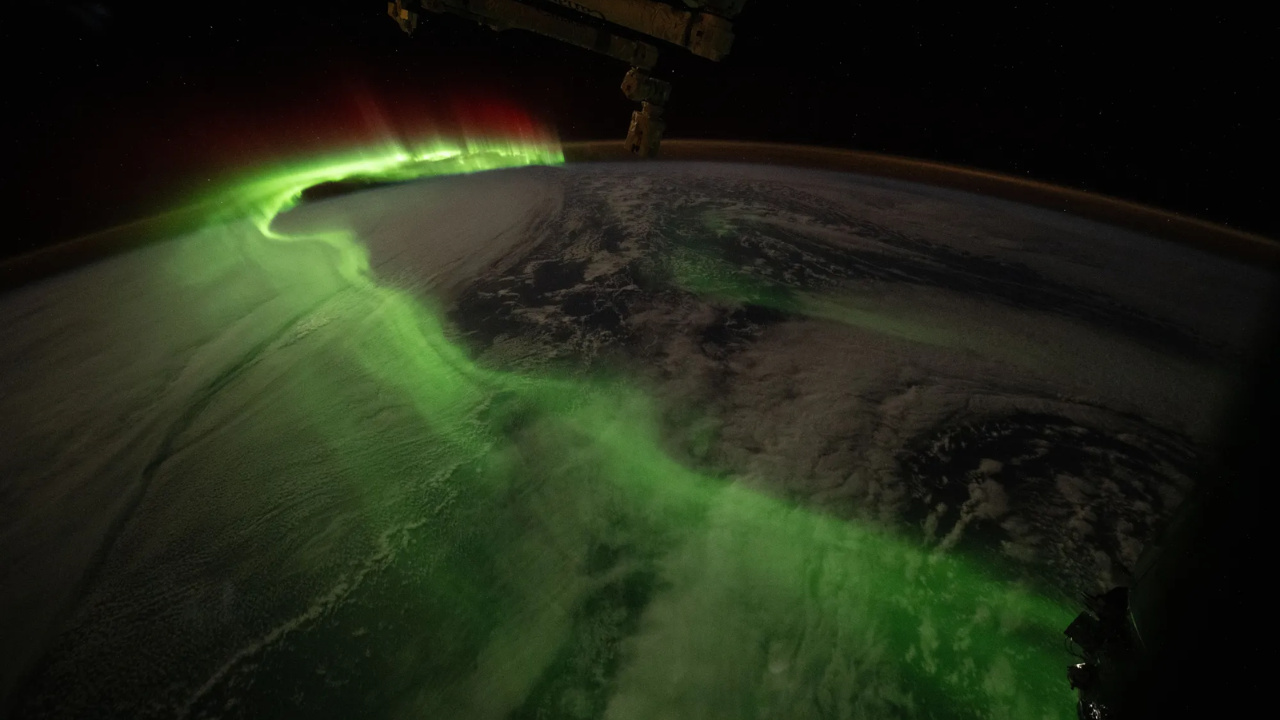
Geomagnetic storms yield non-linear optical phenomena in Earth’s upper atmosphere that ground-based observers fundamentally misinterpret due to perspective distortion. Media accounts regularly rely on anthropomorphic descriptions, such as labeling plasma filaments as "snakes," to describe what are actually highly structured, predictable magnetohydrodynamic interactions. The underlying mechanics of the June 2026 Aurora Australis event, documented from a SpaceX Dragon capsule at an orbital altitude of approximately 265 miles, demonstrate a precise intersection of solar wind kinetics, magnetospheric topology, and atmospheric chemistry. Deconstructing this event requires analyzing the structural inputs that dictate auroral geometry, altitude stratification, and localized structural dynamics.
The Tri-Particle Excitation Vector
The luminous green ribbons observed across the high southern latitudes are the direct visual output of an atmospheric energy dissipation process. This mechanism operates as a thermodynamic cost function, converting the kinetic energy of incoming solar particles into photons through discrete atomic collisions. The process follows a strict tripartite sequence:
- Solar Wind Flux Acceleration: Coronal mass ejections or high-speed solar wind streams inject high-energy electrons and protons into the interplanetary magnetic field. When these particles encounter Earth’s magnetopause, they are deflected and channeled along the planet's converging magnetic field lines toward the polar regions.
- Ionospheric Infiltration: As these charged particles descend into the thermosphere—typically at altitudes between 50 and 180 miles—the atmospheric density increases exponentially. This density gradient creates a high-probability collision zone.
- Quantum De-excitation: The primary structural component of the green aurora is monatomic oxygen ($O$). Collisions with incoming electrons pump these oxygen atoms into an unstable, excited energy state ($^1D$). To return to their baseline ground state ($^3P$), the atoms must release the excess energy. This specific transition emits a photon at a wavelength of exactly 557.7 nanometers, which falls squarely into the green spectrum of human visual perception.
Incoming Electron (e⁻) + Monatomic Oxygen (O) ---> Excited Oxygen (O*) + e⁻
Excited Oxygen (O*) ---> Baseline Oxygen (O) + Photon (λ = 557.7 nm, Green)
Geometry of Low Earth Orbit Perspectives
A critical discrepancy between the recent orbital documentation and standard ground observation lies in the geometric frame of reference. Ground-based observers view auroras via tangent-height projection. Because the observer looks upward through a vertical sheet of light, the aurora appears as a towering, two-dimensional curtain stretching toward the zenith. This perspective introduces severe parallax errors and masks the true volumetric footprint of the storm.
From Low Earth Orbit, the SpaceX Dragon capsule occupies a position well above the primary emission zone. This altitude yields a down-looking, synoptic perspective that exposes the global morphology of the storm. The apparent "snaking" movement is not an erratic path, but rather a direct mapping of the auroral oval—a massive, continuous ring of particle precipitation centered around the geomagnetic pole.
The curvilinear path observed by astronauts occurs because the spacecraft cuts across these field-aligned current sheets at orbital velocities exceeding 17,000 miles per hour. The combination of high-speed orbital transit and the intrinsic wave-like propagation of the plasma creates the visual illusion of independent, serpentine movement.
Structural Triggers of Plasma Morphologies
The localized curling and rippling within the auroral bands represent fluid dynamic instabilities operating within a magnetized plasma. The primary bottleneck controlling whether an aurora appears as a diffuse, stable arc or a highly dynamic, undulating ribbon is the rate of localized field-aligned currents.
The first structural cause of distortion is the Kelvin-Helmholtz instability. This occurs when adjacent layers of magnetospheric plasma shear against each other at different velocities. The velocity differential shears the magnetic field lines, rolling the thin sheets of descending electrons into tight, spiral vortices. From an orbital vantage point, these vortices appear as a continuous, coiling wave.
The second variable driving morphology is the localized ionospheric conductivity gradient. When intense electron precipitation ionizes the thermosphere, it alters the local electrical resistance. This variance forces the auroral current to seek paths of least resistance, constantly shifting the spatial distribution of the light emissions. This electrical reconfiguration happens on millisecond timescales, causing the rapid flickering and pulsing captured in orbital time-lapse photography.
Altitude and Atmospheric Composition Mapping
The vertical stratification of auroral colors serves as a reliable altimeter for atmospheric composition and particle energy distribution. The green emission zone represents only a single slice of a multi-tiered chemical profile.
- Altitudes Exceeding 150 Miles: Incoming particle energy is relatively low, and the atmospheric composition is dominated by low-density monatomic oxygen. At this height, electron collisions excite oxygen to an alternate state ($^1S$), which relaxes by emitting red light at 630.0 nanometers. Because the atmospheric density is low, this transition takes up to 110 seconds to occur, making the red aurora highly vulnerable to collisional quenching if hit by other particles before it can emit light.
- Altitudes Between 60 and 150 Miles: Increased particle energy allows penetration into denser atmospheric layers. Monatomic oxygen remains present but at higher densities. The relaxation time for the green 557.7-nanometer emission is roughly 0.7 seconds. The higher collision frequency matches this shorter lifespan perfectly, making green the dominant and most intense color observed during standard geomagnetic events.
- Altitudes Below 60 Miles: Only the highest-energy solar particles penetrate past the 60-mile threshold. At this depth, molecular nitrogen ($N_2$) becomes the primary collisional target. Ionized nitrogen molecules emit deep blue photons, while neutral nitrogen molecules emit pink or violet light. This creates a distinct, brightly colored lower border along the bottom edge of high-intensity auroral curtains.
Operational Constraints of Orbital Observations
While orbital photography provides invaluable data for cross-verifying space weather models, it operates under tight physical and technical constraints. The International Space Station and accompanying commercial crew capsules do not maintain stationary positions relative to the auroral oval.
Orbiting at high velocities through varying local times means a single auroral feature can only be tracked continuously for mere minutes before the spacecraft moves out of range or enters daylight. Sunlit orbital arcs blind highly sensitive low-light camera sensors due to the high albedo of the Earth's surface below.
The collection of high-fidelity auroral data remains highly dependent on the current stage of Solar Cycle 25. The frequency of coronal mass ejections correlates directly with the structural complexity and global footprint of these ionospheric displays. As solar activity peaks, the volume of kinetic energy injected into the magnetosphere increases, causing the auroral oval to expand equatorward and forcing more frequent transitions from stable laminar flows into highly turbulent, unstable plasma geometries. This ongoing solar cycle ensures that the structural dynamics observed from orbit will continue to fluctuate in intensity and geographical distribution over the coming multi-month window.