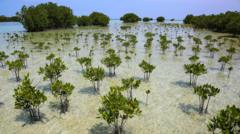
Mangrove forests are shifting from a state of compounding degradation to a phase of non-linear recovery, yet current conservation models routinely miscalculate the structural variables driving this transition. For decades, anthropogenic pressures—primarily aquaculture expansion, urban encroachment, and coastal engineering—treated these intertidal ecosystems as low-value real estate. Today, data-driven assessment reveals that the economic and structural cost of replacing a mangrove ecosystem far exceeds the short-term capital gains of land conversion. To optimize global coastal resilience, asset managers, policymakers, and environmental engineers must analyze mangrove recovery not as a passive natural event, but as a complex resource management problem governed by specific biophysical thresholds and economic feedback loops.
The Triple-Engine Framework of Mangrove Valuation
To evaluate why mangrove recovery yields disproportionate returns compared to artificial infrastructure, the ecosystem must be broken down into three distinct operational vectors: hydrodynamic mitigation, biochemical sequestration, and trophic support.
+-----------------------------------------------------------------+
|                    MANGROVE RESOURCE SYSTEM                     |
+----------------------------------+------------------------------+
                                   |
         +-------------------------+-------------------------+
         |                         |                         |
         v                         v                         v
+------------------+     +------------------+      +------------------+
|  Hydrodynamic    |     |   Biochemical    |      |     Trophic      |
|  Mitigation      |     |  Sequestration   |      |     Support      |
|                  |     |                  |      |                  |
|  - Wave energy   |     |  - Blue carbon   |      |  - Biomass       |
|    attenuation   |     |    burial        |      |    production    |
|  - Sediment      |     |  - Anaerobic     |      |  - Commercial    |
|    stabilization |     |    preservation  |      |    nurseries     |
+------------------+     +------------------+      +------------------+
Hydrodynamic Mitigation and Kinetic Energy Attenuation
Mangrove forests function as living, self-repairing breakwaters. The complex, aerial root structures (pneumatophores and prop roots) create a highly frictional boundary layer that disrupts the kinetic energy of incoming waves.
The attenuation of wave height through a mangrove forest is non-linear and can be modeled by looking at how wave energy decays across a distance. As waves propagate through dense vegetation, the rate of energy reduction per unit distance depends heavily on the density and spatial arrangement of the roots, alongside the water depth and initial wave characteristics.
Statistical models demonstrate that a 100-meter wide band of mature mangroves can reduce wave energy by up to 66 percent. This attenuation decreases the shear stress exerted on coastal soils, shifting the geomorphological balance from net erosion to net sediment deposition. Artificial concrete seawalls lack this adaptive capacity; they reflect wave energy, which frequently accelerates the erosion of the seabed at the structure's base, leading to systemic structural failure.
Biochemical Sequestration and Blue Carbon Capital
The subterranean architecture of mangrove ecosystems acts as one of the biosphere’s most efficient carbon sinks, commonly referred to as blue carbon. Unlike terrestrial forests, where carbon is stored primarily in above-ground biomass and released rapidly upon plant death, mangroves store up to 90 percent of their total carbon allocation in the surrounding waterlogged soil.
The saturated, anaerobic conditions of mangrove sediments severely inhibit the microbial decomposition of organic matter. Consequently, organic carbon remains locked in the sediment matrix for centuries. While a tropical rainforest may reach a carbon saturation equilibrium within decades, mangrove soils continue to vertically accrete and store carbon indefinitely, provided the hydrological regime remains undisturbed. Devaluing this carbon sink during land-use planning represents a profound failure in capital allocation.
Trophic Support and Commercial Fisheries Latency
The structural complexity of submerged mangrove roots provides critical nursery habitats for juvenile marine species, directly underpinning commercial offshore fisheries. The economic output of marine capture fisheries is functionally dependent on the total acreage of adjacent mangrove systems.
- Refuge Efficiency: The high surface-area-to-volume ratio of root clusters minimizes predator efficiency, maximizing the survival rate of post-larval penalid shrimp, mud crabs, and various teleost fishes.
- Nutrient Export: Mangroves export high volumes of dissolved organic matter and detritus into adjacent coastal waters, driving primary productivity across the local marine food web.
Systemic Bottlenecks in Historic Degradation Models
The historical decline of mangrove coverage was accelerated by a fundamental misalignment between immediate cash-flow generation and long-term asset depreciation. Analyzing the failure modes of past coastal management strategies reveals the structural bottlenecks that modern restoration frameworks must resolve.
The Shrimp Aquaculture Trap and Soil Hyper-Salinization
During the late 20th century, vast swaths of mangrove estuarine systems were cleared to construct intensive aquaculture ponds. This conversion strategy suffered from a fatal operational flaw: a complete disregard for soil chemistry and hydrological flushing cycles.
Mangrove soils are frequently rich in iron sulfides. When drained and cleared for aquaculture, these soils oxidize, forming sulfuric acid. This rapid acidification, combined with the accumulation of metabolic waste from high-density shrimp farming, routinely renders aquaculture ponds toxic within three to five years of operation. Operators abandoned these degraded assets, leaving behind hyper-saline, acidic barrens completely stripped of their original regenerative capacity. The short-term economic yield of these operations was systematically wiped out by the permanent loss of the baseline ecosystem services.
Hydrological Severance via Linear Infrastructure
The construction of coastal highways, dikes, and agricultural levees frequently acts as a silent killer of mangrove systems, even when the trees themselves are not directly cut down. Mangroves require a highly precise tidal regime—a delicate balance of alternating saltwater inundation and freshwater runoff.
When linear infrastructure severs this hydrological connectivity, two distinct failure modes occur:
- Impoundment Death: Upstream zones become permanently flooded, drowning the pneumatophores (aerial roots) and suffocating the root systems due to a total lack of oxygen.
- Hypersalinization: Downstream zones are cut off from freshwater inputs. Evaporation rapidly drives soil salinity past the physiological tolerance thresholds of even the most resilient mangrove species, causing localized extinctions.
The Strategic Blueprint for Modern Biomechanical Restoration
Successful mangrove recovery requires moving away from the historically flawed paradigm of mass hand-planting toward an engineering-first framework known as Ecological Mangrove Restoration (EMR). The data indicates that merely planting thousands of monoculture seedlings without addressing systemic environmental conditions yields a long-term failure rate exceeding 70 percent.
+-----------------------------------------------------------------+
|             ECOLOGICAL MANGROVE RESTORATION (EMR)               |
+----------------------------------+------------------------------+
                                   |
         +-------------------------+-------------------------+
         |                         |                         |
         v                         v                         v
+------------------+     +------------------+      +------------------+
|  Hydrological    |     |    Topographic   |      |     Natural      |
|  Recalibration   |     |    Alignment     |      |   Recruitment    |
+------------------+     +------------------+      +------------------+
Hydrological Recalibration
The primary phase of any high-yield restoration project must focus on restoring natural tidal dynamics. This requires identifying and removing artificial barriers, re-profiling blocked tidal creeks, or strategically installing culverts to re-establish the historic wet-dry cycles. Once the correct tidal flux is restored, the chemical profile of the soil—specifically its pH and salinity—frequently returns to baseline parameters within 12 to 24 months without direct chemical intervention.
Topographic Alignment and Target Elevation
Mangrove propagules (seedlings) require a highly specific elevation window relative to the local mean sea level to successfully establish. If the mudflat elevation is too low, the seedling spends too much time submerged, resulting in physiological stress and death. If the elevation is too high, inadequate tidal wetting leads to desiccation.
Before any vegetative restoration begins, high-resolution LiDAR surveys must map the intertidal topography. Targeted sediment deposition or mechanical grading must be deployed to match the exact elevation profile of nearby healthy reference forests.
Natural Recruitment Over Artificial Plantations
When the hydrological regime and topographic elevation are corrected, the need for manual planting dropped drastically. Nearby mature mangrove forests naturally export thousands of waterborne propagules per acre annually.
Allowing natural recruitment to repopulate a restored site ensures optimal species distribution and genetic diversity. The resulting forest develops a complex, multi-tiered canopy and root structure that is vastly more resilient to climate variability and pest infestations than artificial, single-species plantations.
Quantifying the Limits of Biological Defense Systems
While the recovery of global mangrove infrastructure provides unmatched returns on investment, executing this strategy requires a clear-eyed acknowledgment of its structural limits. Mangrove restoration is not a universal solution for coastal vulnerability; it operates within strict biophysical boundaries.
Sea-Level Rise and the Coastal Squeeze Barrier
The long-term viability of restored mangrove systems is directly bound to the rate of global sea-level rise. Mangroves survive rising seas through a process called vertical accretion—trapping sediment and organic matter to elevate the forest floor at a pace that matches or exceeds the rising water.
The maximum rate of sustainable vertical accretion in highly productive mangrove systems typically tops out at approximately 5 to 10 millimeters per year. If sea-level rise accelerates past this threshold, the forest faces deep-water drowning.
Furthermore, in heavily urbanized coastal zones, mangroves encounter the coastal squeeze bottleneck: they are physically prevented from migrating inland by seawalls, highways, and residential developments. In these geographies, the long-term asset survival rate drops significantly unless structural space is explicitly cleared for landward migration.
Thermal Thresholds and Latitude Constraints
Mangroves are fundamentally tropical and subtropical organisms. Their metabolic efficiency is strictly constrained by the frequency and severity of extreme cold events.
The geographical distribution of mangroves is bounded roughly by the 20°C winter isotherm. While warming global temperatures are currently expanding the available latitudinal range for mangrove colonization northward and southward, these frontier zones remain highly vulnerable to sudden, acute freeze events. A single night of sub-zero temperatures can defoliate and kill entire pioneer populations, resetting decades of natural recruitment in a matter of hours. Strategy frameworks must account for this climate volatility when calculating long-term carbon credit yields or coastal protection values at high latitudes.
Operational Execution Plan for Coastal Asset Management
To convert these ecological realities into actionable enterprise strategy, institutional stakeholders must deploy a structured approach to coastal resource allocation:
- Audit Existing Coastal Assets: Utilize high-resolution satellite imagery and machine-learning algorithms to identify abandoned aquaculture ponds and hydrologically severed mudflats within a portfolio. These represent prime undervalued assets with high restoration potential.
- Decommission Inefficient Hard Infrastructure: Wherever feasible, transition from high-maintenance concrete sea defense assets to hybrid green-gray infrastructure, utilizing a forward band of restored mangroves backed by a secondary, low-profile earthen levee. This configuration drastically lowers long-term capital expenditure on infrastructure maintenance.
- Monetize Ecosystem Services via Verified Blue Carbon Frameworks: Anchor the financing of restoration operations in high-integrity carbon offset markets. Ensure all projects utilize rigorous, transparent sediment core sampling and real-time remote sensing verification to command premium pricing in compliance and voluntary carbon markets.
- Establish Community-Vested Co-Management Agreements: Mitigate the risk of localized illegal logging and clearing by formally integrating local populations into the economic loop. Allocate legal harvesting rights for non-timber forest products, such as sustainable wild fisheries and apiculture, to the surrounding communities, aligning local economic incentives with the long-term survival of the forest asset.