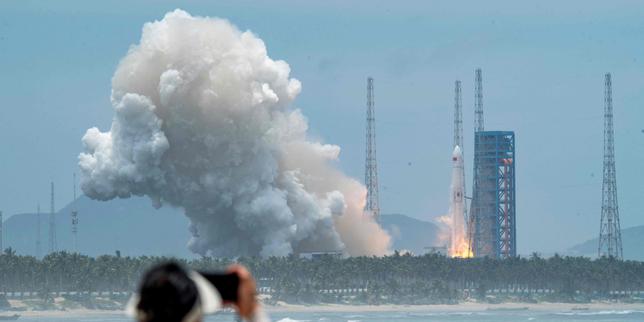
The physical constraints of rocket reusability force a brutal trade-off between the dry mass of a launch vehicle and its maximum payload capacity to orbit. On July 10, 2026, the maiden flight of China's Long March 10B carrier rocket bypassed the conventional structural requirements of propulsive vertical landing by executing the first successful orbital-class net capture recovery at sea. Developed by the China Academy of Launch Vehicle Technology, the 63-meter-tall medium-lift vehicle bypassed heavy, deployable landing legs in favor of an external, ship-mounted network of tensioned cables with hydraulic damping.
This operational pivot addresses the core limitation of modern reusable spaceflight: the deadweight penalty. By shifting the structural components required to absorb kinetic energy at touchdown from the rocket to a specialized recovery vessel, the mechanical architecture redefines the payload-to-orbit cost equation for state-led launch programs.
The Mass Penalty Equation of Propulsive Landings
To understand the strategic utility of China's net-based recovery, one must quantify the structural efficiency losses inherent in traditional vertical landing systems. A standard retro-propulsive landing requires three mass-heavy sub-systems:
- Deployable Landing Legs: High-strength telescoping struts capable of sustaining the dynamic impact forces of a multi-ton booster at touchdown.
- Internal Structural Hardpoints: Localized airframe reinforcements to distribute landing loads into the core tank structures without buckling the skin.
- Pneumatic or Hydraulic Actuators: Dedicated deployment systems, fluid reservoirs, and redundant lines that remain inert throughout the ascent phase.
In rocketry, every kilogram of deadweight added to the first stage diminishes the maximum velocity achievable before stage separation, compounding into a non-linear reduction in final payload mass delivered to low Earth orbit (LEO). This relationship is governed by the Tsiolkovsky rocket equation:
$$\Delta v = v_e \ln \frac{m_0}{m_f}$$
Where $v_e$ represents effective exhaust velocity, $m_0$ is the initial wet mass, and $m_f$ is the final dry mass. Increasing $m_f$ with landing gear inherently depresses the total delta-v ($\Delta v$) available to the upper stage.
By eliminating deployable legs, the Long March 10B shifts the primary mechanical load-bearing structure to the sea-based platform, named Ling Hang Zhe (The Scout). Instead of legs, the airframe features minimal, low-profile external landing hooks. These hooks engage an elevated, cross-grid network of high-tensile wire ropes. The framework absorbs the vehicle's residual downward momentum through shipboard hydraulic dampers, isolating the airframe from severe compressive ground-reaction forces.
Operational Sequence and Boundary Conditions
The recovery of the Long March 10B first stage occurs within a tightly restricted window of temporal and spatial variables. The operational sequence unfolds across distinct aerodynamic and propulsive phases.
Structural Performance Comparisons
The performance metrics of the Long March 10B demonstrate how the net capture architecture alters mass-to-orbit efficiencies relative to American counterparts.
- Vehicle Dimensions: The Long March 10B features a 5-meter core diameter and an overall height of approximately 63 meters.
- Thrust and Mass Profiles: It generates a liftoff thrust of roughly 890 tonnes against a liftoff mass of 760 tonnes.
- Payload Delta: In its fully reusable configuration, the vehicle maintains a payload capacity of 16 metric tonnes to LEO.
By removing deployable landing gear, engineers optimize the structural mass fraction—the ratio of the structural dry mass to the total initial mass. The recovered stage retains higher structural rigidity because the load path during capture is distributed through dedicated, high-strength ring frames containing the hook mechanisms, rather than deep axial loads traveling through the base of the propulsion module.
A primary engineering constraint of this method is the guidance margin. Landing on a wide concrete pad or a large barge allows for a small horizontal drift envelope. Conversely, a net capture system requires decimeter-level spatial accuracy during the terminal hover phase. If the rocket drifts outside the perimeter of the elevated structural framework, the hull risks colliding with the rigid columns supporting the net mechanism, resulting in catastrophic hull breach or structural collapse.
Institutional Infrastructure and Strategic Trajectory
The successful capture of the Long March 10B establishes a parallel technological path to the vertical landing paradigms perfected by SpaceX's Falcon 9 and Blue Origin's New Glenn. This engineering breakthrough is directly integrated into the broader architecture of China's deep-space programs. The state-owned China Aerospace Science and Technology Corporation intends to refly this specific recovered booster before the conclusion of 2026, establishing an empirical baseline for refurbishing timelines and engine cycle lifespans.
Furthermore, the Long March 10 family serves as the foundational booster infrastructure for China’s crewed lunar exploration roadmap, which aims to execute a lunar landing before 2030. Developing high-frequency reusability through sea-based net networks allows the program to scale its launch cadence while driving down the marginal cost per launch. The operational data gathered from these commercial and state deployments will directly inform the structural optimization of heavy-lift launch vehicles, establishing a highly repeatable logistics pipeline for megaconstellation deployments and cis-lunar exploration.