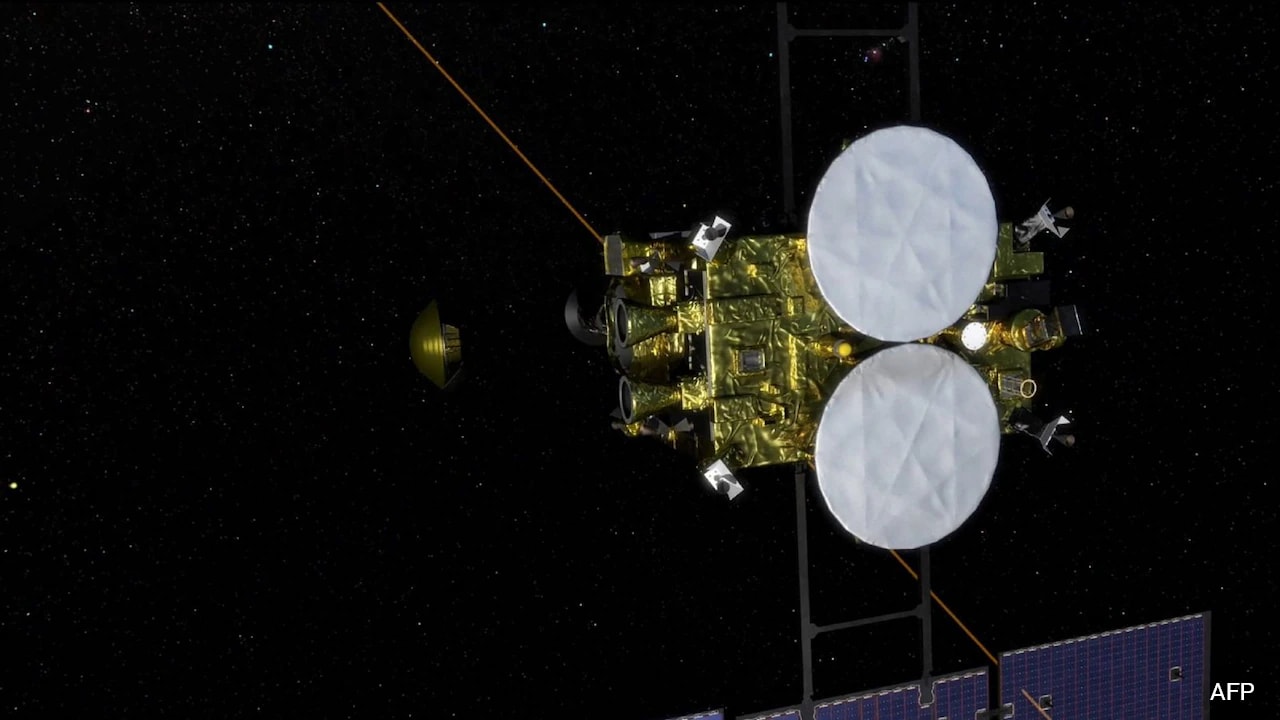
Planetary defense systems rely on a two-part execution strategy: early kinetic detection and precise structural characterization. While mass-media narratives focus heavily on kinetic impactors—such as NASA’s DART mission—the structural integrity of an incoming near-Earth object (NEO) dictates the success or failure of any deflection attempt. The Japan Aerospace Exploration Agency (JAXA) extension mission, navigating a space probe to execute a high-speed asteroid flyby, serves as a validation framework for this secondary capability. To evaluate the true efficacy of this mission, we must deconstruct its operations into three distinct operational variables: orbital synchronization, structural density mapping, and the thermal inertia coefficient.
The Kinematics of High-Velocity Characterization
Executing a close-approach flyby past a fast-rotating asteroid presents severe mechanical constraints. When a probe passes an object at velocities exceeding several kilometers per second, the time window for high-resolution data acquisition narrows to a critical window of minutes. Don't forget to check out our previous article on this related article.
The primary challenge lies in the target's rotational dynamics. A micro-asteroid, often measuring under 100 meters in diameter, frequently exhibits rapid spin rates, sometimes rotating on its axis every few minutes. Standard imaging systems fail under these conditions due to motion blur and phase-angle changes. JAXA's approach relies on autonomous optical navigation tracking, which adjusts the onboard camera alignment in real time based on contrast-edge detection algorithms rather than pre-programmed positioning commands.
This operational framework exposes a fundamental trade-off between flyby proximity and data resolution. A closer approach yields higher spatial resolution but accelerates the angular velocity of the target relative to the probe's sensors. The tracking mechanism faces an upper physical limit dictated by the reaction wheel acceleration rates of the spacecraft. If the target moves across the field of view faster than the attitude control system can rotate the chassis, data degradation occurs instantly. To read more about the background of this, Gizmodo offers an excellent summary.
The Three Pillars of Asteroid Structural Assessment
To build an effective planetary defense model, planetary scientists must calculate the exact kinetic energy required to alter an object's orbital trajectory without causing catastrophic fragmentation. This calculation depends on three core variables derived during a flyby.
- Porosity and Cohesion: Monolithic rocks respond predictably to kinetic impacts. In contrast, "rubble pile" asteroids—loose collections of boulders held together by weak gravitational forces—absorb kinetic energy through internal compaction. A flyby probe assesses this by observing surface features, boulder distribution, and gravitational deflection during the closest approach.
- Albedo and Surface Composition: The reflectivity of the asteroid reveals its mineral taxological classification (e.g., C-type carbonaceous vs. S-type silicaceous). Spectroscopic analysis during the approach maps the absorption bands of surface materials, providing the raw data needed to calculate the material density matrix.
- Thermal Inertia: By measuring how rapidly the asteroid's surface heats up and cools down as it rotates, scientists determine the thickness of the regolith layer. High thermal inertia indicates bare rock; low thermal inertia indicates a thick layer of insulating dust.
The interaction of these three pillars dictates the momentum transfer efficiency factor, known in orbital mechanics as the beta factor. If a defense mission impacts a rubble-pile asteroid with insufficient understanding of its porosity, the impactor may simply bury itself within the debris, shifting the orbit by an imperceptible margin while creating a cloud of unpredictable secondary fragments.
The Thermal Inertia Bottleneck and Trajectory Drift
A critical element missed by surface-level analysis is the Yarkovsky effect, a subtle force caused by the uneven emission of thermal radiation from a rotating asteroid. As the sunward side warms up and rotates into darkness, it radiates photons, creating a tiny but continuous thrust. Over decades, this force alters the asteroid's semi-major axis, turning a safe orbital trajectory into an Earth-crossing path.
A flyby provides the empirical data required to model this thermal drift accurately. By measuring the precise temperature gradient across the asteroid's evening terminator line, the probe allows analysts to calculate the net thermal photon thrust. Without this empirical baseline, long-term orbital predictions carry an unacceptable margin of error, rendering early-warning systems ineffective.
Structural Constraints of the Flyby Methodology
While the technological execution of a high-speed flyby is rigorous, the strategy possesses inherent structural limitations compared to a rendezvous-and-orbit mission.
The primary constraint is the singular data viewpoint. Because the probe sweeps past the target along a hyperbolic trajectory, it captures a comprehensive dataset for only one hemisphere. The unilluminated or opposing side remains unmapped, forcing scientists to rely on gravitational symmetry assumptions that rarely hold true for irregularly shaped fragments.
The second limitation involves the brief duration of the gravitational field interaction. Measuring an asteroid’s mass requires observing its gravitational pull on the spacecraft. During a high-velocity flyby, the deflection of the probe’s trajectory is minuscule. The signal-to-noise ratio in the Doppler tracking data degrades rapidly, introducing high uncertainties into the final mass calculation.
Strategic Intercept Architecture Deployment
Future planetary defense frameworks cannot rely on isolated flyby missions to secure predictive certainty. The strategic allocation of aerospace resources requires a multi-tiered deployment model.
First, standard astronomy assets must identify long-range targets to establish a broad orbital baseline. Second, instead of deploying complex, multi-ton rendezvous craft to every potential threat, space agencies should utilize standardized, low-mass flyby probes specifically optimized for rapid transit. These probes serve as scout mechanisms, refining the mass, porosity, and thermal profiles of the target.
The refined data matrix then dictates the parameters of the final kinetic or nuclear deflection payload. If the scout probe reports a high-porosity rubble structure, the deflection architecture must pivot away from a high-velocity localized kinetic strike toward an unguided stand-off nuclear detonation or a low-thrust gravity tractor system. By decoupling the characterization phase from the deflection phase, space program managers minimize mission failure risks and maximize the efficiency of energy transfer to the target mass.