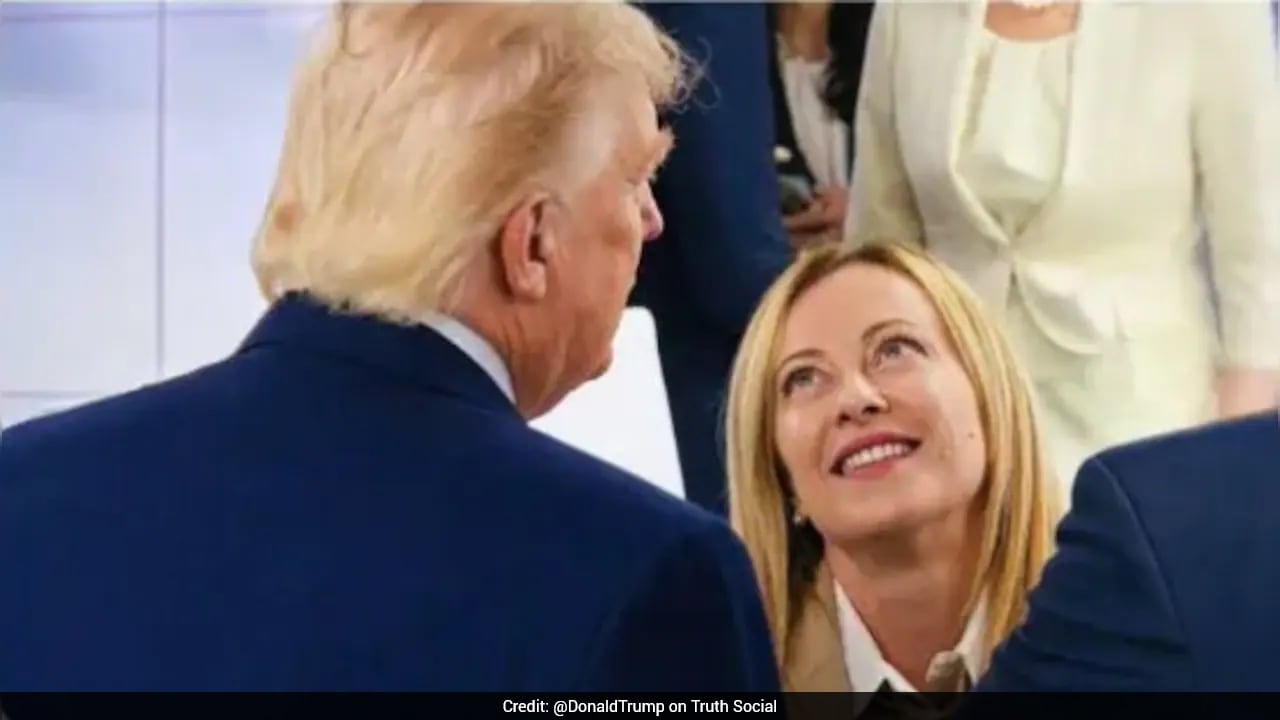
The public escalation between United States President Donald Trump and Italian Prime Minister Giorgia Meloni—culminating in the recent "restraining order needed" social media post ahead of the NATO summit in Ankara—is not a mere breakdown in personal diplomacy. It is the visible surface friction of a structural mismatch in state-level strategic priorities. While mainstream commentary focuses heavily on the performative rhetoric of the conflict, an institutional analysis reveals a deeper divergence concerning sovereign defense autonomy, bilateral basing rights, and the financial architecture of European rearmament.
The relationship between Washington and Rome is operating under an asymmetric strain driven by two competing variables: the American executive branch's demand for unconstrained operational use of European logistics hubs and Italy’s domestic constitutional limits on foreign military engagement. When stripped of political theatrics, the friction exposes the vulnerability of relying on personal ideological alignment to sustain institutional defense treaties.
The Bilateral Base Constraint Function: Sovereignty vs. Operational Control
The primary structural bottleneck in the current U.S.-Italy relationship governs the operational deployment parameters of American military infrastructure on Italian soil. Italy serves as a critical geographic and logistical fulcrum for U.S. European Command (EUCOM) and U.S. Africa Command (AFRICOM), hosting major installations including Naval Air Station Sigonella in Sicily and Aviano Air Base in the north.
The strategic friction materialized directly when Rome declined to permit U.S. bombers to utilize these runways for offensive operations linked to the conflict involving Iran. This refusal highlights a fundamental legal mismatch between unilateral U.S. power projection and the structural governance of joint military installations.
- The Legal Framework of Co-Management: Under the 1951 NATO Status of Forces Agreement (SOFA) and subsequent bilateral memoranda, such as the 1954 Bilateral Infrastructure Agreement (BIA), U.S. operations out of Italian bases are subject to a dual-key sovereignty system. The Italian government retains ultimate sovereign control over its territory, meaning that any deployment not explicitly covered by the collective defense mandates of Article 5 of the North Atlantic Treaty requires specific national authorization.
- The Constitutional Veto: Article 11 of the Italian Constitution explicitly repudiates war as an instrument of offense against the liberty of other peoples and as a means for settling international disputes. For Meloni’s administration, granting operational clearance for non-NATO offensive strikes without parliamentary approval is a direct violation of constitutional boundaries. This creates an institutional barrier that cannot be bypassed by executive-level rapport.
- The Logistical Bottleneck: By withholding landing and overflight rights for offensive assets, Italy alters the cost function of U.S. military logistics. Rerouting strategic bombers around Italian airspace increases fuel consumption, extends flight times, and complicates the tactical synchronization of regional operations, reducing the net efficiency of U.S. power projection in the Mediterranean and Middle Eastern theaters.
The Asymmetric Interdependence of NATO Security Architecture
The second variable driving the current rift is the divergent definition of burden-sharing within the alliance. The current U.S. administration evaluates alliance utility through a transactional model that balances direct military cooperation against American security expenditures. Conversely, European states operate within an institutional framework where security commitments are bound to multi-lateral treaties and economic integration.
[U.S. Transactional Power Projection] <---> [Italian Constitutional & Institutional Boundaries]
               |                                                   |
      (Demands Base Access)                              (Requires Parliamentary Consent)
               \                                                   /
                \---> [Structural Friction at NATO Summit] <------/
This structural division reveals a critical imbalance in how both nations approach defense expenditures and strategic commitments:
- The Defense Spending Imbalance: Italy remains a persistent laggard regarding the NATO target of allocating 2% of Gross Domestic Product (GDP) to defense. Rome’s current trajectory places its defense spending significantly below this benchmark, exposing the administration to structural criticism from Washington regarding free-riding on the U.S. security umbrella.
- The EU Loan Dilemma: Italy’s fiscal constraints prevent immediate corrections to this spending deficit. Meloni's government has balked at utilizing its €14.9 billion allocation of low-cost European Union recovery loans to finance security apparatus upgrades. Diverting these funds to defense ahead of a highly competitive general election year presents prohibitive domestic political costs, creating an environment where immediate military capitalization is structurally unfeasible.
- The Multilateral Trade-Off: While Washington views the refusal to support anti-Iran operations as a lack of alliance loyalty, Rome views it as a preservation of regional stability. Mediterranean European states are highly sensitive to the secondary economic effects of Middle Eastern conflicts, including energy supply disruptions and shifts in maritime migration patterns. For Italy, the strategic utility of maintaining a stable Mediterranean environment outweighs the diplomatic utility of endorsing unilateral U.S. military objectives.
The Domestic Popularity Function and Electoral Risk Mitigation
The public dispute regarding who "begged" for a photograph at the G7 summit in France illustrates how foreign policy is leveraged to fulfill domestic political incentives. For both leaders, the communication strategy is optimized to preserve domestic voter coalitions rather than to maximize diplomatic efficiency.
For the U.S. executive, projecting dominance over traditional European allies serves a clear domestic narrative: it validates the assertion that international alliances are being re-negotiated on terms favorable to American taxpayers. Labeling European counterparts as supplicants reinforces the core political thesis that foreign leaders rely disproportionately on American prestige and security guarantees.
For Meloni, the incentive structure is inverted. Her political authority depends on a delicate equilibrium between nationalist-conservative principles and pragmatic governance.
Meloni Domestic Popularity = f(National Sovereignty Protection, Fiscal Prudence, Transatlantic Stability)
Allowing an American president to publicly diminish Italian sovereignty carries severe electoral risks. The political survival of her administration depends on demonstrating that Italy interacts with Washington as an equal sovereign partner rather than a subordinate actor. Her public counter-attacks—asserting that "neither I nor Italy ever beg"—are calculated maneuvers designed to neutralize domestic opposition criticism from both the left and the far-right, which would otherwise exploit any sign of geopolitical submission.
This domestic dynamic creates a structural barrier to resolution. When foreign policy becomes entirely subverted by the requirements of domestic electoral cycles, diplomatic compromise is treated as a political liability. Consequently, personal insults serve as a low-cost tool for domestic mobilization, even as they erode the institutional trust required for long-term intelligence sharing and joint defense planning.
Strategic Projections for the Ankara Summit
The immediate operational risk of this dispute will manifest during the upcoming NATO summit in Ankara. The primary challenge for the alliance is maintaining a credible deterrence posture while its internal leadership dynamics are visibly fragmented.
The institutional apparatus of NATO will attempt to isolate these executive-level disputes from the functional layers of military cooperation. Secretary-General Mark Rutte’s strategy focuses on framing Europe's rearmament drive through an economic lens, highlighting how increased European defense acquisition generates manufacturing jobs within the United States. This approach aims to shift the dialogue from a transactional assessment of base access to a structural analysis of industrial cooperation.
However, the structural prose of defense treaties cannot entirely mask the operational uncertainty generated by executive volatility. The long-term stability of U.S. military assets in Europe faces a dual vulnerability:
- The Risk of Accelerated Drawdown: Continued friction over base access may incentivize the U.S. to shift its logistical footprint toward more compliant or permissive security partners in Eastern Europe or the periphery, altering the geopolitical balance of the Mediterranean.
- The Legislative Retaliation Bottleneck: In response to public diplomatic pressure, the Italian parliament may enforce more stringent oversight on existing bilateral security agreements, introducing bureaucratic delays into routine U.S. troop rotations and equipment transfers through Aviano and Sigonella.
The strategic play for Italy requires decoupling its broader defense relationship with the United States from the immediate executive conflict. To mitigate the risk of isolation within the alliance, Rome must pivot toward deeper integration within European-specific defense frameworks, accelerating joint procurement programs with France and Germany. This provides a structural hedge against an unpredictable U.S. security commitment.
At the same time, Italian defense officials will rely on quiet, institutional diplomacy via military-to-military channels to reassure the U.S. defense establishment that logistical and intelligence-sharing mechanisms remain operational, regardless of the rhetorical environment generated on social media platforms. The durability of the transatlantic alliance will depend entirely on whether these underlying institutional foundations can absorb the friction of high-level political discord.