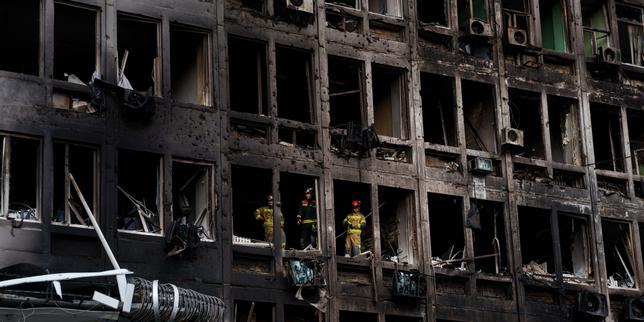
Modern aerial bombardment campaigns targeting high-density urban centers expose a profound operational asymmetry between offense and defense. When ballistic missiles, cruise weapons, and hybrid drones breach the airspace of a major metropolitan area such as Kyiv, live-reporting media streams often reduce the event to frantic updates regarding air raid alerts, flash sequences, and structural fires. While real-time dispatches capture the immediate acoustic and visual signature of kinetic impacts, they obscure the underlying structural realities governing the conflict. A rigorous, data-driven examination requires moving past daily tactical summaries to deconstruct the economic cost curves of missile interception, the severe physical constraints of ballistic flight mechanics, the cascading vulnerabilities of metropolitan infrastructure, and the sensor-to-shooter latency that dictates urban survivability.
The Economic Asymmetry of Interception
The foundational constraint governing modern strategic defense is the stark divergence in marginal costs between offensive delivery systems and defensive interceptor batteries. Offensive strike packages rely on a heterogeneous mix of domestically manufactured weapons and foreign-procured munitions, such as tactical ballistic missiles and long-range loitering platforms. These assets are engineered for mass production and scalable destructive yield. Conversely, high-tier air defense interceptors—such as those deployed within advanced Western-supplied Patriot or equivalent systems—represent extraordinary engineering expenditures involving intricate guidance sub-assemblies, solid-propellant rocket motors, and specialized sensor suites.
This creates an acute financial attrition model. When a defending air command expends multi-million-dollar interceptors to neutralize incoming supersonic or ballistic threats, the economic burden shifts disproportionately onto the defender. The fiscal ratio heavily favors the attacking force, turning sustained bombardment into a deliberate strategy of economic exhaustion.
Supply chain realities compound this fiscal friction. The specialized components required for high-tier guidance systems cannot be rapidly scaled to match the manufacturing tempo of standard missile and drone production lines. As a result, military planners face finite stockpile thresholds long before offensive inventories deplete. This hard limit forces commanders into austere rationing protocols. Critical interceptors must be reserved strictly for high-value strategic command nodes or vital power generation facilities, leaving peripheral municipal sectors reliant on decentralized, lower-tier mitigation tactics.
The Ballistic Targeting Calculus
Ballistic missiles present a defensive challenge fundamentally distinct from subsonic cruise munitions or propeller-driven drones. Operating along predictable parabolic arcs before executing high-speed terminal re-entry, ballistic projectiles compress the decision space for automated air defense networks to seconds.
The defense challenge unfolds across three distinct phases: boost, midcourse, and terminal. Interception during the boost phase offers optimal tactical advantage by destroying the missile while its propulsion stage is active and its payload is unseparated. However, achieving boost-phase interception requires positioning counter-strike assets dangerously close to contested border regions or enemy launch zones, exposing launchers to immediate counter-battery fire and raising immediate escalation risks. Midcourse interception demands space-based or high-altitude radar tracking networks capable of filtering complex decoys and countermeasures deployed in the upper atmosphere.
Consequently, defense networks rely heavily on terminal-phase interception. During terminal descent, projectiles accelerate rapidly, often reaching hypersonic speeds just prior to impact. This leaves an extremely compressed window for radar acquisition, tracking calculation, interceptor launch, and kinematic interception. Even when an interceptor successfully scores a kinetic hit, the explosive force and high terminal velocity scatter massive debris fields across populated urban zones. Falling booster stages, unburnt solid fuel, and heavy shrapnel create secondary kinetic hazards that pose severe risks to civilian populations and structural integrity, regardless of whether the primary warhead was neutralized aloft.
Infrastructure Vulnerability and Distributional Strain
The strategic calculus behind urban bombardment extends far beyond localized kinetic destruction. The primary objective focuses on systemic degradation through the disruption of interdependent metropolitan networks. Modern cities operate as highly integrated socio-technical systems where electricity transmission, water purification, sewage treatment, district heating, and public transportation networks function in tight mutual reliance.
When ballistic impacts or drone strikes target electrical transformer substations, heating plants, or switching yards, the failure propagates rapidly across civil infrastructure. The loss of primary grid power immediately halts municipal water pumps, which in turn depressurizes water mains and disables sewage removal within multi-story residential blocks. During sub-zero winter operational windows, sustained power and heating outages freeze internal plumbing, rendering entire neighborhoods uninhabitable within hours and triggering acute humanitarian strain.
Defenders cannot achieve uniform protection across an expansive metropolitan grid. Given finite air defense batteries and launchers, military planners must execute rigorous operational triage. Primary air defense assets cluster tightly around vital national command centers, nuclear or thermal infrastructure, and primary administrative hubs. Peripheral residential and commercial districts must rely on lower-tier point defenses, mobile gun teams, and passive civil hardening. This uneven resource allocation produces stark geographic disparities in urban safety, where central administrative zones maintain high interception success rates while outer municipal rings absorb the brunt of secondary debris and unintercepted munitions.
The Intelligence Bottleneck and Sensor Latency
The efficacy of any air defense architecture is fundamentally bounded by its sensor-to-shooter loop. The time elapsed between initial threat detection, ballistic trajectory calculation, fire-control solution generation, and interceptor launch determines whether an incoming projectile is successfully engaged or impacts its target coordinate.
Launch detection relies on an integrated network of space-based infrared early-warning satellites, ground-based phased-array radars, and over-the-horizon monitoring arrays. However, real-time intelligence feeds are subject to transient disruptions, data bottlenecks, and processing latencies. When communication links between allied intelligence platforms and local command centers experience delays, the compressed warning window for high-speed ballistic threats narrows past the threshold of effective automated reaction.
Furthermore, modern strike packages integrate sophisticated electronic warfare (EW) suites designed to degrade radar fidelity. Attackers deploy active radar-jamming pods, digital radio-frequency memory (DRFM) spoofers, thermal chaff clouds, and radar-absorbent materials to saturate filtering algorithms. Defending radar networks must expend vast computational resources to differentiate between actual warheads, spent booster segments, and decoy payloads. Every millisecond lost in target discrimination increases the statistical probability of an uncontested impact.
Decentralized Adaptation and Future Operational Resilience
Faced with persistent missile pressure and the structural constraints of finite interceptor inventories, defensive strategies are forced to evolve toward decentralized, multi-layered architectures. Relying exclusively on high-tier institutional air defense systems is mathematically and economically unsustainable over prolonged conflict timelines.
To mitigate this bottleneck, military forces deploy distributed sensor grids utilizing acoustic triangulation networks. These low-cost, passive listening posts span vast geographical corridors, detecting the distinctive acoustic signatures of low-flying, jet-powered drones and cruise missiles without emitting active radar signals that invite anti-radiation missile targeting. By decentralizing threat detection down to squad-level mobile defense units equipped with heavy machine guns, searchlights, and man-portable air-defense systems, defenders can intercept lower-tier kinetic threats cost-effectively, preserving expensive guided interceptors strictly for supersonic and ballistic targets.
Simultaneously, regional defense partnerships and domestic engineering initiatives focus on accelerating the production of lower-cost domestic interceptor missiles and standardized mobile launch platforms to reduce reliance on constrained foreign supply chains. The long-term viability of urban defense under ballistic pressure rests entirely on closing the economic and technological gap between offensive delivery costs and defensive interception outlays. Until interceptor manufacturing scales significantly and detection systems achieve absolute fidelity against advanced jamming and decoys, urban centers will remain locked in an attritional calculus of continuous tactical adaptation.