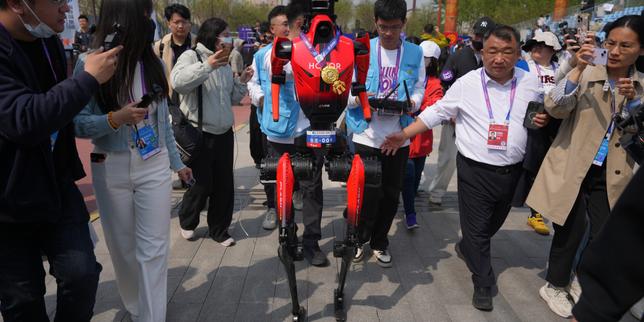
The recent performance of a humanoid robot completing a half-marathon distance in under 50 minutes—effectively doubling the speed of the current human world record—is not a victory of "robotics" as a monolith. It is a victory of energy density management and the decoupling of biological cooling constraints from mechanical locomotion. While human athletes are limited by a physiological ceiling defined by VO2 max, heat dissipation via perspiration, and glycogen depletion, a bipedal machine operates under a modular performance envelope where battery discharge rates and actuator torque-to-weight ratios are the primary bottlenecks.
The Three Pillars of Robotic Distance Dominance
To understand why a machine can now outpace an elite human over 21.1 kilometers, we must analyze the system through three distinct engineering pillars: structural rigidity, thermal equilibrium, and gait efficiency.
1. Structural Rigidity and Force Transmission
Human locomotion is inherently "soft." Every strike of a human foot involves energy loss through soft tissue deformation, joint compression, and the dampening effects of muscle. In contrast, a humanoid robot utilizing high-modulus carbon fiber or aerospace-grade aluminum frames achieves near-total force transmission.
The kinetic energy generated by the electric motors (actuators) is transferred directly to the running surface with minimal parasitic loss. This creates a high "Q factor" for the mechanical system, where the oscillations of the legs act more like tuned springs than biological dampers. The robot does not suffer from muscle fatigue because its "muscles" are brushless DC motors that do not experience lactic acid buildup or microscopic fiber tears.
2. Thermal Equilibrium and Active Cooling
The primary failure point for a human runner at high speeds is heat. The human body is roughly 20-25% efficient, meaning 75-80% of energy consumed is lost as heat. When ambient temperatures rise or intensity increases, the body must divert blood flow from the legs to the skin for cooling, which creates a competitive trade-off between oxygen delivery and temperature regulation.
A robot bypasses this biological bottleneck through active thermal management. Liquid-cooling loops or high-airflow heat sinks allow the machine to maintain its optimal operating temperature regardless of the pace. The machine can sustain a "sprint" power output for the duration of a half-marathon because its cooling capacity is scaled to its motor output, whereas human cooling capacity is fixed by surface area and sweat gland density.
3. Gait Efficiency and the Cost of Transport
The Cost of Transport (CoT) is a dimensionless metric used to compare the energy efficiency of different moving systems. It is defined by the formula:
$$CoT = \frac{E}{m \cdot g \cdot d}$$
Where $E$ is the energy expended, $m$ is mass, $g$ is gravity, and $d$ is distance. Historically, bipedal robots had a CoT significantly higher (worse) than humans because of the "heavy" computational cost of maintaining balance. Recent breakthroughs in Reinforcement Learning (RL) have allowed robots to develop "natural" gaits that exploit passive dynamics. By allowing gravity to do the work during the swing phase of a stride, modern bipedal systems have driven their CoT down to levels that rival, and now exceed, human biological efficiency.
The Actuator Bottleneck and Power-to-Weight Optimization
The record-breaking run was made possible by a shift from hydraulic systems to high-torque electric actuators. Hydraulics, while powerful, suffer from internal fluid friction and require heavy pumps that consume "vampire power" even when the robot is standing still. Electric actuators allow for regenerative braking—recovering energy during the deceleration phase of a step—which extends battery life.
The primary constraint remains the energy density of Lithium-ion batteries compared to human adipose tissue. Fat contains approximately 37 MJ/kg of energy, while high-end batteries hover around 0.9 MJ/kg. The robot compensates for this 40-fold disadvantage in energy density through:
- Mechanical Over-Engineering: Using components that can withstand much higher stress-to-weight ratios than bone and tendon.
- Precision Frequency: Maintaining a cadence that stays perfectly tuned to the resonant frequency of the leg assembly.
- Zero Cognitive Load: The robot does not have a central nervous system that perceives "pain," allowing it to operate at 99% of its mechanical limit for the entire 48-minute duration.
Erasing the Human Benchmark
A human world record for a half-marathon sits just under 58 minutes. The robot’s sub-50-minute time represents a 15% improvement, a margin that would take decades of human evolution or pharmaceutical intervention to achieve. This disparity highlights a fundamental shift in the definition of "performance."
In human athletics, the goal is to optimize a fixed biological engine. In robotics, the goal is to optimize a modular system. If the robot needs to go faster, engineers increase the voltage or swap in higher-torque motors. There is no biological homeostasis trying to prevent the system from "overclocking" itself. This creates an asymmetric competition where the human is capped by biology while the robot is capped only by the current state of materials science.
The Bottleneck of Unstructured Terrain
While the flat-track half-marathon record is an impressive display of raw speed and thermal endurance, it does not translate directly to real-world utility. The "Laboratory Bias" in these records ignores the complexity of uneven surfaces. A human runner uses a sophisticated sensory-motor loop to adjust foot placement on a millisecond basis, accounting for friction, slope, and stability.
Current robotic gaits are largely optimized for "blind" locomotion on consistent surfaces. Transitioning this speed to a trail or a cluttered urban environment requires a massive increase in onboard compute power. This leads to the Computation-Power Paradox:
- To navigate complex terrain at high speeds, the robot needs more sensors (LiDAR, Vision) and faster processors.
- Faster processors consume more battery power and generate more heat.
- The added weight of larger batteries and cooling systems increases the inertia of the limbs, reducing gait frequency and top speed.
Solving this paradox is the next requirement for moving beyond stunt records and toward functional autonomous deployment.
Strategic Path Toward General Purpose Locomotion
The path to 2030 will not be defined by faster track times, but by the convergence of high-speed endurance with environmental adaptability. For organizations looking to integrate bipedal systems into logistics or emergency response, the focus must shift from "peak speed" to "variable terrain efficiency."
The strategic play for the next 24 months is the development of Variable Stiffness Actuators (VSAs). These components allow a robot to change the "springiness" of its legs in real-time, mimicking how a human runner stiffens their legs on sand versus softening them on concrete. This will reduce the Cost of Transport in unstructured environments, which currently remains the final stronghold of human physiological superiority.
Investment should be diverted from raw motor power toward edge-computing architectures that can process 3D spatial mapping at the same frequency as the motor control loop (typically 1kHz). The first entity to achieve a sub-60-minute half-marathon on a technical trail—not a flat track—will have solved the problem of autonomous physical agency.