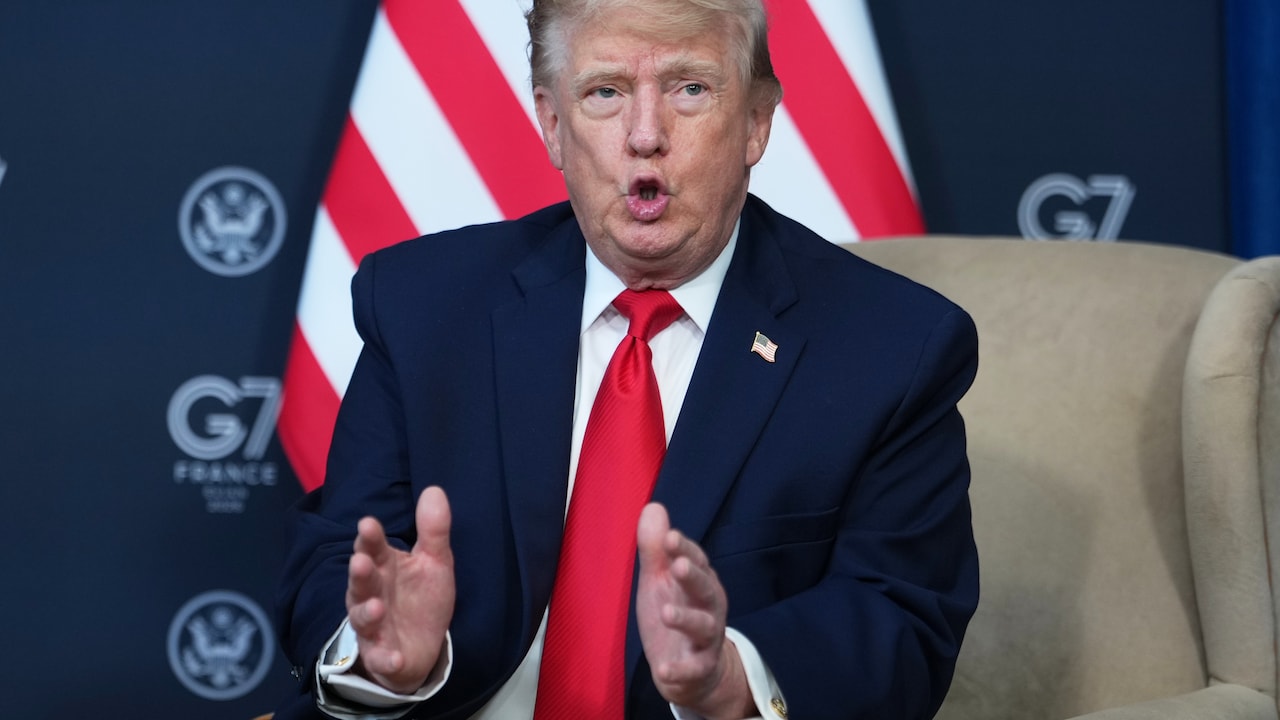
The legacy press loves a predictable script. When a dominant political figure stands up at a global summit, beats their chest, and declares some variation of "I'm the boss," the editorial rooms immediately fall into two camps. One side panics over the erosion of democratic norms, while the other mocks the bravado as empty comedy. Both sides are completely wrong. They mistake high-stakes theater for a lack of sophistication, completely missing how raw power actually operates behind closed doors.
When former President Trump famously dominated the room at past global gatherings, drawing nervous laughter from seasoned diplomats, the mainstream narrative framed it as a gaffe or a breakdown in protocol. That interpretation is lazy. It views international relations through the pristine, polite lens of a university textbook rather than the gritty reality of a corporate boardroom or a union negotiation. In the real world, projecting absolute dominance is a calculated strategy designed to force concessions before the formal pens even touch paper. For an alternative view, see: this related article.
To understand why the conventional analysis fails, you have to look at the gap between public performance and structural reality.
The Mirage of Consensus Politics
International diplomacy is built on the illusion of equal partnerships. The prevailing media narrative insists that groups like the G7 or the G20 function like a corporate board of directors, where every member has a vote and decisions are reached through collaborative debate. This is a comforting fiction designed for public consumption. Similar coverage on the subject has been shared by The Washington Post.
The reality is starkly uncollaborative. Multilateral agreements are dictated by economic leverage and military capability. When a leader strips away the polite euphemisms and openly demands compliance, they are not breaking the system—they are merely exposing its underlying architecture.
During my years advising multinational firms on cross-border regulatory risks, I watched executives make the exact same mistake. They would enter negotiations in Brussels or Tokyo believing that logic, data, and mutual respect would carry the day. They got crushed by counterparts who understood that the rules are always written by the party most willing to walk away from the table. Dominance displays at political summits serve the exact same purpose: they establish the true baseline of power, signaling to every lower-tier state that the old rules of polite deference no longer apply.
The laughter that often follows these blunt assertions is rarely a sign of dismissal. It is a defense mechanism. It is the nervous reaction of career bureaucrats who suddenly realize the standard diplomatic playbook has been thrown into the fireplace.
Dismantling the Consensus View on Diplomatic Protocol
The conventional wisdom dictates that adherence to established protocol is the metric of a successful summit. Let us dismantle that premise entirely.
- The Myth of the Communiqué: The press tracks every line of the final summit joint statement as if it holds the weight of law. It does not. These documents are notoriously watered-down compromises that look impressive on paper but lack any real enforcement mechanism. A leader who disrupts the drafting process by demanding unilateral changes understands that a failed communiqué is far more valuable than a polite, meaningless one. It signals that bilateral deals are the new currency of international relations.
- The Illusion of Multilateral Unity: Pundits often argue that public division weakens global alliances. The opposite is frequently true. When the dominant partner creates calculated unpredictability, it forces allies to reassess their own leverage. It drives them to make quiet, bilateral concessions behind the scenes just to keep the overarching structure intact. Unpredictability is an asset, not a liability.
- The Flawed Premise of Soft Power: The academic consensus has long preached that "soft power"—cultural influence, moral standing, adherence to international norms—is the ultimate currency of modern diplomacy. This is a luxury belief held by nations that do not possess significant hard power. When global supply chains fracture or energy security is threatened, soft power evaporates. The leaders who command attention are those who control access to capital, markets, and raw physical security.
The Cost of the Contrarian Stance
It is critical to admit the downsides of this disruptive approach. It is not a free lunch. Operating as a geopolitical wrecking ball carries massive, long-term costs that can hamstring a nation's strategic objectives if overused.
First, it burns through historical goodwill at an alarming rate. Alliances are built on trust and predictability over decades. When you systematically violate those expectations for short-term tactical wins, you force your allies to hedge their bets. They begin seeking alternative partnerships, building redundant supply chains, and quietly investing in domestic capabilities to reduce their dependence on you. You might win the immediate trade concession, but you lose the structural alignment that allows you to project power effortlessly in the future.
Second, it creates a massive succession problem. Dictating policy through sheer force of personality means the entire apparatus collapses the moment that specific leader exits the stage. Institutions provide stability precisely because they transcend individuals. When you hollow out the professional diplomatic corps and reduce complex foreign policy to personal whims, the state loses its institutional memory. The next administration is left inheriting a fractured network of allies who no longer trust the longevity of any agreement.
Reorienting Your Strategic Framework
If you are evaluating geopolitical risk for an organization, or simply trying to read the news without succumbing to partisan spin, you must change the questions you are asking.
Stop asking: Did this leader look presidential? Did they offend our traditional allies?
Instead, ask the brutal, transactional questions that actually dictate the flow of capital and power:
- Who controls the domestic consumer market? A leader can say whatever they want on a stage if they represent a population that commands the world's primary purchasing power. Allies will tolerate public humiliation if the alternative is losing access to that consumer base.
- What is the cost of non-compliance? If a dominant state threatens to impose unilateral tariffs or withdraw security guarantees, look at the actual math. Can the target nation survive the economic shock? If the answer is no, the public posturing is irrelevant. The concession is already guaranteed.
- Is the disruption tactical or structural? Distinguish between theater meant for voters back home and actual shifts in foreign policy. A loud statement in front of a camera often serves as cover for quiet compromise on technical regulations away from the media spotlight.
The Mechanics of Calculated Friction
The media focuses on the theater because it is easy to broadcast. It requires zero deep knowledge of trade mechanics or sovereign debt structures to report that a leader acted brashly or drew a laugh from the crowd.
The real action happens in the friction that theater generates. When a dominant player asserts total authority, they create a temporary vacuum. Career diplomats panic, financial markets twitch, and corporate compliance officers rewrite their risk assessments. In that moment of manufactured chaos, the dominant nation can slip through policy changes that would take years to negotiate under normal conditions.
Think of it as a structural reset. By explicitly stating "I'm the boss," a leader forces every other nation in the room to re-evaluate their own positions. They have to decide what they are actually willing to fight for, and what they are willing to surrender just to restore a sense of normalcy. Most of the time, they surrender.
The next time you see a clip of a global summit where a populist leader creates a scene, shocks the audience, or breaks standard etiquette, ignore the talking heads analyzing the body language. Look at the bond yields. Look at the bilateral trade numbers over the following six months. Look at who quietly signs the real estate and energy deals while the world is busy laughing at the performance.
Stop looking at the stage. Watch the money. Watch the leverage.
The theater is just the distraction used to keep the crowd occupied while the real terms of global governance are rewritten in the dark.